Manhattan Melodrama - Warner Archive Collection
Clark Gable, William Powell, and Myrna Loy make a formidable trio in Manhattan Melodrama, a top-notch chronicle of the friendship between two boyhood pals who take divergent moral paths as adults. Another stellar Warner Archive transfer struck from a new 4K scan of the best preservation elements, remastered audio, and a few vintage supplements enhance the appeal of this coveted classic release. Highly Recommended.
Storyline: Our Reviewer's Take
You don't have to be a movie fan to have heard of Manhattan Melodrama. Any U.S. history buff will tell you the 1934 gangster flick was the last film famed bank-robber John Dillinger watched before the FBI gunned him down outside Chicago's Biograph Theater. Though Dillinger's bloody demise doesn't mirror the fate of Blackie Gallagher, the movie's lead character, their life paths are strikingly similar, and it's hard not to think about Dillinger and the events that transpired on July 22, 1934 while watching this crackerjack crime drama.
As they say (or sing) in a famous Disney movie, it's "a tale as old as time." Two poor boys grow up together in the tenement slums of New York City. One follows the straight and narrow path, while the other embraces corruption and lawlessness. In Angels with Dirty Faces, the "good" boy becomes a Catholic priest; in Manhattan Melodrama, he becomes the Big Apple's district attorney. The "bad" boys in both movies remain unrepentant to the bitter end, but their brash charm and deep affection for their lifelong friend engender sympathy despite their reprehensible actions.
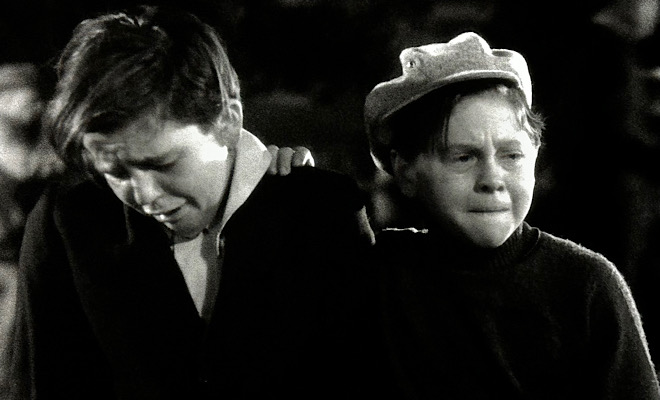
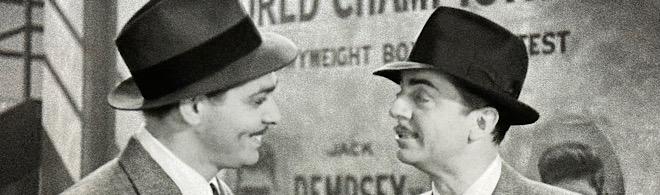
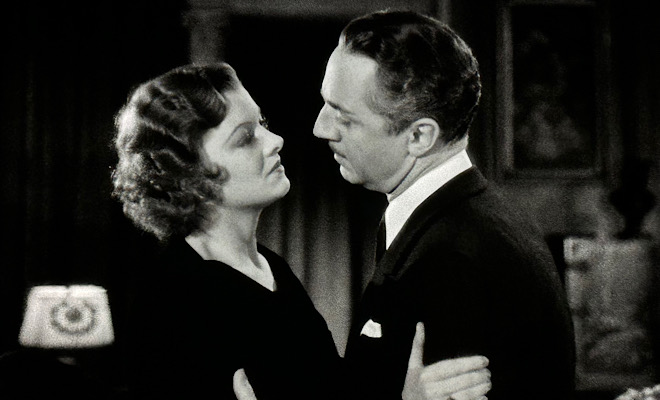
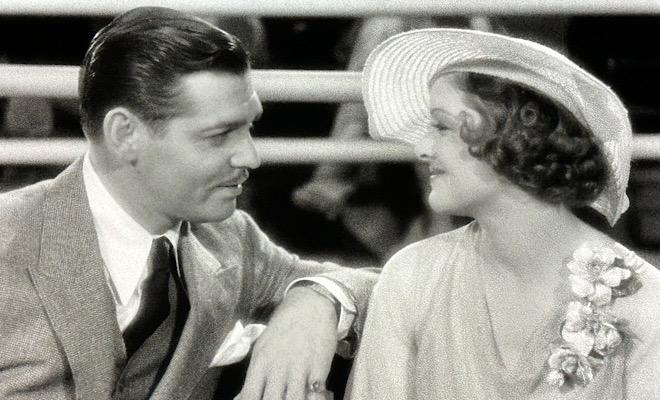
After their parents perish in the horrific General Slocum ferry boat disaster in New York City's East River in 1904 (the devastating event opens the film and is harrowingly recreated), Blackie and his buddy Jim Wade are adopted by a man who lost his son in the tragedy. The young, charismatic, carefree Blackie (played - or should I say overplayed - by 13-year-old Mickey Rooney) gravitates toward gambling while the studious, serious Jim hits the books. As adults, Blackie (Clark Gable) heads up a classy illegal casino syndicate while Jim (William Powell) brings hoodlums to justice in the D.A.'s office.
Their bond remains rock solid despite their differences. Blackie barely bats an eye when his long-time society girlfriend, Eleanor (Myrna Loy), whose repeated pleas for Blackie to go straight fall on deaf ears, leaves him and eventually falls for Jim. Other gangsters would order a hit on Jim, but Blackie hides his hurt and genuinely wishes the couple well. And when a disgruntled former employee threatens to upend Jim's campaign for governor, Blackie makes sure he keeps his mouth shut...permanently. That violent act sets in motion a string of events that tests each man's devotion and moral fiber.
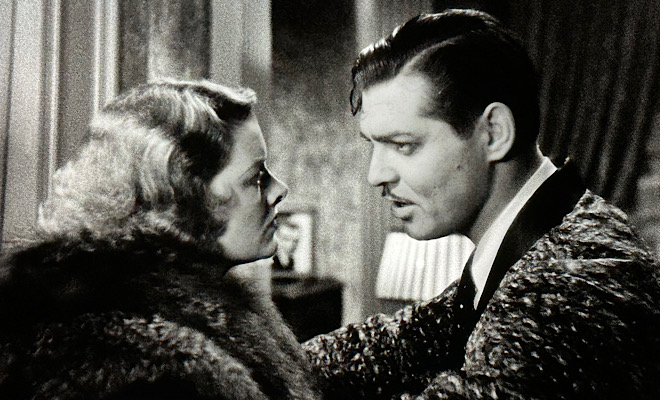
Manhattan Melodrama's plot may be predictable, but the glossy production, brisk pacing, and potent performances make us forgive the clichés. (In her autobiography, Loy terms the film "hokum, but artfully done.") Arthur Caesar's original story (which surely seemed a lot fresher 91 years ago) won an Oscar, and the snappy script is co-written by Joseph L. Mankiewicz, who later won consecutive screenwriting Oscars for A Letter to Three Wives and the incomparable All About Eve. The characters may be cardboard cutouts, but Mankiewicz and Oliver H.P. Garrett (perhaps best known for adapting Duel in the Sun and The Hurricane) give them enough dimension to scale the story's hurdles.
Credit director W.S. Van Dyke - affectionately known as "one-take Woody" for his uncanny ability to finish most pictures well ahead of schedule - for both keeping the narrative rolling without sacrificing craftsmanship and, more importantly, recognizing the crackling chemistry between Powell and Loy, who had never worked together - or even met - before. Loy recognized it, too. "From [the] very first scene," she wrote in her autobiography, "a curious thing passed between us, a feeling of rhythm, complete understanding, an instinct for how one could bring out the best in the other." Once production wrapped, Van Dyke proposed reteaming the two in Dashiell Hammett's comic mystery The Thin Man. MGM studio chief Louis B. Mayer initially balked, claiming both actors were only suited for dramatic parts. Van Dyke persisted, Mayer finally relented, and - lucky for us - one of the most iconic screen partnerships was born. Over the next 13 years, the two would co-star in 12 more films, and the Thin Man franchise would become one of the most enduring and successful in Hollywood history.
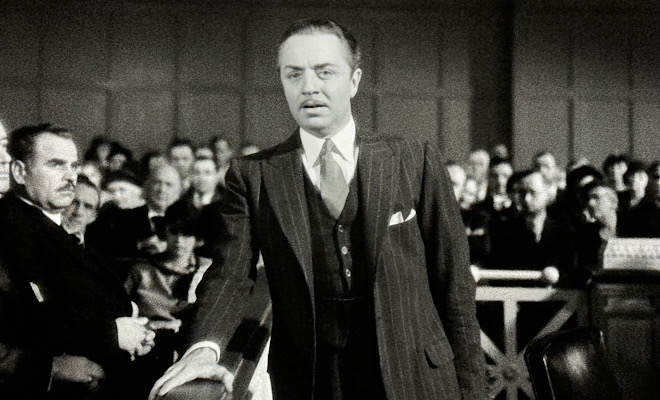
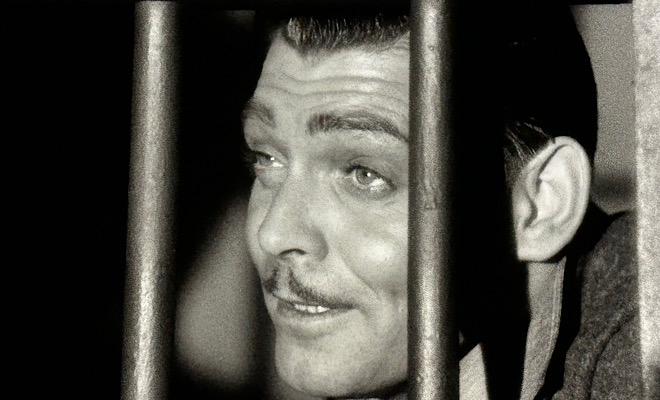
Gable could play a role like Blackie Gallagher in his sleep, but thankfully he resists phoning in this portrayal. He laces his cocky, tough, devil-may-care attitude with just enough warmth and sincerity to make Blackie human, and generates more of a rapport with Powell than Loy. Their brotherly bond drives the picture, and Powell more than holds up his half of the relationship. As the D.A. and later governor who holds his friend's fate in his hands and must do the right thing over his heart's objections, Powell is passionate, tender, and often tortured, and he steals the picture with his multi-faceted performance.
Loy is a terrific buffer between the two and plays off both Gable and Powell to perfection. Over the course of her multi-decade career, Loy acted opposite all of Hollywood's great leading men, but even when her roles were subservient, she never let any of them overshadow her. Always an equal partner, she keeps her co-stars on their toes and brings out their best. Audiences of the day loved her, and reportedly one of her admirers was the notorious Dillinger. In her memoir, Loy writes of the famous Dillinger incident, "Supposedly a Myrna Loy fan, he broke cover to see me. Personally, I suspect the theme of the picture rather than my fatal charms attracted him, but I've always felt a little guilty about it, anyway."
Another interesting bit of Manhattan Melodrama trivia concerns the song esteemed composer Richard Rodgers and lyricist Lorenz Hart wrote for the film's nightclub sequence. The title is "The Bad in Every Man," and when Shirley Ross began singing it, I instantly recognized the melody, but couldn't place it because the lyrics didn't seem to fit. About halfway through, it came to me. The melody was identical to the iconic Rodgers & Hart standard "Blue Moon." I assumed Hart merely changed the lyrics of "Blue Moon" to fit the movie, but I later learned the opposite was true. Hart wrote new lyrics to "The Bad in Every Man" a few months after Manhattan Melodrama was released to give the tune wider appeal. "Blue Moon" was born and it endures to this day.
As does Manhattan Melodrama. The picture holds up well, thanks to the solid performances, sassy script, slick direction, and classy touch of producer David O. Selznick, whose attention to detail made him MGM's top producer before he started his own company and mounted a little Civil War film you might have heard of called Gone with the Wind. Manhattan Melodrama isn't as gritty as The Beast of the City or the gangster fare cooked up by Warner Bros, but it delivers the goods and stands as the blueprint for a host of copycat films. For his last night out at the movies, Dillinger picked a good one.
Vital Disc Stats: The Blu-ray
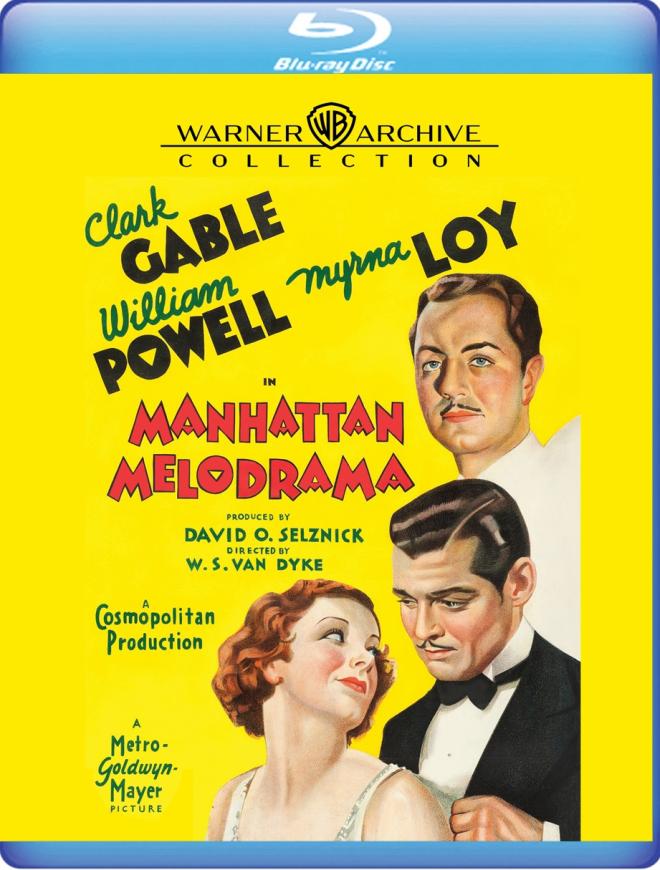
Manhattan Melodrama arrives on Blu-ray packaged in a standard case. Video codec is 1080p/AVC MPEG-4 and audio is DTS-HD Master Audio 2.0 mono. Once the disc is inserted into the player, the static menu without music immediately pops up; no previews or promos precede it.
Video Review
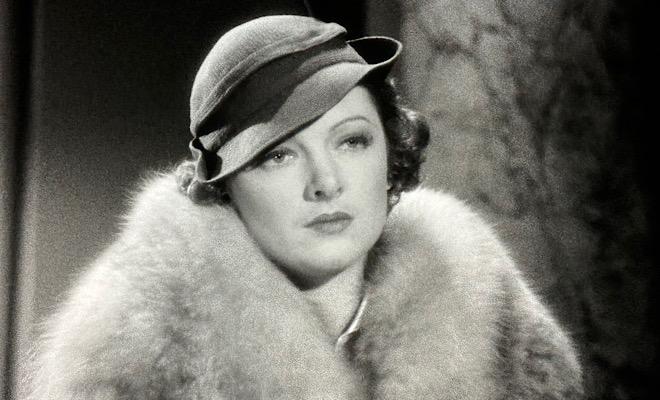
A brand new HD master struck from 4K scans of the best preservation elements yields a terrific 1080p/AVC MPEG-4 transfer that revitalizes this 91-year-old film. Other than a missing frame or two early in the movie, this presentation is just about perfect, and once again Warner Archive deserves kudos for its preservation efforts. Grain is evident, but it never overwhelms the image. The film-like picture features excellent clarity and contrast, dense blacks, bright and stable whites, and a satisfying grayscale. Costume textures and background elements are well defined, shadow delineation is quite good, and sharp close-ups showcase Gable and Powell's respective mustaches, Loy's pug nose, the faint scar on Powell's nose, glistening sweat, and tears. A few scenes run a bit soft, but that's to be expected from a film of this vintage, and no nIcks, scratches, or dirt mar the pristine source. If you own any other home video incarnation of Manhattan Melodrama, you'll definitely want to toss it and upgrade to this high-quality Blu-ray edition.
Audio Review
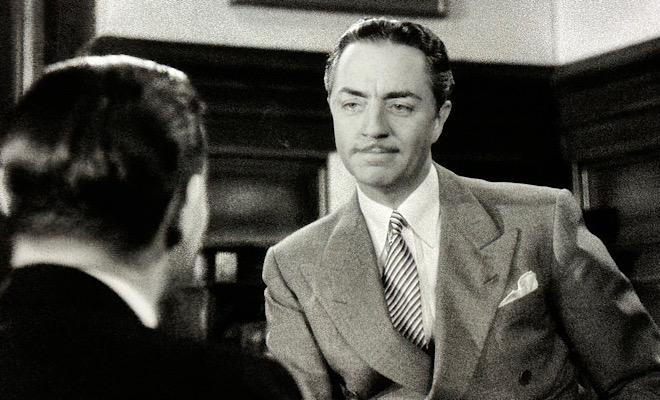
The DTS-HD Master Audio 2.0 mono track outputs robust sound that adds plenty of atmosphere to the film. Sonic accents like ringing bells, shattering glass, and gunshots are crisp, solid bass frequencies that enhance the rumble of galloping horse hooves, and subtleties like the gentle dropping of a ball into a roulette wheel are well defined. There's very little music in the movie, but the Rodgers and Hart song performed at the Cotton Club exhibits good fidelity and a pleasing depth of tone. Sometimes dialogue can be compromised by excessive background effects, but most of the exchanges are clear and comprehensible, and though a bit of surface noise can be heard during quiet moments, no pops or crackles intrude. Overall, the sound is impressive, especially when one considers the track's advanced age.
Special Features
A few extras flesh out the disc.
- Vintage Radio Adaptation (60 minutes) - Powell and Loy reprise their roles in this truncated radio adaptation of the film, broadcast on September 9, 1940 on the long-running Lux Radio Theater series. Don Ameche takes over Gable's part and producer-director Cecil B. DeMille hosts the program.
- Vintage Short: The Big Idea (HD, 19 minutes) - Ted Healy and his Three Stooges (Larry Fine, Moe Howard, and Curly Howard) headline this two-color Technicolor short about an idea man's interactions with several eccentrics.
- Vintage Short: Roast-Beef and Movies (HD, 16 minutes) - Shot in two-color Technicolor, this bizarre short incorporates scenes from a couple of silent movies as it chronicles the efforts of three amateurs to interest a studio executive in their movie. Curly Howard appears with two other "stooges" prior to the formation of the trio that would become a comedy icon.
- Theatrical Trailer (SD, 3 minutes) - The film's original preview gives away too many plot points, but certainly stokes enthusiasm for the picture.
Final Thoughts
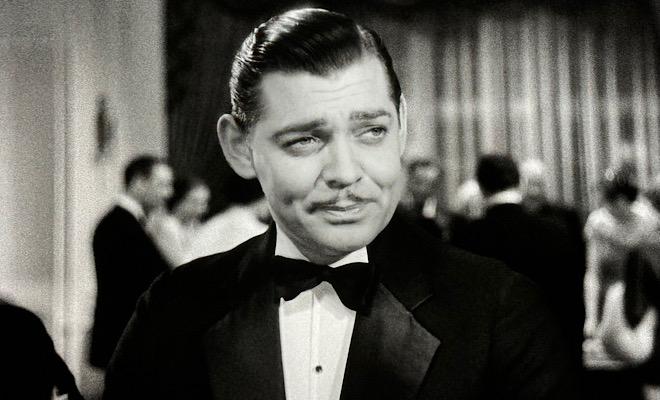
Part of American history as well as film history, Manhattan Melodrama remains an entertaining gangster drama that captures its time period well and contains solid performances. Gable, Powell, and Loy all shine, as do the beautifully remastered video and audio transfers. A few vintage supplements cap off this highly recommended release.
-
 Grab The Glasses - The Turbine Collector Series Grows with Three More Blu-Ray 3D Discs!By:
 -
 Closing Out 2024 and Welcoming 2025 - HDD's 4K UHD & Blu-ray Shopping Guide, Week of Dec. 31, 2024By:
 -
 Holiday Greetings - HDD's 4K UHD & Blu-ray Shopping Guide, Weeks of Dec. 17 & Dec. 24, 2024By:
 -
 Santa Comes Early This Year! Turbine Delivering 'Bumblebee' 'Transformers: Rise of the Beasts' & 'Sing 2' to 3D Blu-ray on December 19thBy: