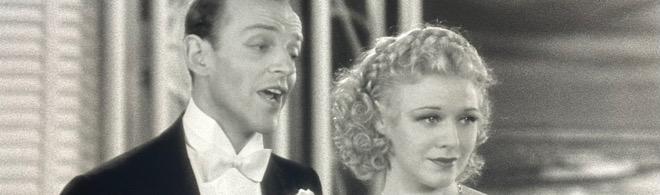
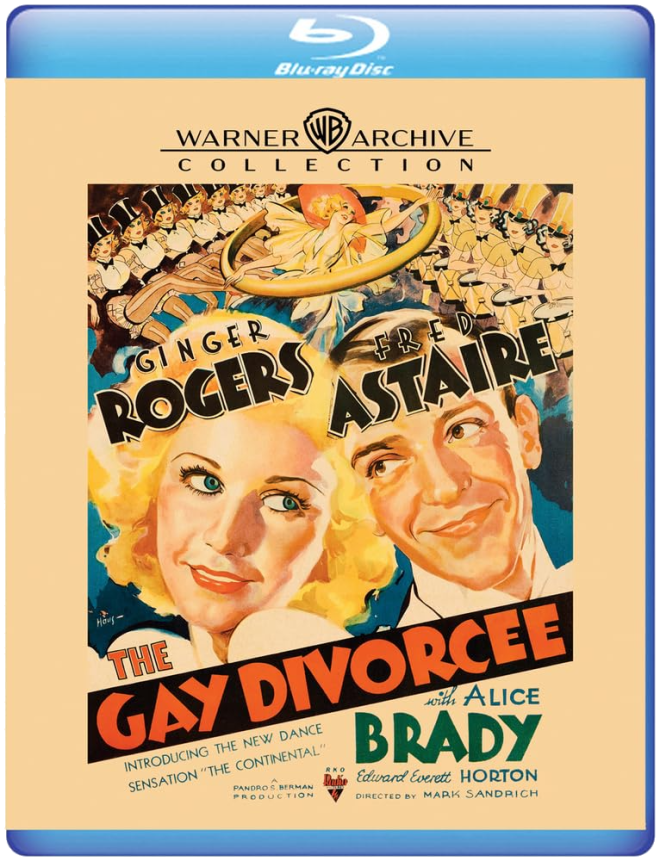
The Gay Divorcee - Warner Archive Collection
Fred Astaire and Ginger Rogers' first starring vehicle comes to Blu-ray all dressed up with a transfer that's as elegant as the two stars. The Gay Divorcee features a couple of knockout numbers, plenty of madcap comedy, and chemistry galore between the incomparable Fred and Ginger, whose talent and appeal remain timeless. Highly Recommended.
Click To Order

Storyline: Our Reviewer's Take
Perfection. It's an elusive quality - eternally sought and rarely achieved. Yet Fred Astaire and Ginger Rogers made it their standard, and in 10 films produced between 1933 and 1949, this ethereal dance team defined the term. Whether stomping out exuberant tap routines, waltzing on air, or constructing devastating mini-dramas to the music of Gershwin, Kern, and Berlin, Astaire and Rogers rarely make a false move. With impeccable style and grace, they sashay across the floor, wordlessly infusing a multitude of emotions into twirls, lifts, and dips. The phrase "poetry in motion" surely was coined with them in mind, and their incomparable talent transformed an ordinary pastime into an art form.
Most amazing of all, they make it look so easy.
We've been waiting an eternity for the Astaire-Rogers RKO films to hit Blu-ray. When the Criterion Collection released Swing Time, arguably the pair's best musical, on the format back in 2019, I thought maybe the dam had broken, and all the other Astaire-Rogers films would follow, but sadly, it's been crickets ever since. Now Warner Archive has blessed us with The Gay Divorcee, the second Fred and Ginger feature, and though the wait has been long, I've gotta say it's been worth it.
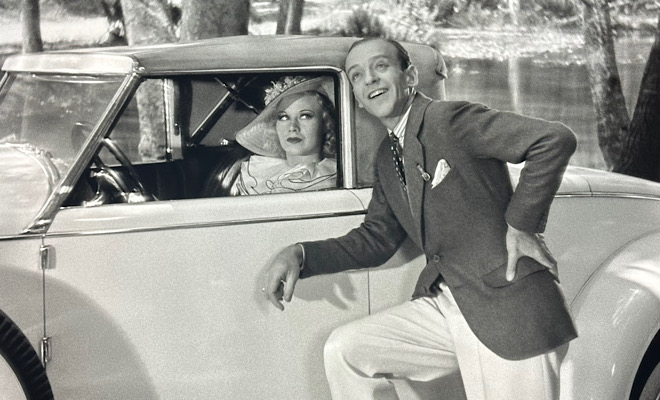
After wowing the public as supporting players in 1933's Flying Down to Rio, RKO Pictures rushed Astaire and Rogers into a vehicle all their own the next year. The Gay Divorcee, an adaptation of a 1932 hit Broadway musical called Gay Divorce that also starred Astaire (it would be his final show before he abandoned the stage to try his luck in movies), was tailor-made to showcase the hot new terpsichorean team, but unfortunately, the studio discarded all but one of the Cole Porter tunes from the Broadway original. The one they kept is the iconic "Night and Day," and it stands as one of the duo's most stunning routines.
It's also a welcome respite from the film's flimsy story, which chronicles Astaire's pursuit of Rogers, who's trying to wriggle out of an unhappy marriage by hiring a professional co-respondent (Erik Rhodes) to act as her lover. Misunderstandings and mistaken identities ensue, and the light comedy rolls pleasantly along until "The Continental," a dazzling yet interminable 17-minute production number specifically designed to outdo Flying Down to Rio's "The Carioca," stops the show cold (and not in a good way). Afterwards, The Gay Divorcee has trouble regaining momentum, but remains an agreeable diversion, thanks to the growing chemistry between its two leads.
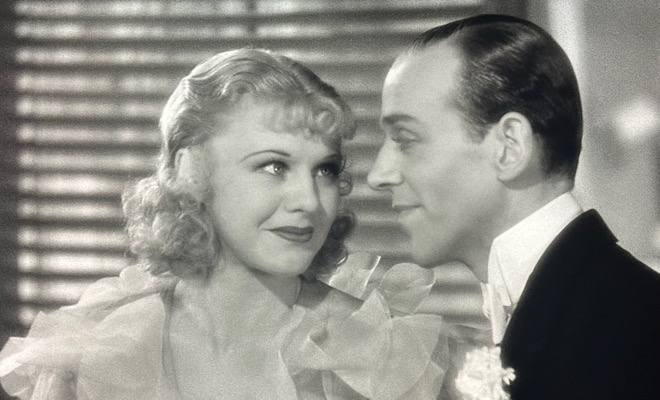
The natural, easygoing rapport between Astaire and Rogers is evident from the get-go and doesn't just occur on the dance floor. Their banter, blow-ups, and love scenes are as graceful and finely executed as their ballroom routines. As Katharine Hepburn once famously opined about the pair, "He gave her class, and she gave him sex appeal." Though Hepburn wasn't specifically referring to The Gay Divorcee, the quote fits the film to a T. Both actors are still feeling each other out to a certain degree and defining their individual personas. Neither was yet a bona fide star, but this movie would make them household names and act as a blueprint for many of their subsequent eight pictures.
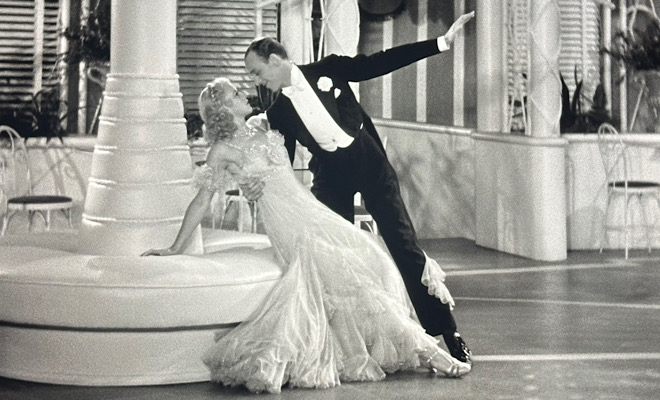
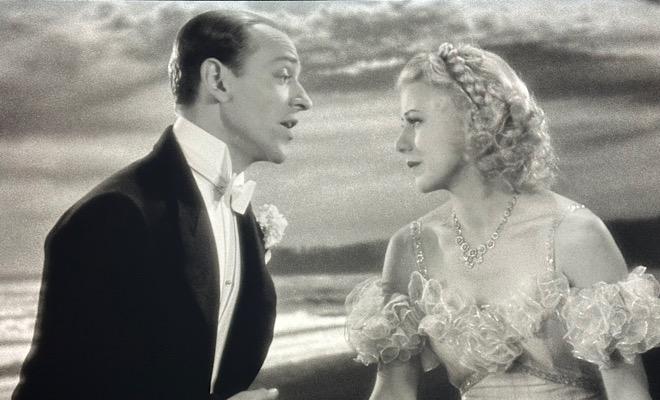
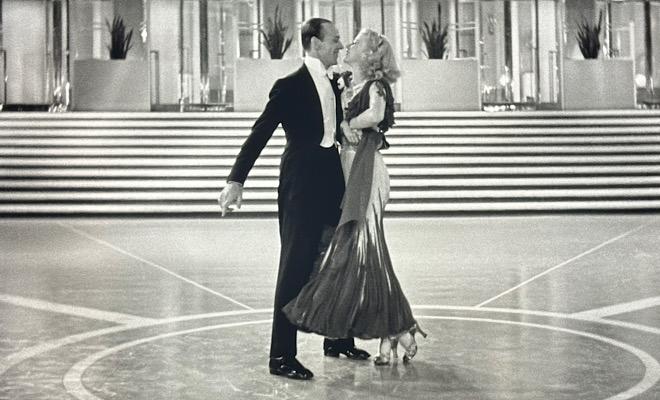
The blueprint also applies to their dance numbers. Sadly, there are only two of them in The Gay Divorcee, but the first is one for the ages. "Night and Day" is an absolutely gorgeous Cole Porter song, but the dance raises it to another level. Like he would do so many more times in future movies, Astaire must gently coax a reluctant Rogers onto the floor and into the mood. She resists; he persists. She demurs; he insists. And when she finally relents and succumbs, the magic begins. Yes, they dance on air, but more importantly, they dance as a single unit, exquisitely in sync, the personification of elegance and poise, exuding palpable emotion with every step. It's romance in microcosm and so stunningly beautiful you won't want it ever to end.
Their other number is more of a gimmick, but they nevertheless give it their all and make it memorable. "The Continental" would win the very first Oscar for Best Song and become a popular dance craze. It's a behemoth of a production number, with dozens of dancers, a massive, opulent set, and plenty of visual panache, but it just goes on and on and on and on. ("The Continental" would hold the record for the longest musical number on film until Gene Kelly's 18-minute "An American in Paris" ballet eclipsed it in 1951.) Fred and Ginger only appear in a portion of it, but every moment is bliss.
Directed by Mark Sandrich, who would also helm such future Astaire-Rogers classics as Top Hat, Follow the Fleet, Shall We Dance, and Carefree, The Gay Divorcee remains a frothy confection spiked with snappy repartee. Seven writers contributed to the screenplay, including the acerbic Robert Benchley, who doesn't receive screen credit, but undoubtedly penned some of the script's funniest quips. A forerunner to the screwball comedies that would soon take Hollywood by storm, The Gay Divorcee is populated by a cast of madcap characters who are astutely portrayed by a first-rate supporting cast, several of whom would become members of an Astaire-Rogers stock company that greatly enhanced their films.
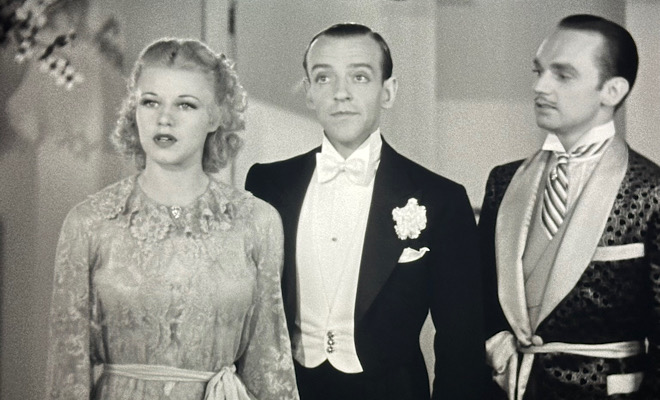
The debonair yet eternally befuddled Edward Everett Horton (who also enlivens Top Hat and Shall We Dance), hilarious Eric Blore (who had already appeared in Flying Down to Rio and would grace Top Hat, Swing Time, and Shall We Dance), and dashing Rhodes (who would play a temperamental Italian once again in Top Hat) all perk up the proceedings with colorful portrayals distinguished by pitch-perfect comic timing. Blore and Rhodes were both imported from the stage production to recreate their roles, and while both earn their share of laughs, Blore - as always - steals the show. There aren't many actors who can provoke guffaws by simply saying "toasted scones," but Blore can and does.
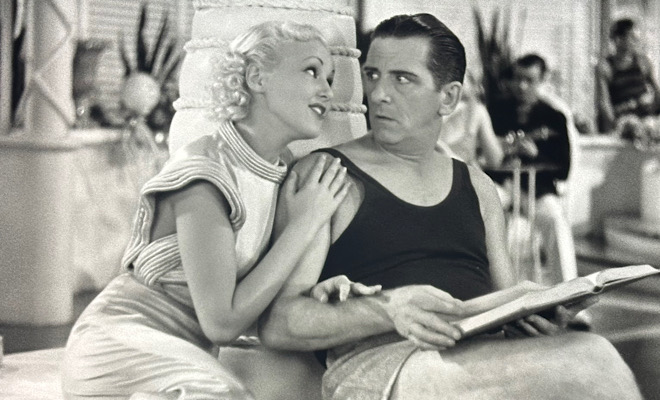
The delightfully daffy and ditzy Alice Brady, who would nab a Best Supporting Actress Oscar nod two years later for a similarly flighty performance in the screwball classic My Man Godfrey (then win the award two years after that for her affecting dramatic turn in the historical disaster flick In Old Chicago), grabs the lion's share of laughs as Rogers' flibbertigibbety Aunt Hortense, and a young Betty Grable, who receives 10th billing, makes her first big splash as a specialty performer who sings the coyly titillating tune "Let's K-nock K-nees" with a smitten Horton.
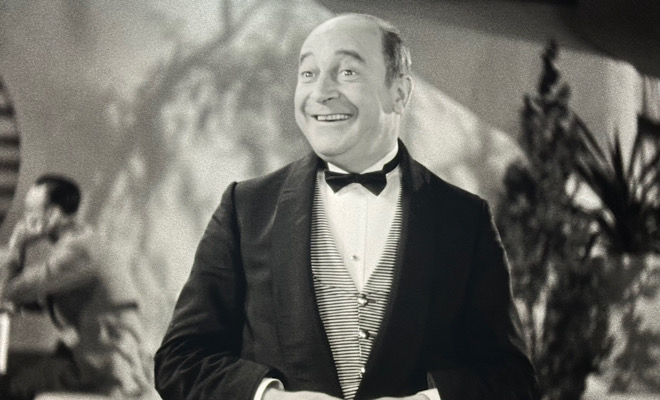
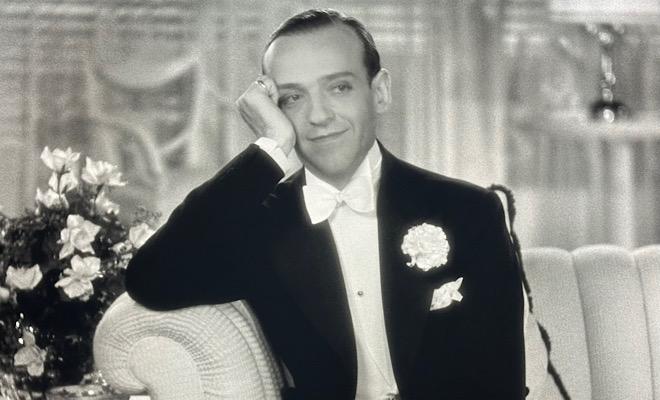
Astaire's two solo numbers, "Don't Let It Bother You" and "A Needle in a Haystack," both feature exuberant tap routines that show off Astaire's agility, creativity, and boundless energy. They aren't nearly as refined as much of his later work, but they spotlight a man eager to strut his stuff and bring dance to a rarefied cinematic plane. In just his third movie, Astaire proves dance isn't just an entertaining diversion, it's an art form worthy of respect and able to produce a sense of wonder and even awe.
The Gay Divorcee earned five Oscar nominations, including Best Picture, and though it may not equal the subsequent Astaire-Rogers films, it's still a lively, entertaining musical that mixes song, dance, comedy, and romance with aplomb. Back when "gay" also meant happy, this film infuses us with that particular brand of exhilaration and joy that only musicals can deliver. That feeling was new and fresh in 1934, and if Astaire and Rogers can't be credited with creating it, they certainly amplified it as their partnership flourished over the course of the decade.
Vital Disc Stats: The Blu-ray
The Gay Divorcee arrives on Blu-ray packaged in a standard case. Video codec is 1080p/AVC MPEG-4 and audio is DTS-HD Master Audio 2.0 mono. Once the disc is inserted into the player, the static menu with music immediately pops up; no previews or promos precede it.
Video Review
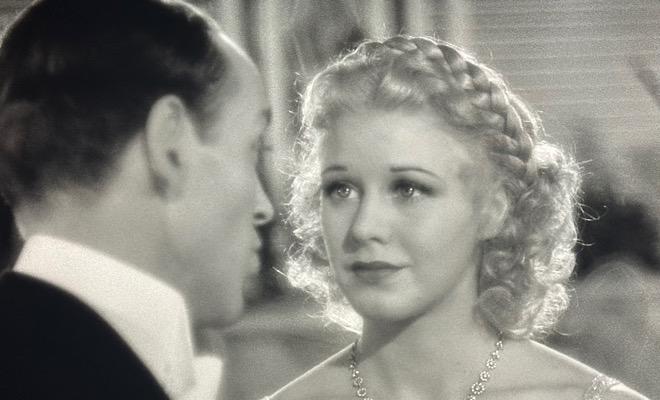
Fred and Ginger are perfection, and this 1080p/AVC MPEG-4 transfer struck from a new 4K scan of the original nitrate camera negative is perfection, too. The wow factor oozes from almost every frame of this glorious rendering that makes this 92-year-old movie look decades younger. Clarity and contrast are superb. Grain has been beautifully resolved, yet the picture still maintains a lovely film-like feel that showcases the lush cinematography of David Abel, who would photograph four other Astaire-Rogers films - Top Hat, Follow the Fleet, Swing Time, and Shall We Dance. Rich blacks, bright whites, and wonderfully varied grays produce a crisp, detailed image that showcases the fine details in the sets and costumes that helped The Gay Divorcee earn an Oscar nomination for Best Art Direction. Getting Astaire's signature black tuxedo, top hat, white tie, and tails just right is mandatory, and this transfer does just that.
Shadow delineation is excellent and sharp close-ups highlight Astaire's angular features and Rogers' glamor. Process shots, dissolves, and montages are surprisingly stable and seamless, and not a single mark, scratch, or speck of dirt dot the pristine source. All the issues that plagued the 2007 DVD have been addressed and corrected, making this Blu-ray the gold standard for Astaire and Rogers so far. An upgrade is mandatory.
Audio Review
The Gay Divorcee earned Oscar nominations for Best Sound and Best Score, and this DTS-HD Master Audio 2.0 mono track honors those nods, outputting terrific sound that's been beautifully remastered. A wide dynamic scale easily handles all the highs and lows of the music score that includes work by an uncredited Max Steiner, and all the instrumentals and vocals during the musical numbers benefit from top-notch fidelity. Astaire's taps are marvelously distinct, and all the dialogue and song lyrics are well prioritized and easy to comprehend. Distortion is absent and no age-related hiss, pops, or crackle intrude.
Special Features
The only supplements Warner Archive imports from the 2007 DVD are a vintage cartoon and promotional radio program. The other two vintage extras on the DVD (both two-reel short subjects) have been replaced with two other vintage shorts, an additional cartoon, and a radio adaptation starring Frank Sinatra.
- Vintage Short: Art Trouble (SD, 21 minutes) - This comedy short starring Shemp Howard is noteworthy because it contains the film debut of 23-year-old James Stewart, who plays a spoiled rich kid who doesn't want to be shipped off to Paris to go to art school. Mary Wickes also makes her film debut as an extra (you can spot her in the background during a cafe scene) in this silly two-reeler that features a blink-and-you'll-miss-it early performance from the lovable Marjorie Main, too.
- Vintage Short: Masks and Memories (SD, 32 minutes) - This rare three-reel short stars singer Lillian Roth, who performs a few tunes, including Duke Ellington's classic "Sophisticated Lady."
- Vintage Cartoon: Shake Your Powder Puff (SD, 6 minutes) - This black-and-white Merrie Melodies cartoon adopts a variety show format, but it takes place in a barn and the performers are all farm animals.
- Vintage Cartoon: I Like Mountain Music (HD, 7 minutes) - Another black-and-white Merrie Melodies animated short, this Friz Freleng/Rudolf Ising effort that depicts what happens when magazines on a newsstand come to life has also appeared on the Little Women and Ladies They Talk About Warner Archive discs. Spot-on caricatures of Will Rogers, Edward G. Robinson, George Arliss, Eddie Cantor, and even Benito Mussolini enliven this genial musical cartoon.
- Vintage Radio Promotional Program: Hollywood on the Air (14 minutes) - A lengthy array of musical highlights from the film, including "Night and Day" (of course!), comprise this episode of the long-running promotional series.
- Vintage Radio Adaptation (28 minutes) - This severely truncated adaptation of The Gay Divorcee was broadcast on March 6, 1944 as part of the long-running Screen Guild Players series and stars Frank Sinatra, Gloria DeHaven, Edward Everett Horton, and Spring Byington. A highlight is hearing the young Sinatra croon "Night and Day."
- Theatrical Trailer (SD, 1 minute) - "An RKO Musical Miracle" is how The Gay Divorcee is hyped in its original preview.
Final Thoughts
Classics fans have pined for more Astaire-Rogers films on Blu-ray for years, and Warner Archive has at last granted our wish. The Gay Divorcee is a sparkling showcase for the iconic pair and contains one of their most breathtaking routines set to Cole Porter's all-time standard "Night and Day." The 4K scan struck from the original nitrate camera negative is a revelation, the remastered audio is pitch-perfect, and several vintage supplements enhance the disc. Astaire and Rogers never go out of style, and this beautiful restoration captures them to perfection. Highly Recommended.
Click To Order
-
 Grab The Glasses - The Turbine Collector Series Grows with Three More Blu-Ray 3D Discs!By:
 -
 Closing Out 2024 and Welcoming 2025 - HDD's 4K UHD & Blu-ray Shopping Guide, Week of Dec. 31, 2024By:
 -
 Holiday Greetings - HDD's 4K UHD & Blu-ray Shopping Guide, Weeks of Dec. 17 & Dec. 24, 2024By:
 -
 Santa Comes Early This Year! Turbine Delivering 'Bumblebee' 'Transformers: Rise of the Beasts' & 'Sing 2' to 3D Blu-ray on December 19thBy: