Tea and Sympathy - Warner Archive Collection
Tea and Sympathy examines masculinity, judgmental attitudes, and the destructive effects of bullying as it chronicles one teen's horrific ordeal at a rarefied boarding school and his relationship with the sympathetic wife of a macho teacher. Warner Archive's new HD master struck from a 4K scan of the original camera negative enhances the power of this lush, timeless film. Highly Recommended.
Click to Order:

Storyline: Our Reviewer's Take
Many believed Tea and Sympathy could never be filmed due to its taboo subject matter, but after some critical narrative alterations and major concessions to the censors, MGM produced a fine screen version of Robert Anderson's hit Broadway play. The story of a sensitive teenage boy who doesn't fit in with his macho peers at an all-boys boarding school and is mercilessly bullied and ostracized as a result insightfully examines masculinity in American society and how going against the grain of established mores can crush the human psyche and spirit. Though the movie wasn't allowed to call a spade a spade and use the term homosexual or any of its offensive slang synonyms, the innuendoes come through loud and clear and deliver a series of devastating gut punches.
If you're a guy who didn't fit the cocky jock stereotype and didn't bang dozens of girls in high school, and consequently were teased, degraded, and pummeled by gay slurs...or you were a bully who took brutal advantage of someone like that and got a big kick out of it, you'll be able to relate on some level to Tea and Sympathy. Anderson claimed his play was not about homosexuality or the perception and fear of it, but rather the shattering effects of being labeled as "different." Using masculinity and sexuality as vehicles to explore that theme was inspired. The topics hadn't been widely explored in the 1950s (Tennessee Williams' Cat on a Hot Tin Roof was yet to come) and they struck a chord. They still strike chords today.
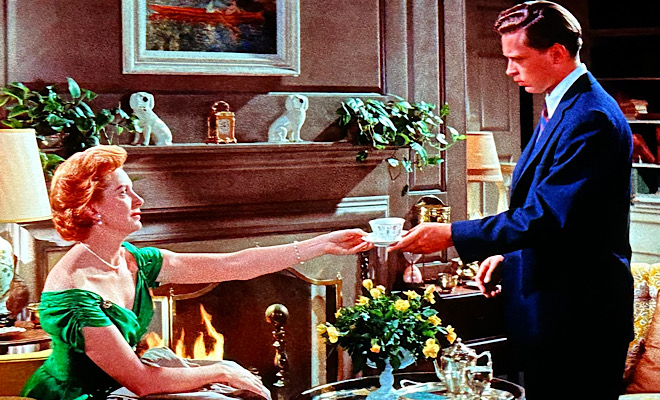
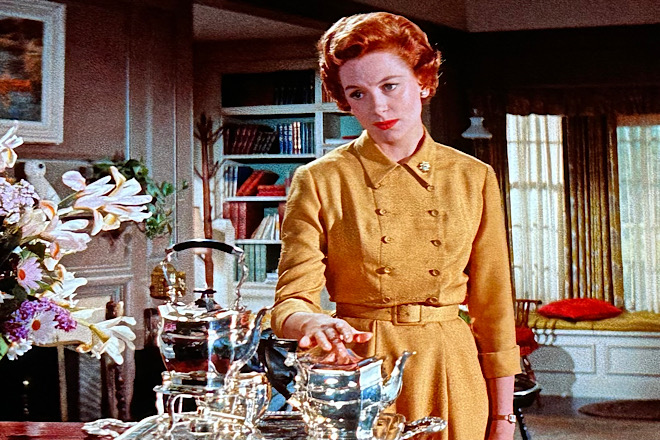
Laura Reynolds (Deborah Kerr) is the patient, loving, and largely subservient wife of Bill Reynolds (Leif Erickson), a teacher and coach at Chilton, a ritzy all-boys prep school. Bill is also the housemaster at one of the dormitories, where the empathetic Laura provides "tea and sympathy" to any students who have problems or need nurturing. One of those students is Tom Lee (John Kerr), a quiet, introverted teen who largely sticks to himself, prefers poetry, classical music, and erudite pursuits to carousing, rough-housing, and skirt-chasing with his young-buck housemates, and harbors a not-so-secret crush on Laura. When Tom's peers spot him in a sewing circle with a group of faculty wives (in the play, he's swimming with a professor rumored to be gay) and later espy a dress in his closet that's a costume for the upcoming school play (boys must play female parts at an all-boys school), they saddle him with the nickname "Sister Boy" and ruthlessly tease and bully him thereafter.
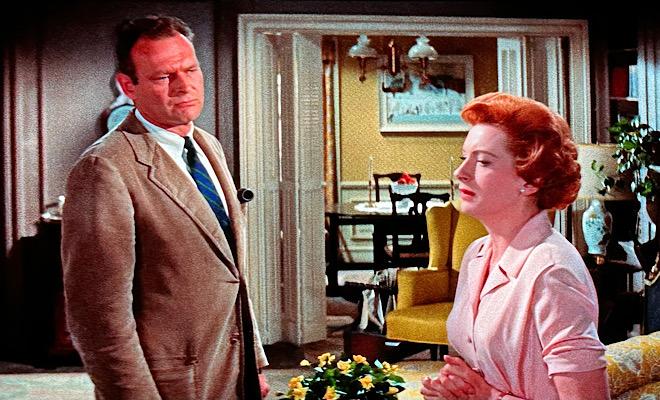
The gruff, macho Bill silently condones the abhorrent behavior, thinking "it might make a man" out of Tom, and even Tom's own father, Herb Lee (Edward Andrews), indirectly piles on. Like any father, he wants his son to be part of the gang, but when Tom chooses pastimes that don't align with macho sensibilities, won't get a crew cut like the other boys, and worst of all, is denigrated and marginalized by his own gender, Herb is deeply ashamed, embarrassed, and angry. He should stand up for Tom and offer support and encouragement, but instead, Herb withholds his love and approval.
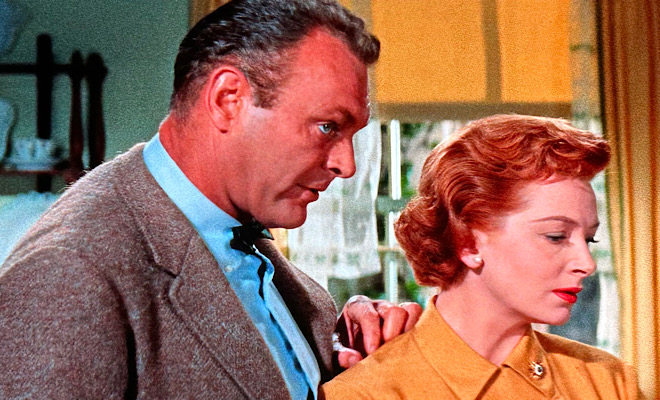
Laura tries to fill the void and save Tom, and in the process gets more involved than she should, much to the consternation of her husband, who shows little affection for Laura and seems to prefer the company of his posse of teenage jocks. Tom innocently drives a wedge between Laura and Bill, who must confront the cracks in their marriage as his crisis crescendos. Fed up with the taunts and abuse that have destroyed his self-esteem and made him question who he is, Tom endeavors to shut everyone up by proving to them - and most importantly himself - that he really is one of the guys and a true-blue, red-blooded, chest-thumping male by making it with the town slut, Ellie Martin (Norma Crane), a sassy, blue-collar waitress at a diner called The Joint.
Censorship doesn't destroy the film version of Tea and Sympathy, but it does severely compromise it. Anderson adapted his own play, so he obviously did the best he could, but by being forced to delicately skirt around the story's core issues and invent trite episodes that imply a lack of manhood and therefore hint at homosexuality, the screenplay dilutes Tom's ordeal. If you haven't walked a mile in Tom's shoes, you might think his tale is melodramatic and overblown, but if you take a step back and think about the rampant social media bullying that's ruined countless lives over the past decade, it will ring very, very true.
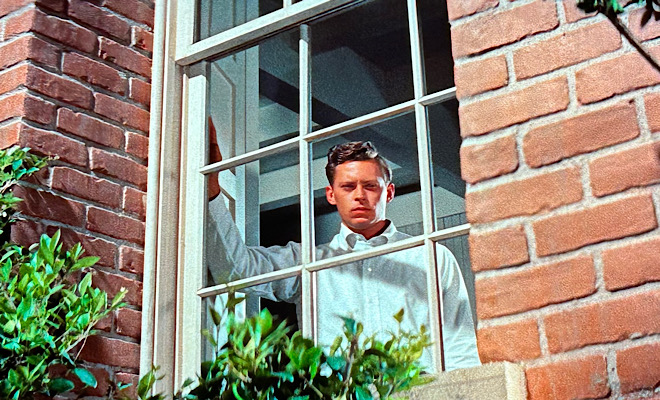
And then there's the epilogue. Mandated by censors, it practically invalidates everything that comes before it. Divulging anything more would spoil the movie, but suffice it to say the film version of Tea and Sympathy is told in flashback, and if you really want to preserve the play's integrity, you should stop watching after Laura says one of the most famous last lines in theater history: "Years from now, when you talk about this - and you will - be kind." It should have been the last line of the film, too, were it not necessary for Laura to "pay" for a selfless, some might say, life-saving act.
One of the many cogent points the movie makes is that there's an emotional component to sexual attraction that's often overlooked. Not all heterosexual men are studs on the perennial prowl who only want one thing from a woman; men can be tender, loving, vulnerable, and still be considered manly. And sometimes being overly macho is a shield for sublimated desires and insecurities people can't face or wish to hide. Maybe we're enlightened enough today to realize that, but again, back in the 1950s, social and sexual roles were rigidly defined and any variance from them was rarely tolerated, especially outside of big cities. Tea and Sympathy dared to address such sensitive and controversial issues.
Of course, you can also view the film's story as a thinly veiled jab at the era's Communist witch hunt, where a whisper about someone's patriotism or political beliefs could cause instant personal and professional ruination. Coloring outside the lines at all in American society was a risky business in those days, and though Tea and Sympathy tries to reassure us that different is okay, it starkly depicts the high price often paid for individualism.
Director Vincente Minnelli brings both his patented sensitivity and artistry to this wrenching tale. Though he's best known for splashy musicals like Meet Me in St. Louis, An American in Paris, and Gigi, Minnelli could also weave a powerful spell, and that's exactly what he does here. Instead of wallowing in sentiment, Minnelli brilliantly depicts Tom's anguish and the growing hopelessness and despair that send him over the edge.
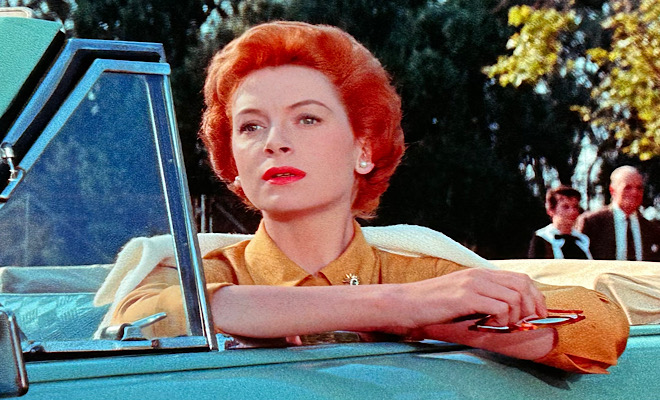
The trio of Kerr, Kerr, and Erickson all originated their roles in the Broadway production, and their finely nuanced performances and well-honed chemistry carry the film. Deborah Kerr (who is not related to John) utterly inhabits her role, crafling a dimensional portrait of a woman struggling to manage myriad emotions and agendas. Warmth and empathy ooze from her pores, and she would have received a Best Actress Oscar nomination for her portrayal had the Academy not bestowed one on her equally authentic turn in Rodgers and Hammerstein's The King and I the same year.
John Kerr strikes just the right tone as Tom, mixing boyish charm and naïveté with confusion, anger, and heartbreaking despair, while Erickson expertly plays a similarly tortured man hiding behind a brawny physique and blustery, brusque persona. Bill follows the masculine rule book to a fare-thee-well, but his inability to express any emotions other than arrogance and anger alienates him from Laura and hints at demons simmering beneath his seemingly virile veneer.
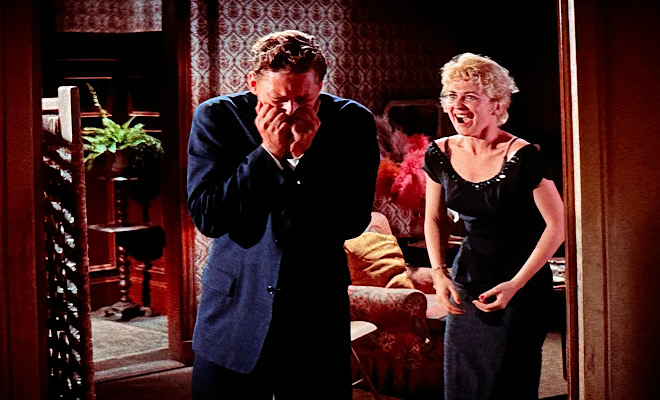
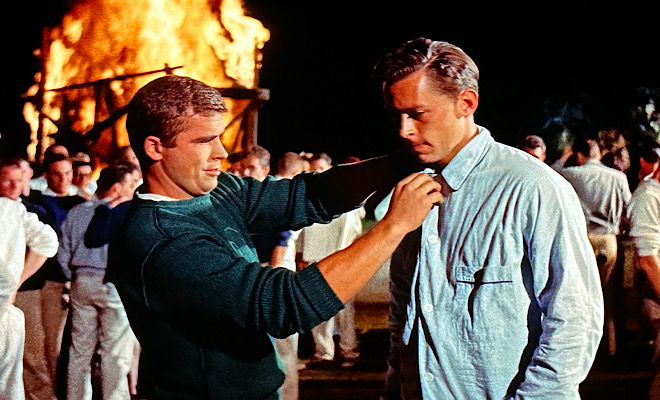
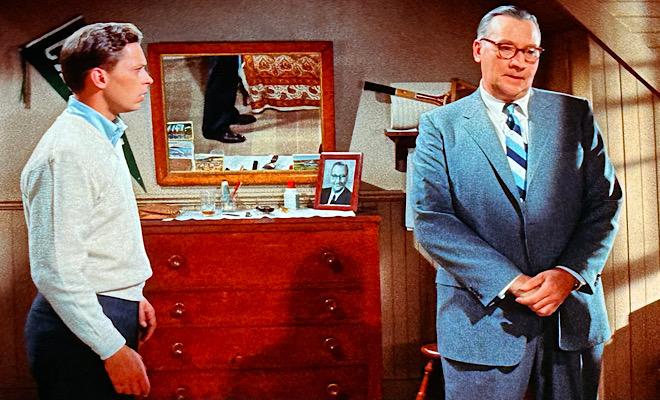
In supporting roles, the ubiquitous Andrews nails his portrait of Tom's distant, judgmental, and selfish father; Crane is quite effective as the jaded, slovenly waitress who deals Tom a crushing blow; Darryl Hickman shines as Tom's caring and supportive roommate who faces his own masculine pressures from his overbearing dad; Tom Laughlin, in his first billed role and 15 years before he became an indie icon and symbol of counter-culture rebellion in Billy Jack, plays the stereotypical macho jock bully to perfection; and Dean Jones, in his second billed role and nine years before he became the live-action face of many Walt Disney films, ably portrays another student who taunts the troubled Tom.
Some dated elements temper Tea and Sympathy somewhat, but it remains an elegant, potent, and affecting drama that's beautifully directed and acted. However you interpret its message, the points it makes are thought-provoking, relatable, and timeless.
Vital Disc Stats: The Blu-ray
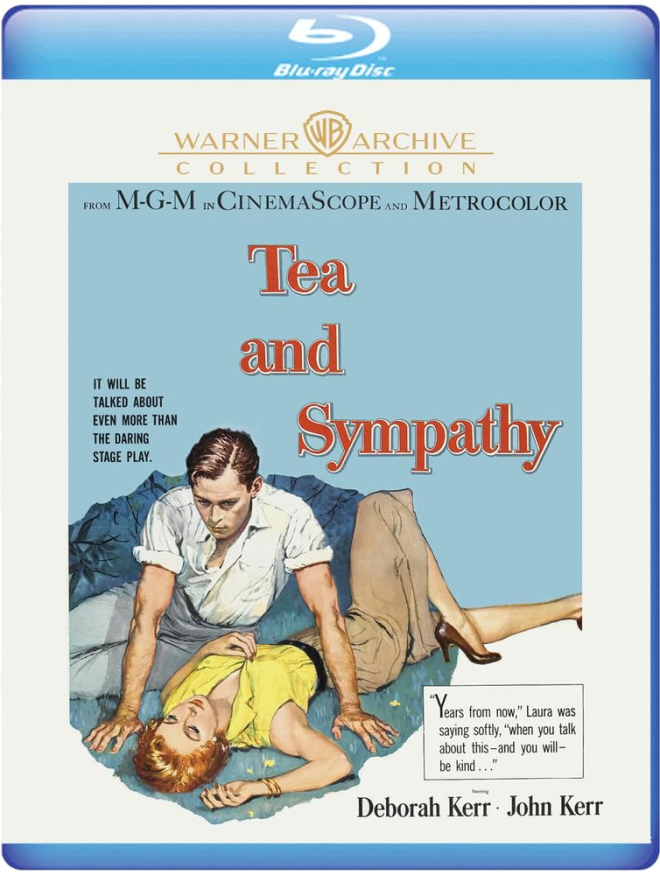
Tea and Sympathy arrives on Blu-ray packaged in a standard case. Video codec is 1080p/AVC MPEG-4 and audio is DTS-HD Master Audio 2.0 mono. Once the disc is inserted into the player, the static menu with music immediately pops up; no previews or promos precede it.
Video Review
A brand new HD master struck from a 4K scan of the original camera negative yields a lovely 1080p/AVC MPEG-4 transfer that beautifully renders the movie's bucolic academic setting. Oscar-winning cinematographer John Alton once again weaves his magic and maximizes Minnelli's typically sumptuous color palette. It's just a shame Tea and Sympathy was shot in single-strip Metrocolor instead of three-strip Technicolor, which really would have made the image pop. The movie's original grain structure remains intact, producing a film-like image that errs on the soft side a little more frequently than I would have liked. There's a gauzy quality to some scenes, while others are wonderfully crisp and vibrant.
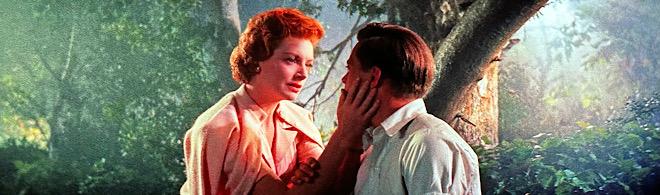
Laura's lush flower garden, teal-colored car, and emerald green dress all look great, as does Deborah Kerr's flaming red hair and lipstick. Inky blacks and excellent shadow delineation create a dark mood during the climax, the bright whites resist blooming, and sharp close-ups showcase Deborah Kerr's immaculate complexion, John Kerr's boyish features, and Erickson's ruggedness. No nicks, dirt, or scratches dot the pristine print and no digital anomalies could be detected. This is surely the best Tea and Sympathy has ever looked on home video, so fans shouldn't hesitate to upgrade.
Audio Review
The DTS-HD Master Audio 2.0 mono track outputs solid sound that's free of any age-related hiss, pops, or crackle. A wide dynamic scale handles all of the sweeping highs and weighty lows of the lyrical music score by three-time Oscar-winner Adolph Deutsch, all the essential dialogue is well prioritized and easy to comprehend, and sonic accents like crashing waves at the beach and the thwack of tennis balls during Tom's match are distinct. This isn't a particularly active track, but does what it needs to do seamlessly and pleasingly.
Special Features
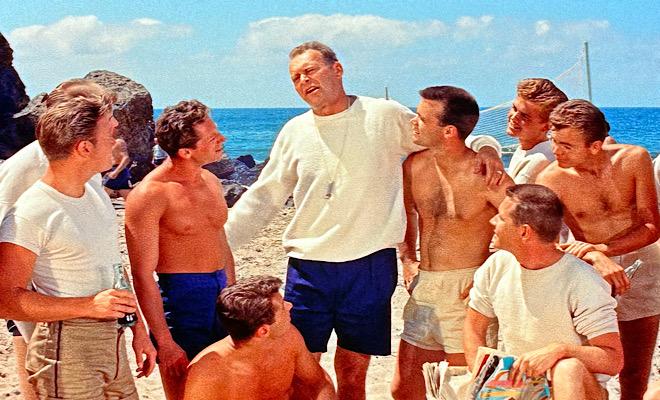
The 2011 DVD was devoid of extras. Warner Archive (mildly) rights that wrong by including a vintage cartoon and the film's original theatrical trailer on this Blu-ray release.
- Vintage Cartoon: Down Beat Bear (SD, 6 minutes) - This Hanna-Barbera Tom & Jerry cartoon chronicles the duo's entanglement with a dancing bear that disrupts their lives whenever music plays.
- Theatrical Trailer (SD, 3 minutes) - The film's original preview hypes the taboo subject matter and success of the play on Broadway.
Final Thoughts
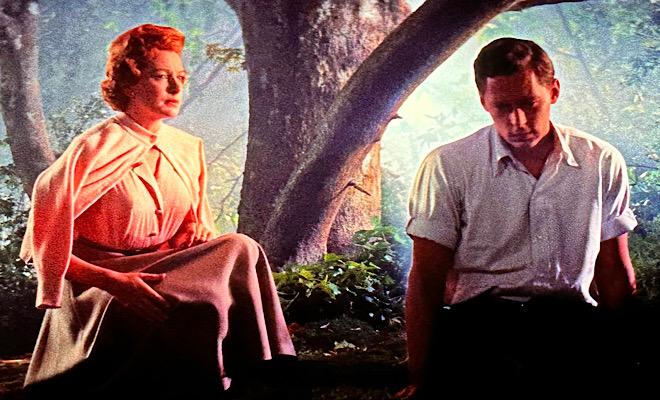
A deeply affecting portrait of how rumor and innuendo can drive an introverted teenage boy to the precipice, Tea and Sympathy weaves timeless themes into its absorbing and relatable narrative. Warner Archive honors director Vincente Minnelli's film with a sumptuous transfer struck from a new 4K scan of the original camera negative and remastered audio. Highly Recommended.
Click to Order:
-
 Grab The Glasses - The Turbine Collector Series Grows with Three More Blu-Ray 3D Discs!By:
 -
 Closing Out 2024 and Welcoming 2025 - HDD's 4K UHD & Blu-ray Shopping Guide, Week of Dec. 31, 2024By:
 -
 Holiday Greetings - HDD's 4K UHD & Blu-ray Shopping Guide, Weeks of Dec. 17 & Dec. 24, 2024By:
 -
 Santa Comes Early This Year! Turbine Delivering 'Bumblebee' 'Transformers: Rise of the Beasts' & 'Sing 2' to 3D Blu-ray on December 19thBy: