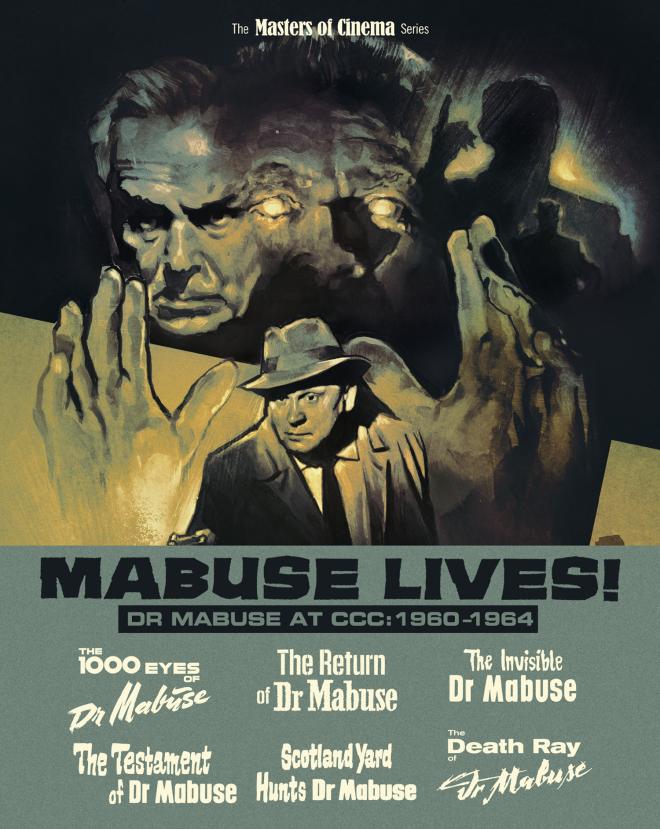
Mabuse Lives! Dr. Mabuse at CCC: 1960-1964
Blu-ray Review By: S. Tony Nash
Eureka! Entertainment’s Masters of Cinema line presents the US and UK premiere of the Dr. Mabuse 6 film series produced by Germany’s CCC Film between 1960 and 1964. The films: Die 1000 Augen des Dr. Mabuse (The 1000 Eyes of Dr. Mabuse), Im Stahlnetz des Mr. Mabuse (The Return of Dr. Mabuse), Die Unsichtbaren Krallen des Dr. Mabuse (The Invisible Dr. Mabuse), Das Testament des Dr. Mabuse (The Testament of Dr. Mabuse) (1962), Scotland Yard Jagt Dr. Mabuse (Scotland Yard Hunts Dr. Mabuse), and Die Todesstrahlen des Dr. Mabuse (The Death Ray of Dr. Mabuse) are all presented in new 2K restorations via the original negatives and film elements with a slew of extras including interviews and audio commentaries. Highly Recommended
Storyline: Our Reviewer's Take
I only have one lord and ruler, Dr. Mabuse – spoken by unnamed extra
Disc 1
Die 1000 Augen des Dr. Mabuse (The 1000 Eyes of Dr. Mabuse): Legendary filmmaker Fritz Lang concluded his behind-the-camera career in his native Germany with a return to the Dr Mabuse character that catapulted him to international fame. A mystery man has christened himself the new Dr. Mabuse, using the madman’s knowledge of hypnosis to cause a series of crimes and terrorist attacks, with aims to take over Germany and create a third Cold War power. Only an American businessman and a determined Police Commissioner can stop the chaos.
Fritz Lang’s final film as a director packs the same punch as his Silent films and first two talkies. Dr. Mabuse, originally a Moriarty-like figure in crime fiction, was morphed by Lang into the archetype for those hungry to gain power in times of crisis. Whether the failed Weimer Republic of the 1920’s, or the evil of the National Socialists in the early 1930s, or the Cold War, Lang shows viewers with finesse how men like Mabuse thrive in such environments and what it takes to stop them. Lang expresses this beautifully in his depiction of Germany in 1960, primarily in Berlin and the Wall separating the West from the East. While lacking the fantastical and dreamlike atmosphere from his earlier features, Lang still evokes an otherworldliness from the city and the people, most of whom are still finding their way in a rebuilt world. The majority of the film’s characters are shown to be living fairly well and calmly, trying not to dwell on the craziness of the world stage, but their lives are soon thrown for a loop as crime after crime is committed.
An international cast helps the film to really shine. Popular German character actor Gert Frobe, most famous to American audiences as James Bond supervillain Goldfinger, plays a working-class Police Inspector assigned to find and apprehend the mastermind behind these crimes. Blunt and to the point, Frobe’s Kommissar Kras wastes no effort to get the job done. Peter van Eyck, another favorite German character actor – though less known outside his native land -, brings a Nordic charm as visiting American business Henry B. Travers who gets caught up in the intrigue when he falls for Marion Menil, played by British actress Dawn Addams, who knows much more about events than what she’s saying. Kras and Travers soon find they have a long list of suspects who could be the new Mabuse including Andrea Checchi as Hotel Detective Berg, Wolfgang Priess as lecturer Prof. Peter S. Jordan, Werner Peters as funny but evasive salesman Hieronymus B. Mistelzweig, and Reinhard Kolldehoff as Marion’s husband Roberto the Clubfoot. Rounding out the cast is Jess Franco’s favorite actor Howard Vernon as Mabuse’s efficient and deadly assassin referred to only as No. 12. Vernon’s ridged and sometimes stone stare serve him well as the atypical hired killer who asks no questions and is very accurate in his work. 5/5
Disc 2
Im Stahlnetz des Dr. Mabuse (The Steel Net of Dr. Mabuse/The Return of Dr. Mabuse): Despite being declared dead, Dr. Mabuse has seemingly returned to continue his reign of terror, this time utilizing a drug that paralyzes the will of its victims, turning them into super-efficient criminals. He’s looking to team up with a crime syndicate in Chicago to keep the authorities guessing. Police Commissioner Lohmann and FBI Agent Joe Como team up to stop Mabuse from causing a massively destructive attack.
After Fritz Lang rejected Arthur Brauner’s offer to expand the Mabuse character into a series of films, successful genre director Harold Reinl took the reins for the first sequel. While Reinl does nods to Lang with camera angles, motifs, and imagery to foreshadow what’s to come, he does them in such a fashion that makes said tricks his own. Reinl’s success at the Edgar Wallace Krimi films and his fascination with Film Noir give the film a hard-boiled taught Crime Thriller look with hints of the supernatural in Mabuse remaining in the shadows, no one knowing who he is or where he is. While lacking Lang’s allegory of evil resulting from chaos, Reinl makes up for this by showcasing Mabuse as more myth than man, a megalomaniac with a god-like grandeur, his extraordinary intelligence and abilities giving him a legendary aspect,
Like with the first film, Reinl has a top-notch international cast. Gert Frobe returns for the first sequel, but this go around is playing Inspector Lohmann, another blunt and to-the-point no-nonsense working-class cop. Aware of the events of the previous year, Lohmann is certain Mabuse is back in action, but can’t prove it. Lex Barker, an American expatriate actor who became one of Germany’s biggest international stars, adds a touch of suave coolness as Joe Como, an FBI Agent working both with the German police and undercover to find and arrest Mabuse. Israeli-Naturalized German actress and singer Daliah Lavi plays the damsel in distress as reporter Maria Sabrehm, who’s certain her father is being held captive by Mabuse for his scientific knowledge. Italian character actor Fausto Tozzi plays prison warden Wolf, a man just a little too calm when told his inmates may be being used as guinea pigs for the nefarious Mabuse. Wolfgang Priess is listed as a special cameo star. Werner Peters returns as prison aid Bohlmer who isn’t everything he appears to be. 5/5
Die Unsichtbaren Krallen des Dr. Mabuse (The Invisible Claws of Dr. Mabuse/The Invisible Dr. Mabuse): FBI Agent Joe Como gets called back to Germany when fellow operative Nick Pardo is found murdered and it’s discovered he stumbled upon shady goings-on at a theater. Como then learns a reclusive scientist recently invented a device that makes the user invisible and believes a very much alive Dr. Mabuse intends to use the device for his nefarious schemes. Como must now protect the scientist and the woman he loves from Mabuse’s clutches.
Harold Reinl returns to the director’s chair for the second Mabuse sequel, bringing the same flair and style he perfected during The Return of Dr. Mabuse. Reinl expands on this sequel by diving into the realm of Science Fiction with a scientist inventing a device that renders the wearer of it totally invisible. While fans hoping for Reinl to be metaphoric like Lang in invisibility. Reinl and the special effects team do a fantastic job at making it appear people are disappearing and reappearing. The effects might not be of the standards of what viewers are generally used to but are still pretty impressive for the 1960s.
Lex Barker returns for the role of FBI man Joe Como, asked to return to Germany to identify a fellow agent who was murdered while on the case. Barker, not having to don several aliases for security this time, now plays Como as a typical tough guy government man with a playboy side as he charms and negotiates his way to information regarding a new criminal organization planning something big. Barker also adds a touch of Sir Galahad when he learns of people in serious jeopardy. Karin Dor, a popular German actress of the late 1950s throughout the early '70s, plays stage actress Liane Martin who is being pursued by an unknown individual. Dor is another of the many damsels in distress here but performs her part very well. Wolfgang Priess finally gets to be credited as the Mabuse character, no longer having to stay in the shadows. Priess brings a devilish glee and sly sinisterness to Mabuse in his wickedness. He also dons the role of a henchman named Dr. Primarius Krone and he does so with a clever nastiness. Werner Peters returns for the third film in a dual role as Clown Bobo and Martin Droste, one a loyal Mabuse henchman posing as a theater performer, the other who is astonished his company has been hijacked by Mabuse’s men. 4.5/5
Disc 3
Das Testament Des Dr. Mabuse (The Testament of Dr. Mabuse) (1962)
Having gone mad after escaping a burning building and now confined to a mental hospital, Dr. Mabuse finally appears to no longer be a threat. Inspector Lohmann, having tangled with the madman before, isn’t so sure however when a series of crimes bearing Mabuse’s moniker begin occurring throughout the city of Berlin. Prof. Dr. Pohland, head of the institute where Mabuse is being treated, insists there’s no chance of him orchestrating these events. Is Mabuse genuinely mad, or is he still pulling the strings?
The 4th Mabuse film and the 3rd sequel in the franchise was meant to be producer Artur Brauner’s dream passion project. Inspired by Fritz Lang as a boy and having seen the original Testament of Dr. Mabuse in the theater, Brauner envisioned doing a remake one day that would be a love letter and equal to Lang’s classic. Lang however was uninterested in remaking Testament, feeling he accomplished what he set out to already with it, but Brauner was undeterred and went forward. The end result was not what Brauner had hoped at all. Not completely a carbon copy remake as the screenplay has the film in 1962 Berlin and many of the characters are new or composites of some of the originals, the lack of Lang’s otherworldly visual style and his maverick use of practical effects leaves something big missing. While new director Werner Klingler’s style is a little more generic for the majority of the film, he does work in some really good surreal dreamlike cinematography during the last 20 or so minutes that Lang would’ve been proud of. The film itself is still entertaining and a lot of fun, but Brauner sadly shot too high to impress Lang, and it fell a little flat.
The Testament remake is the first to have an entire German-speaking cast. Gert Frobe returns for the third and final time, once again in the role of Inspector Lohmann, a nod to actor Otto Wernicke from the 1933 film. Not as gruff or no-nonsense as his 1930s predecessor, Frobe still gives off the tough everyman cop feel to Lohmann who goes in knowing he’s dealing with the biggest fish of the criminal underworld. Frobe giving Lohmann street smarts shows the character knowing not to take everything at face value. Walter Rilla, a veteran German character actor, joins the series as Professor Pohland, a reimagining of the Prof. Dr. Baum character played by Oskar Beregi in 1933. Pohland is the head of the psychiatric institute where Mabuse is being treated and is portrayed as a level-headed man who, while doubting Mabuse is still organizing crime, is willing to help Lohmann discover the truth. It isn’t long, however, before the good professor realizes something terrible is happening that he can’t prevent. Wolfgang Priess is on equal par with his predecessor Rudolf Klein-Rogge in the role of Dr. Mabuse. Priess gets a good amount of screen time this go around in the series and offers up quite the performance as a man who may or may not be faking his madness. Leon Askin, an Austro-Hungarian character actor mainly remembered for his recurring role as General Burkhalter in the hit TV series Hogan’s Heroes, plays Flocke, a disgraced ex-policeman first thought to be working for Mabuse, but in reality, is spying on the gang to redeem himself. Askin mixes heroic dedication with very human fears as he balances the fine line between being successful or found out. 4/5
Scotland Yard Jagt Dr. Mabuse (Scotland Yard Hunts Dr. Mabuse)
Dr. Mabuse is dead, but his intellect and schemes live on through his new avatar, Prof. Dr. Pohland. Their minds now one, Pohland/Mabuse fakes drowning in a lake and escapes to England where he plans to steal and use a recently created mind control device to force the disbandment of the current government and build a new one of people under his control. British Major Bill Tern and visiting German Inspector Vulpius, along with Tern’s crime novel expert mother, are the only ones who can stop this dastardly act.
With the commercial and critical failure of the Testament of Dr. Mabuse remake, Artur Brauner had to cut back for the next film. Constantine Film, Brauner’s usual production partner, had pulled out of the Mabuse franchise and Brauner looked to veteran studio Gloria Film for help. Gloria Film was once a titan in the post-war era of German films but was now struggling to survive, and its hope was that the Mabuse character could compete with the immensely popular Edgar Wallace Krimi films that mixed crime thrills and supernatural Horror elements. Brauner was convinced to mimic the romanticized view of England this go around and have the arch-fiend escape there and plan his next crime. The franchise loses some of its appeal taking Mabuse out of his native Germany, but the beauty of the English countryside, whether shot on location or in Brauner’s CCC soundstage, is too lush and wonderful to snub at. Veteran pre-war director Paul May takes the helm this time, and while he doesn’t offer anything in terms of inventiveness and uniqueness, still does a fine job with the material at hand, especially with the well-staged robbery scenes.
Peter van Eyck returns to the series and takes over for Gert Frobe in the lead, this time playing British Major Bill Tern. Initially contacted by the German police for background information on a recently escaped war criminal he helped arrest, Tern suddenly finds himself thrust into intrigue when a series of murders and “suicides” start occurring and believes Mabuse is still very much alive. While van Eyck can’t hide his German charm, he’s still quite believable as the quintessential Brit and is very animated in the part. Werner Peters appears for the fourth and final time in the franchise, this time in a rare good guy role as Inspector Vulpius. Like Inspectors Kras and Lohmann, Vulpius is an everyman, no-nonsense kind of cop hoping to finally put away Mabuse’s villainy for good. Peters is very likable in the part and gives off a fine mixture of humor and seriousness. Walter Rilla returns with an effective menacing look as the now Mabuse-possessed Prof. Pohland, looking to take over England. Wolfgang Priess only cameos as Dr. Mabuse in spirit form, but his presence is always welcome. Klaus Kinski, the always controversial German actor, scores with an early role as MI6 agent Joe Rank. Kinski mainly works as a sidekick to van Eyck, but his presence and face alone are more than enough to have the audience remember him. 4/5
Prof. Pohland, his mind shattered from his trauma with Dr. Mabuse, is committed to a mental hospital. British Major Bob Anders is certain somewhere in Pohland’s mind is Mabuse’s secrets, but before Pohland can be cured, he’s whisked away in a daring break-in. Believing the trail has run cold, Anders is sent to Malta to protect Prof. Larsen, who is certain someone is after his newest invention, a ray machine capable of mass destruction. Anders and British Intelligence soon realize Mabuse is back at work, either as Pohland or someone else.
The Mabuse franchise was losing steam, and Artur Brauner at the point of being willing to try anything to keep it going. The 5th Mabuse film only changed location, but the Death Ray entry changed the tone and style of the series profoundly, making it look very little like a Mabuse film. The first two James Bond films made a splash and the spy film craze was on the rise, so Brauner and his partners went this route. Journeyman filmmaker Hugo Fregonese, who worked both in Hollywood and independently in Europe, brings that hybrid mix of styles to the Mabuse character and films that is fun and exciting but lacks what had previously made the series and character wonderful. Taking Mabuse out of and away from his German and Expressionist roots was Brauner’s biggest error, this final film having more of an air of a spy film rather than a brooding crime thriller with eerie elements. Granted Mabuse has the right characteristics to be a villain to the likes of James Bond, Superman, and even Sherlock Holmes, but his presentation through the Expressionist lens gave him an aura that took him to a whole new level the final film doesn’t have.
The final Mabuse film does get a nice leg up with a strong international cast. Peter van Eyck returns once more, again playing a totally new character, this round in the role of Major Bob Anders. The Major Anders character is not too different from Major Bill Tern, only in that Anders works for British Intelligence while Tern is more involved with the Military Police. Eyck does a pretty decent job as a James Bond-like government operative, leading a double life while trying to keep the world safe, and doing it with a smile on his face. O.E. Hasse, another of Germany’s many reliable character actors of the day plays Professor Larsen, a loner scientist who has just found the secret to a deadly ray. Hasse plays Larsen as conflicted as while he wasn’t happy with the many turn downs he got from governments for his services, even he recognizes the deadliness of his latest discovery and doesn’t want it falling into the wrong hands. Walter Rilla once again returns as Prof. Pohland, this time suffering memory loss and trauma after Mabuse exited his mind. All Pohland can tell people is that Mabuse took control of him, but before he can be cured, someone kidnaps him, possibly for Mabuse’s spirit to once again seize control. Despite a clear onscreen credit, Wolfgang Priess makes no appearance at all as Mabuse as he was on vacation, but Brauner still used his name to sell the film. Iconic British character actor Leo Genn joins the series playing against type as the rough, tough, and ready Admiral Quency. Despite having lost much of his body to varied battles, Quency’s mind is still sharp as he leads the way to stopping a heinous scheme and attack. Italian character actor Claudio Gora also joins in as Museum Director Botani, who seems too good to be true. 3.5/5
Vital Disc Stats: The Blu-rays
The Mabuse Lives! set comes in a hard outer box containing two 14 mm clear Blu-Ray cases with two discs apiece, changeable artwork, a removable J Card containing disc specs and general information, and a 60 pg. book containing new and archival writing on the films and cast and crew lists. All Discs are Region A/B. All six films are presented in their original aspect ratios with new 2K restorations by CCC Films with support from Eureka! Entertainment. The 1000 Eyes of Dr. Mabuse runs 103 min in 1:66:1, The Return of Dr. Mabuse runs 89 min, in 1:66:1 The Invisible Dr. Mabuse runs 89 min in 1:66:1, The Testament of Dr. Mabuse (1962) runs 88 min in 1:66:1, Scotland Yard Hunts Dr. Mabuse runs 90 min in 1:37:1, and The Death Ray of Dr. Mabuse runs 91 min 1:37:1. Complete runtime is 549 min.
Video Review
It wasn’t me. It was Mabuse. He used my brain. – Professor Pohland
CCC Films, in conjunction with Eureka! Entertainment, presents all 6 films in beautiful looking 2K restorations. Shot in glorious black and white cinematography, all the films have a crisp and clean look to them, each scene vibrant with the blacks, greys, and whites complimenting each other greatly. Only the dissolve and fade in/out scene cuts show age. Some sequences in Scotland Yard Hunts Dr. Mabuse and The Death Ray of Dr. Mabuse have small signs of age that couldn’t be eliminated from the negatives, but otherwise look fabulous. Grain blends well into these Black and White films, the image and texture having a smooth and fine tone to them. I was surprised how uniform all the transfers looked, differing little in overall image quality from one film to the next, showing CCC Films took great care of their materials over the decades. Eureka! Originally released The 1000 Eyes of Dr. Mabuse on Region B locked Blu-Ray back in 2020, this transfer being ported over this boxset release. I have both and checked them and they are indeed the same 2K transfer.
Audio Review
All six films are presented with two audio options: German and English, both DTS-HD MA 2.0. The German track on all the films are of excellent quality with little to no popping and dropouts at all. Hissing is also at a bare minimum as well. All the voices and music cues come out clearly and evenly with little need to constantly readjust the volume button. The English dub tracks don’t fare similarly, unfortunately. While volume doesn’t need to be adjusted, the English tracks do suffer from popping and hissing throughout, never to any annoyable high degree, but certainly enough to let viewers know it’s there. Interestingly enough, Fritz Lang gave his approval for the English dub of 1000 Eyes, which is odd given Bernie Grant who dubbed Peter van Eyck was completely flat. When choosing the English dub of Scotland Yard Hunts Dr. Mabuse, Eureka! puts up a disclaimer stating that some parts of the English dub are missing and will play in German with English subtitles.
Two English subtitle tracks are offered for all six films, one a translation of the German audio track, opening credits, and writing, and another that just translates the credits and writing when choosing the English dubbing. The German audio translation subtitles are easily readable and spot on, with only an occasional misspelling here and there.
Special Features
All Discs
Audio Commentaries by David Kalat: Film Historian David Kalat, the author of the first English-friendly book on the Dr. Mabuse character and films The Strange Case of Dr. Mabuse, provides commentary for all 6 films. Kalat’s audio commentary for The 1000 Eyes of Dr. Mabuse was originally recorded for Eureka! Entertainment in 2009. Kalat is a rich source of film information and cast and crew biographies. Very worth listening to.
Introductions by Tim Lucas: Film Historian and Mario Bava biographer Tim Lucas provides some history of the directors and screenwriters and some background on each film viewers can choose to either watch on their own or play as intros to the features. Filmed exclusively for Eureka! Entertainment Lucas is never a bore with his wealth of information and these intros are a must-watch.
Disc 1: The 1000 Eyes of Dr. Mabuse
- Introduction By Tim Lucas (HD 12:00)
- Audio Commentary featuring David Kalat
- A conversation with Dr. M – Interview with Wolfgang Priess
- Alternate Ending (SD 1:05) This extended version of the ending originally appeared in French prints of the film. It’s not known whether this ending represents a ‘more’ or ‘less’ definitive variant of Lang’s vision. (SD, 0:01:05)An interesting curio for the film’s love story fans, but doesn’t add much to Lang’s favored ending.
- Theatrical Trailer (SD 2: 43) US release trailer titled Eye of Evil
Disc 2: The Return of Dr. Mabuse & The Invisible Dr. Mabuse
- Audio Commentaries featuring David Kalat
- Mabuse Lives at CCC – Interview with Alice Brauner
- Theatrical Trailers:
- The Return of Dr. Mabuse German trailer, In German with translated English subtitles (SD 03:33)
- The Phantom Fiend, The Return of Dr. Mabuse US trailer (SD 01:33)
- The Invisible Dr. Mabuse German trailer, In German with translated English subtitles (SD 2:41)
- The Invisible Horror and Terror of the Mad Doctor, The Invisible Dr. Mabuse and The Testament of Dr. Mabuse US Trailers (SD 2:08)
Disc 3: The Testament of Dr. Mabuse and Scotland Yard Hunts Dr. Mabuse
- Introductions By Tim Lucas
- Audio Commentaries featuring David Kalat
- Kriminology - Video Essay (HD 30:17) - David Cairns and Fiona Watson analyze the Dr. Mabuse character’s place in the world of German Krimi films and his subsequent transformation from a force of chaos to an immortal Pheonix continually rising from the ashes. Recorded exclusively for Eureka! Entertainment and The Masters of Cinema line. Cairns and Watson paint quite an interesting picture of how an already good creation like the Mabuse character changed to a kind of atypical supervillain appropriate for James Bond of superhero movies. An entertaining and informative watch.
- Theatrical Trailers:
- The Testament of Dr. Mabuse original German trailer, In German with translated English subtitles (SD 03:25)
- The Terror of the Mad Doctor, The Testament of Dr. Mabuse US trailer (SD 00:53)
Disc 4: The Death Ray of Dr. Mabuse
- Introductions By Tim Lucas
- Audio Commentaries featuring David Kalat
- I Raggi Mortali del Dr. Mabuse – Alternate Italian cut of The Death Ray of Dr. Mabuse (HD/SD 109 min.) This version of the final Mabuse film is 17 minutes longer with a different score. Scenes that were filmed, but left out of the original German version’s premiere, were put into the Italian cut. Many of these scenes help bring into coherent context some plot holes that exist in the original German cut, in particular the possible fate of the Professor Pohland character who abruptly disappeared with no explanation, while others give an added suspense that isn’t existent in the German cut. The only filler is an added new introduction to Claudio Gora’s character Museum Director Fausto Botani, which earnestly doesn’t add much. These new scenes were too damaged and/or worn to be re-edited into CCC’s new restoration, so are presented in an integral style cut with the 2K restoration as a special feature. In Italian with translated English subtitles.
- This alternate cut of the final Mabuse film fits the story and atmosphere quite better than the original German cut I have to admit, plot holes in the original getting answered quite well. The back and forth between the 2K restored scenes and the untouched Standard definition inserts is very noticeable, but doesn’t take away from the overall enjoyment viewers get.
Dr. Mabuse’s 1960’s revival can finally be seen in all its glory with the US and UK Blu-Ray premiere of the entire franchise, Fritz Lang’s 1000 Eyes of Dr. Mabuse previously seeing a UK only Blu-Ray. While Germany did release a boxset of the films in 2019, it was in German language and subtitles only, highly limiting the market and making an English friendly set all the more desired. The Blu-Rays are fantastic upgrade from the previous low grade grey market DVDs that had floated around for years, breathing new life into a very niche, and almost forgotten, series in European genre filmmaking. The 1000 Eyes of Dr. Mabuse, The Return of Dr. Mabuse, The Invisible Dr. Mabuse, and The Testament of Dr. Mabuse (1962) remake are the best of the bunch, the surreal atmosphere boosted by the characters Expressionist origins. Scotland Yard Hunts Dr. Mabuse and The Death Ray of Dr. Mabuse are still fun watches, but the lack of the surrealness Fritz Lang and Mabuse’s original creator Norbert Jacques had in mind for the character takes some of the punch out of the quality. The mix of Thrilling crime action, suspense, Sci-Fi, and fantasy will appeal to most audiences who will always find something to enjoy and love. Those a little on the hesitant side about watching films in Black & White need not be worried, the B&W cinematography enhances the vibe of the entire series, the Mabuse character being perfectly suited to the medium. Topped off by some exciting extras and an info laden mini book make the Mabuse Lives set a must for any fan and collector of Cult and Genre Cinema. Highly Recommended.
-
 Grab The Glasses - The Turbine Collector Series Grows with Three More Blu-Ray 3D Discs!By:
 -
 Closing Out 2024 and Welcoming 2025 - HDD's 4K UHD & Blu-ray Shopping Guide, Week of Dec. 31, 2024By:
 -
 Holiday Greetings - HDD's 4K UHD & Blu-ray Shopping Guide, Weeks of Dec. 17 & Dec. 24, 2024By:
 -
 Santa Comes Early This Year! Turbine Delivering 'Bumblebee' 'Transformers: Rise of the Beasts' & 'Sing 2' to 3D Blu-ray on December 19thBy: