Plastic / Yamato (California)
Blu-ray Review By: Jesse Skeen
Two films shot in Japan by director Daisuke Miyazaki, both with music as a central theme, are included on this release from Kani. Both feature characters whose lives are highly inspired by music and the desire to make their own, as well as desire companionship while at the same time needing space to do their own thing. Both are enjoyable even though I didn't connect entirely with the main characters, as with many foreign-language films I've seen something may simply have been lost in translation. Worth a look. 

Storyline: Our Reviewer's Take
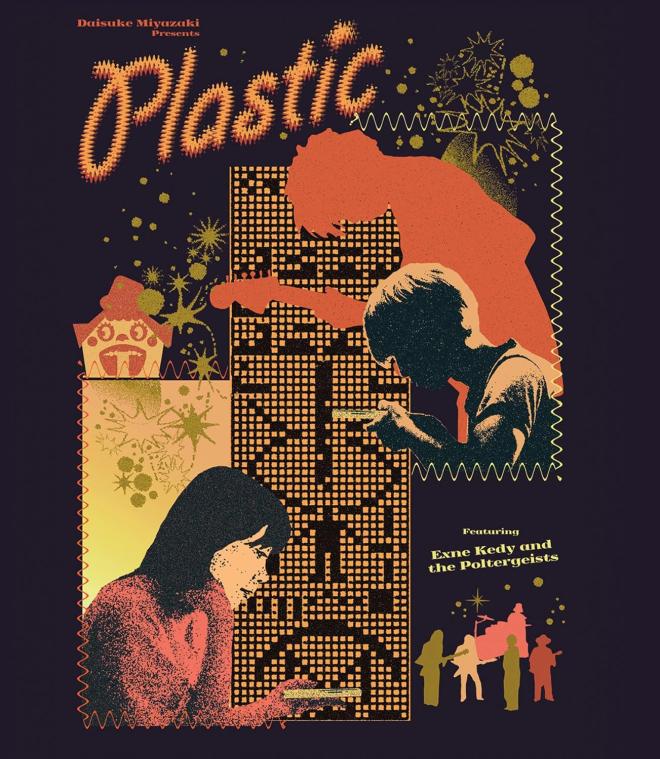
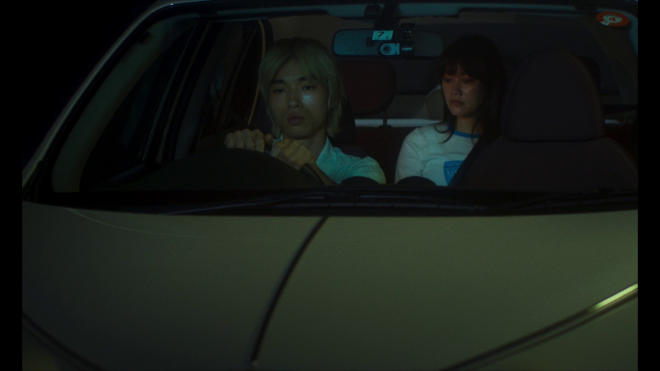
The first of the two movies (and featured on the front cover by default) is Plastic released in 2023. We're first told by a number of older characters about progressive rock artist Exne Kedy and the Poltergeists, who broke up in 1974. This is a fictional band but was actually already the subject of a 2021 album by Kensuke Ide, which he and his bandmates recorded to make it sound like a band and album from that time (inspired in part by David Bowie's "Ziggy Stardust"). The storyline here assumes that Exne Kedy is a real artist, who was popular in the early 70s and still has devoted fans today. Naturally however the younger people aren't as familiar with them.
The main character Ibuki (Ogawa An) is obsessed with them however, listening to their past albums and wishes she could see them perform again. As the movie begins in the year 2018 she is riding her bike singing one of their songs, she sees Jun (Fujie Takuma) outside singing and playing the same song on his guitar. She's amazed that someone else her age has heard of them. Jun has just arrived in town and is about to transfer into the same school as Ibuki, and has aspirations of becoming a rock star himself.
The narrative gets a bit unconventional at the point where the two characters fall in love with each other- instead of lingering on their love for the duration of the movie, it suddenly jumps ahead about a year later when their relationship starts falling apart. They've simply lost interest in each other and have different goals in life, even though they still love the music of Exne Kedy. The narrative continues to jump ahead by a few months- Jun carries on hoping to get a record deal but can only get so far as working in a local record store, while Ibuki finds someone else in her life who in one comical scene doesn't even know about the album she holds in such high regard. Jumping to the year 2020, this may be the first time the COVID epidemic is depicted in a historical context as the characters suddenly have to deal with that.
This isn't the first time a movie has used a fictional music artist as a device that brings characters together, it works well enough here but it seems director Miyazaki considers the sudden forward-jumping of the narrative to be a creative enough solution to filling in holes in the story. Perhaps he didn't have a great reason for the two main characters to eventually break up but felt it as something that needed to happen, so simply skipping over that was a good enough explanation. Not knowing any Japanese myself and relying on the optional English subtitles, I had the feeling that I was missing something in the translation as well.
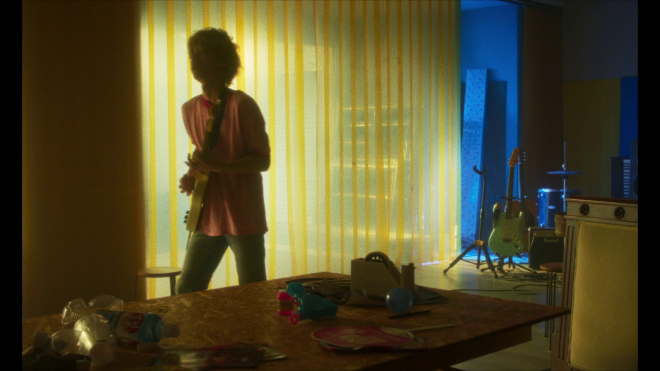
The second feature is Yamato (California) originally released earlier in 2016. The title Yamato refers to a city an hour outside Tokyo whose main asset is a US military base which lies on what is technically US territory within its bordering fences. California is the name of a club in Yamato featuring music performances. Director Miyazaki grew up in Yamato and considered it a rather boring place at the time but has since set a number of his films there. Our main character here is Sakura (Hanae Kan), who shares a small home including a bedroom split with her brother Kenzo. The musical element here is Sakura connecting with rap (one genre of music I've never had much respect for, although a few movies have used it well enough to hold my interest) and wanting to perform herself, making up rhymes in her spare time. She seems to be mostly a loner, often running off to an abandoned motor home to escape from the world. However, she soon connects with Rei (Nina Endo), the daughter of her mother's off-screen boyfriend, who comes from San Francisco to visit.
As with the romantic relationship in Plastic , first the two girls here are inseparable and Rei is invited into the sacred space of the motorhome, but eventually differences come between them and their friendship's future becomes uncertain. Sakura begins hiding away from home to avoid Rei, resulting in a violent attack. The movie still culminates on a high note when she performs in a local music contest.
I considered Yamato the weaker of the two films, despite its longer running time. In contrast to other films about rap which led to me at least having a bit more appreciation for the genre, there aren't a lot of onscreen performances here nor even many on the soundtrack. Of course, as an outsider, it was still interesting to see daily life in a smaller Japanese town which isn't shown as often in more mainstream films. Japan has been influenced by American culture for some time and has a number of familiar businesses there such as fast food restaurants. Again, I felt that I might have been missing something not knowing the native language and relying on the English subtitles to understand what was going on.
Vital Disc Stats: The Blu-Ray
Kani's release is packaged similar to OCN Distribution's other releases, available with an optional limited outer slipcover. The standard release is in a clear Blu-Ray case, with a reversible cover insert. At first glance, Plastic is the main attraction, with Yamato (California) mentioned only on the back cover as a "Bonus Feature." The cover sheet is reversible so if you prefer the second feature, you can display the reverse side facing out showing that as the main attraction with Plastic being the "Bonus Feature". The main menu is split in half with options for both movies presented. Inside the case is a 20-page booklet with photos and notes about Daisuke Miyazaki from Louis-Alexandre Bearegard.
Video Review
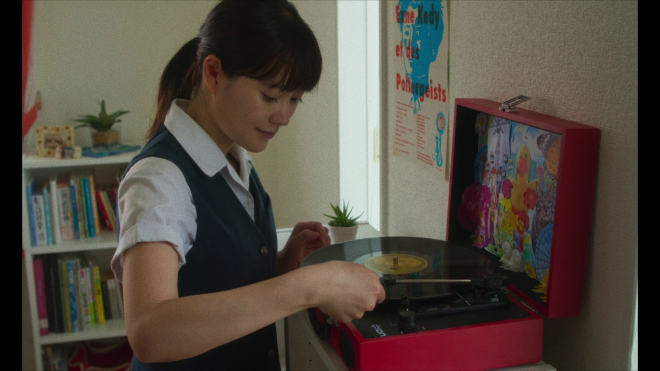
Not many technical notes are included and the credits are solely in Japanese, but to my eyes Plastic appears to have been shot on film or at least processed to look as such. Framed at a 1.66 ratio, there is light film grain throughout. Colors are natural and not oversaturated nor muted. The Blu-Ray disc's encoding appears solid with no noticeable compression artifacts even in dark scenes.
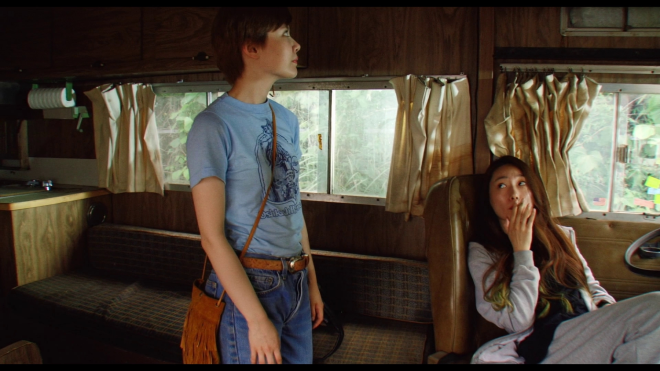
Yamato (California) at least tries to maintain a filmed look (framed at 1.85), but at least on this disc the picture has a slight blocky appearance which cost a few stars in this area's score. At least on a good-sized screen, one can see blockiness along the edges of objects (similar to some of Warner's early high-def transfers but not as obvious as those). Compression artifacts in dark scenes are also noticeable, which may be more inherent in the source material than this disc's encoding. Colors appear strong here, which is likely the film's intended look.
Audio Review
Both films feature 5.1 mixes in DTS-HD Master Audio. The use of the multi-channel format isn't particularly strong aside from moments where music is in the foreground. Dialogue remains centered while some slight ambient sounds are heard in the front left and right channels. The surrounds aren't used much at all, but in Yamato the sound of overhead aircraft is heard from them every now and then, making for a nice surprise once you've forgotten that those existed. (Alternate 2-track mixes are also included, though I can't imagine the 5.1 tracks having any difficulties being downmixed on their own.)
Special Features
Each film includes a video extra with director Daisuke Miyazaki:
- Plastic Tour Q&A (HD, 28 minutes) follows Miyazaki to a screening at the SXSW Film Festival in Sydney, where he answers a few questions from the audience after a screening. This is cut short by an alarm in the building going off, forcing everyone into the front lobby of the theater.
- Interview With Daisuke Miyazaki (HD, 23 minutes) is a more personal conversation held at a restaurant where the director discusses elements of Yamato as well as his past. (He mentions Tower Records as an important part of his discovery of music. That of course began in my hometown of Sacramento CA and no longer exists in the US but continues on in Japan as that section had been sold off.)
Final Thoughts
With this release being primarily for American audiences, their enjoyment of this will likely depend on how much they follow Japanese film in general. As an outsider, I found both of these interesting glimpses into present-day Japan; I also appreciated the musical elements although I didn't feel enough actual music was used prominently enough. As I've noticed with other films I've seen recently in languages I don't understand, it seems I likely missed some elements relying on English subtitles. Worth A Look
-
 Grab The Glasses - The Turbine Collector Series Grows with Three More Blu-Ray 3D Discs!By:
 -
 Closing Out 2024 and Welcoming 2025 - HDD's 4K UHD & Blu-ray Shopping Guide, Week of Dec. 31, 2024By:
 -
 Holiday Greetings - HDD's 4K UHD & Blu-ray Shopping Guide, Weeks of Dec. 17 & Dec. 24, 2024By:
 -
 Santa Comes Early This Year! Turbine Delivering 'Bumblebee' 'Transformers: Rise of the Beasts' & 'Sing 2' to 3D Blu-ray on December 19thBy: