Dogleg
Blu-ray Review by: Bryan Kluger
The nightmare that is making a film is out front and center in this dark comedy, Dogleg, from Al Warren as he tries to make his movie while looking for a lost dog. It's painfully real and hilariously sweet at the same time. The 1080p HD video looks fantastic and the DTS-HD 2.0 audio track sounds good. There are some amazing bonus features to watch as well. Recommended! 

Storyline: Our Reviewer's Take
In Dogleg, writer-director Al Warren presents a fragmented portrait of anxiety, self-sabotage, and existential malaise, wrapped in a series of surreal vignettes that capture the odd rhythms of Los Angeles life. The film follows Alan, a perpetually stressed independent filmmaker whose life unravels after he loses his girlfriend’s beloved dog—a seemingly trivial mishap that snowballs into a crisis of professional and personal proportions. The narrative, such as it is, exists in a loose, episodic structure that forgoes conventional storytelling in favor of exploring mood, character, and the often absurd nature of human folly. The film’s nonlinear, vignette-based format gives it a feeling of creative restlessness, as if Warren, both in front of and behind the camera, were embracing a series of half-formed ideas and exploring the edges of narrative possibility. Many of the scenes feel like abandoned short films—tangents in the director’s mind that never quite cohere into a singular vision, yet somehow contribute to the movie’s overall feeling of disquiet. This dissonance, particularly evident in the film’s latter half, where Alan’s increasingly fragmented perception of reality begins to bleed into the story, provides an intriguing commentary on authenticity, identity, and the tenuous nature of self-awareness in the face of constant distraction.
The central theme of Dogleg is one of alienation—both from others and, perhaps more tellingly, from oneself. Alan, played with remarkable awkwardness by Warren, is a man adrift, unable to connect emotionally, professionally, or even physically to the world around him. His obsession with a lost dog—one that ultimately becomes a symbol of his failure and disintegration—mirrors his inability to nurture any of his relationships or hold onto his own sense of self. As the film drifts from one off-kilter vignette to the next, Alan’s narrative becomes less about resolving the central conflict (the missing dog) and more about the unraveling of his identity and purpose in a city where personal crises are just another noise in the background. The film does not offer easy answers. In fact, Dogleg seems determined to avoid them altogether, favoring an introspective, almost solipsistic approach to its storytelling. While Alan’s self-destructive path is made painfully clear, the film refuses to give him—or its audience—a tidy conclusion or catharsis. This lack of resolution is both the film’s strength and its potential frustration. Dogleg asks viewers to engage with the mood of its fragmented storytelling rather than demand traditional narrative satisfaction, making it a challenging but rewarding experience for those willing to embrace its disorienting world.
It’s in the contrasting vignettes—featuring an array of oddball characters—that Dogleg finds some of its most compelling moments. While Alan dominates the screen, the film’s ensemble offers brief, chaotic glimpses into lives that seem at once insignificant and profoundly vast. One particular vignette, for example, features a bizarre encounter with a swinger couple, a segment that feels jarringly contrived and unnecessarily uncomfortable, but nevertheless underscores the film’s themes of miscommunication, boundarylessness, and the often absurd spectacle of human intimacy. In these moments, Dogleg slyly critiques Alan’s myopic self-pity, drawing attention to the messiness and complexity of other people’s lives, which are as vast and full of meaning as his own, despite his inability to perceive them as such. Not all of the vignettes land with equal force. Some feel underdeveloped, little more than whimsically absurd diversions that contribute little to the film’s thematic cohesion. The swinger scene, in particular, risks undermining the otherwise delicate balance of humor and discomfort that Dogleg so carefully cultivates. Yet, even in these weaker moments, Warren’s direction and the performances shine. There’s a scrappy, DIY charm to the film that underscores its rough edges—its low-budget aesthetic and fractured structure—making it clear that the narrative’s disintegration is as much a stylistic choice as a thematic one.
Warren’s performance as Alan is the beating heart of the film. He delivers a deeply funny and often cringingly relatable portrayal of a man who is both painfully aware of his own shortcomings and tragically incapable of doing anything about them. His awkwardness, paranoia, and slow-burning panic infuse the film with a nervous energy that makes Alan’s every attempt to salvage his life both tragic and absurd. The character’s Kafkaesque suffering, while often humorous, carries an existential weight, turning what could have been a simple story of a lost dog into a meditation on the disconnection that permeates modern existence. As the film closes, leaving more questions than answers, audiences are likely to feel the weight of its oppressive atmosphere. The exhaustion that builds over the course of the 85-minute runtime is not merely a result of watching a beleaguered protagonist flounder through one anxiety-inducing situation after another, but rather the sense of immersion into a world that refuses to offer easy relief. Warren has crafted a film that is at once a comedy and a philosophical inquiry, where the humor arises not from the resolution of Alan’s dilemmas, but from the absurdity of those dilemmas themselves. Dogleg is a film that actively resists easy categorization or interpretation, and in doing so, it asks its viewers to engage with the emotions and sensations of its characters without the crutch of tidy conclusions. In an age of overly polished narratives and neatly packaged films, this kind of messy, authentic filmmaking feels like a necessary disruption—a portrait of a life that is simultaneously both entirely ordinary and quietly profound.
Vital Disc Stats: The Blu-ray
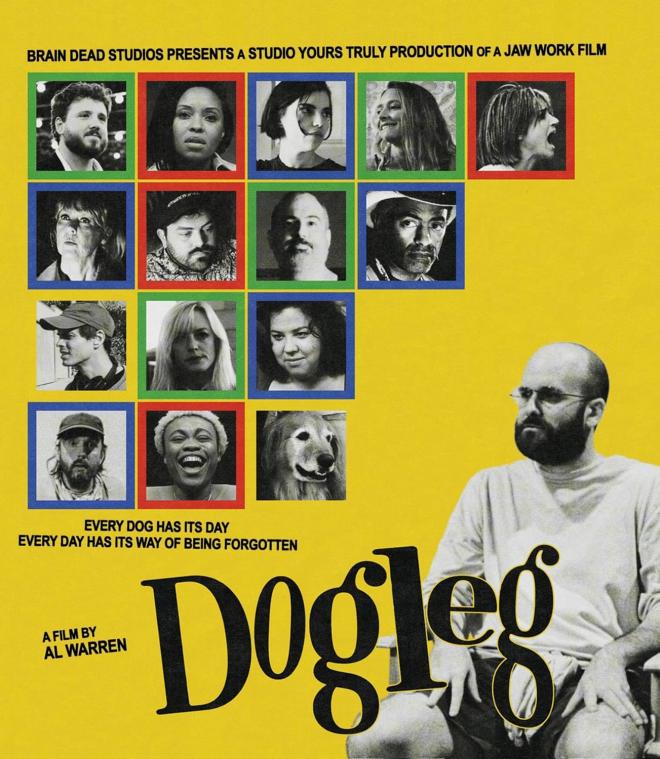
Dogleg shoots its way to Blu-ray via Memory and OCN Distribution. The sole disc is housed inside a hard, clear plastic case. There is a 30-page booklet about the film inside. The double-sided artwork features a couple of fun images. One is of the original movie poster Al Warren looking at a group of images who are the characters in the film. The reverse side is an image of the desert landscape.
Video Review
Dogleg makes a wonderful Blu-ray debut with a stunning 1080p presentation that captures the film's unique visual style. The image boasts a filmic quality, with a vibrant natural color palette that richly saturates the screen. The expanses of nature are especially captivating, showcasing a range of complex hues that are a joy to behold. The presentation also emphasizes the depth of the city’s diverse Los Angeles locations, offering plenty of texture, particularly in the production design and clothing. While black levels occasionally show mild banding in the darkest scenes, they generally retain strong depth and detail. Skin tones are natural, with close-ups revealing excellent detail in facial hair and makeup.
Audio Review
This release features a superb DTS-HD 2.0 Master Audio track that captures the film's sonic nuances with precision. Dialogue is consistently clear and crisp, never overwhelmed by competing sounds. As the characters navigate the urban landscape, distinct ambient details enrich the setting, adding depth to the environment. While the film doesn't require aggressive low-end action, key moments introduce subtle texture to the sound. Environmental sounds are expertly balanced, satisfyingly engaging the speakers, creating a rich, three-dimensional experience. The music is well-integrated and maintains excellent fidelity, further enhancing the immersive atmosphere.
Special Features
There are about 107 minutes worth of bonus features included here. There are three new short films, some behind-the-scenes, test footage, and more. There aren't any standard interviews, however, the production process is outlined.
- Three Short Films
- Home Clips
- Cigarette Girl
- Afterparty Visuals
- GMA Apology
- Feng
- Cellular Memory
- 30-Page Booklet
Dogleg is a must-see nightmare for any aspiring filmmaker out there who is trying to get a movie made. The nightmare becomes a dream of course of wonderous proportions, however, this dark comedy tackles some creative obstacles that many will relate to. The 1080p HD video presentation looks great and the DTS-HD 2.0 audio track does the job well. There are some fun and interesting bonus features to watch as well. Recommended!
-
 Grab The Glasses - The Turbine Collector Series Grows with Three More Blu-Ray 3D Discs!By:
 -
 Closing Out 2024 and Welcoming 2025 - HDD's 4K UHD & Blu-ray Shopping Guide, Week of Dec. 31, 2024By:
 -
 Holiday Greetings - HDD's 4K UHD & Blu-ray Shopping Guide, Weeks of Dec. 17 & Dec. 24, 2024By:
 -
 Santa Comes Early This Year! Turbine Delivering 'Bumblebee' 'Transformers: Rise of the Beasts' & 'Sing 2' to 3D Blu-ray on December 19thBy: