| BLU-RAY NEWS TAGGED "WARNER HOME VIDEO" | Receive Blu-ray News via RSS |
HDD Attends a Virtual Roundtable with Andy Parsons (BDA), Jeffery Baker (Warner Home Video), and Ned Price (Warner Technical Operations)
Thu Aug 02, 2012 at 04:35 PM ETTags: Warner Home Video, Warner Brothers, Film Preservation, Film Restoration, Aaron Peck (all tags)
Last time the Blu-ray Disc Association (BDA) had a virtual roundtable, we discussed a wealth of information about Disney and their commitment to the Blu-ray format. This time around Warner Brothers is in the hot seat.
The people present for this virtual roundtable were Andy Parsons of the BDA, Jeffery Baker of Warner Home Video, and Ned Price who is in charge of Warner Bros. Technical Operations. As soon as the roundtable was ready and all the journalists had joined in, the questions came fast and furious.
As always the Q&A session is definitely the most informative part of these Q&As so we'll get right to it. Below are the questions that were asked during the session. Personally, I was impressed with the amount of information given about the restoration process and particularly how expensive it is to convert a 2D movie to 3D. Although, their explanation on the restoration behind 'Singin' in the Rain' could have been expounded on, a lot.
[Note: The text has been cleaned up for grammar and spelling errors from a live chat environment.]
Q: Jeff, does WB hold rights to the new restoration/reconstruction of an extended version of 'Once Upon a Time in America'?
Jeffrey Baker: We do have the rights, a release date has not yet been determined.
Q: How does 4k play a role in this effort and how will it fit on an expected 4k Blu-ray?
Andy Parsons: We think that Blu-ray would be suitable for 4K content because of its high capacity and data throughput (particularly in comparison to streaming), and the BDA continues to explore new technologies, though at this time, no 4K development activities are taking place within the BDA.
Q: Ned, could you please talk about new techniques that WB has been experimenting with to extract images from older films with damaged elements like 'Red Dust', 'Test Pilot', 'A Guy Named Joe'?
Ned Price: One of our largest challenges is creating algorithms to correct density fluctuations from photo chemical processing of the films, density pulsation also occurs in color film as a result of dye fading, we lose density in the negative as well as color layer. The emulsion layers of a color negative deteriorate unevenly which creates color pulsation as well as density flicker.
Q: Jeff, I know WB has been looking at 2D tests for 'The Wizard of Oz' for years. Are you encouraged this will be going forward in the near future?
Jeffrey Baker: We are testing many films while watching consumer interest and demand from theatrical exhibition to the home on 3D, conversion costs from 2D to 3D are quite high ($4M to $6M), until they come down further it will continue to be a deterrent in our converting library films to 3D.
Q: I would love to hear a little about the amazing restoration work that went into bringing 'Singin' in the Rain' to Blu-ray.
Jeffrey Baker: We performed a 4K scan and took advantage of current state of the art color correction tools, we also enhanced the audio quite a bit.
Q: It's been a long time since we've heard anything regarding Blu-ray and managed copy. Can you offer any update on the feature?
Andy Parsons: We are hearing that AACS, the entity that is responsible for implementing managed copy, should be launching the capability soon. In the meantime, a great aspect of Blu-ray is that many titles are being offered in combo packs that include a DVD and "digital extensions" such as Digital Copy and Ultraviolet that allow us to extend our home theater experience to other locations like an airplane seat or hotel room or anyplace we want to watch movies.
Q: When looking at the enhanced content aspect of your releases, what do you generally look for? Do you use outside archival sources or is it primarily internal as in the case with the 'Ben Hur'?
Jeffrey Baker: We first look internally to mine assets, however, in the case of 'Ben Hur' and other films we have gone to third parties to help us source and or develop assets.
Q: Are there any plans to start releasing Warner Archive titles on Blu-ray? And is there ever a time when you released a film on Blu-ray that may not have had the monetary stats to back up its release because Warner felt it was important? Is financial feasibility more important to a release than the film's impact on film history?
Jeffrey Baker: We are not yet ready to convert archive titles to BD, we are hopeful that more economically viable tools in the near future will make this possible. Yes, I have green-lit numerous conversions to BD that did not meet short term financial thresholds, and we will continue to. We believe that the long term growth in BD will provide adequate ROI in the future.
Q: Can you please tell me why some movies like 'Blade Runner' are given multiple releases while other classics fail to get one?
Jeffrey Baker: Sometimes it's based on consumer inquiries and demand, other times it's based on finding new materials. In the case of 'The Exorcist', we released it on BD in 2010 (37 years old), we have plans although it has not been announced, to re-release 'The Exorcist' in 2013 with new extra content, I cannot disclose what it is, but it's rich!
Q: To what extent is your selection of library titles to preserve/restore is filmmaker-driven (as for example the recent efforts with 'End of the Road' which were spearheaded by Steven Soderbergh?
Ned Price: We approach library preservation from two angles; preservation work is primarily motivated and funded on behalf of the corporation, title selection in based on physical condition of materials rather than the current popularity of a title. The corporate preservation efforts are not motivated by sales, however the results of our corporate preservation efforts are made available for sales division use. Sales driven requests often initiate preservation as well as restoration use as was the case for 'End of the Road'. We often have film makers championing film which have influenced their work so that it's made available to the next generation of developing film makers.
Q: I'm interested a bit more in what happens when a film is chosen for restoration and box set/special edition treatment such as 'Ben Hur' and a more bargain treatment that could hit the budget pricing category mentioned. Might the budget film not get a full restoration at, I think I heard 8K mentioned.
Jeffrey Baker: Correct, we will render a less robust conversion on a budget priced BD release; however, to be clear the quality is still quite good and exceeds DVD.
Q: Would you elaborate on your 3D strategy? Including restoration/remastering of classic titles made in 3D (i.e. 'Dial M for Murder') or 2D titles that might be converted to 3D (i.e. 'The Matrix'), as well as new 3D releases. Roughly how many 3D BD titles do you expect to release in say the next 2 years?
Jeffrey Baker: More than one, less than 10!
Q: How would you define the difference between preservation and restoration when it comes to Blu-ray? Is there one?
Jeffrey Baker: It's 10 times more expensive to restore vs. preserve.
Q: Jeff, will the next Blu-ray edition of 'A Star is Born' (1954) include the cut theatrical release version? A lot of us find the black-and-white stills in Ron Haver's restoration takes us "out of the movie" and we'd like to have this option.
Jeffrey Baker: Not sure, however, I can tell you that the 1976 version of the film will be coming out on BD in the next 12 months.
Q: What would you say to the argument that BD is simply another phase in the format world and soon we won’t have the need for physical items as everything will be avail via “cloud” tech?
Andy Parsons: We think that Blu-ray and online distribution serve different needs, with Blu-ray offering the best possible HD picture and sound due to its very high capacity and bandwidth -- it has roughly ten times the data transfer rate as the average U.S. broadband connection. This makes it ideal for big screen home theater viewing. Streaming, on the other hand, is great for casual viewing of content on smaller screens or handheld devices such as tablets or smartphones. Also, since content tends to come and go from streaming services, your copy of a Blu-ray title will always be available to you. We believe Blu-ray sits, and will continue to sit, at the center of home entertainment for quite some time Digital extensions such as digital copy or Ultraviolet enable Blu-ray collectors to extend their content library to their mobile devices. And, a connected Blu-ray player not only plays CDs, DVDs, BDs, 3DBD's and BD Recordable, but also serves as a gateway to streamed content. It's not really a zero sum game -- physical media and online distribution can and will coexist for many years to come.
Q: I know the Blu-ray format keeps adding new features. Can you tell us what we can expect in the future?
Andy Parsons: We are always keeping an eye on new developments in theatrical and home entertainment, but for the moment, we are focusing on continuing to encourage adoption of the Blu-ray format we know and love to the widest possible audience around the world. Adding new capabilities is not something we do lightly, as we need to keep the millions of existing Blu-ray players in mind. It's important to maintain backward compatibility as much as we possibly can.
Q: Which movie presented the most difficulty to restore for you and your team?
Ned Price: The two most challenging, but ultimately most satisfying restorations were 'North by Northwest' and 'Ben-Hur' due to characteristics of the original camera negative stock and physical condition. Color fading was the most difficult hurdle; both features were shot on early single strip camera negative which was poor at capturing color and had poor dye retention, meaning that color faded very quickly. The negatives also sustained physical damage due to the popularity of the titles and multiple theatrical re-issues.
Q: It is my understanding that the original negatives for 'Singin' in the Rain' were lost in a fire. How did you go about putting this film together again and with such high quality for Blu-ray?
Ned Price: The studios maintain master positive protection elements on all titles, we scanned 35mm 3-strip nitrate master positives for 'Singin' in the Rain' which were manufactured by MGM at Technicolor in 1952. To their credit, Technicolor materials were extremely well made and the transition from protection masters to original camera negative. The original negative for the last reel which includes the "Broadway Melody" sequence, still survives. We did use a small amount of grain reduction on the optical sections from positive masters due to the heavy grain content due to generation loss.
Q: Is there such thing as “too sharp” within the era of Blu-ray and restoration? How do you maintain the classic look within a technologically advanced format?
Ned Price: There is no such thing as "too sharp" unless you are artificially enhancing the image. We never "dumb down" an image in order to make it look more like a theatrical release print as our goal is to mine the entire image inherent in the original photography. I've never encountered a film that did not hold up to scrutiny of high resolution, the craftspeople always exceeded the limitation of the capture medium, we do encounter the occasional wig line, but we find that the "fix" (hand painting) is typically worse than the problem.
Q: Would you discuss any special challenges involved in restoring/remastering a 3D title such as 'Dial M for Murder'?
Ned Price: The 3D titles produced in the 1950's have unique problems, the single strip titles are faded differentially, meaning that the left eye negative has faded differently than the right eye negative, so making them match seamlessly is quite challenging. On the positive side, the 3D camera work from the 50's is impeccable, so there was no need to manipulate the 3D design for the home market.
Q: In a time when 35mm is slowly disappearing from exhibition, yet needs to be utilized to create these beautiful BR editions, is there any kind of thought on future restoration work down the line when we have no primary sources to go by?
Ned Price: The current preservation medium for the studio is still 35mm film, we do archive the original digital production files, but until there is a long term, industry accepted digital archive solution, we will continue with creation of film materials.
Q: What is your general policy on grain reduction?
Ned Price: I've always been conservative when it comes to image processing for three reasons, the first being that grain reduction tools start to add artifacts before they effectively reduce grain. Secondly, I feel that grain carries image information and texture, similar to a noise floor in audio which in a way, help continuity of the shots. Also, I'm a great fan of the color information carried by the grain.
That's it for the Q&A. Let us know what you thought about it in the forums by clicking on the link below. There's a lot of stuff to take in, so please continue the discussion in the forums.
See what people are saying about this story in our forums area, or check out other recent discussions.
Off To See The Wizards: HDD Gets An In Depth Look at the Restoration of 'The Wizard of Oz' (UPDATED - Before and After Pics!)
Fri Sep 11, 2009 at 02:45 PM ETTags: Michael S. Palmer, Film Restoration, Warner Home Video, MGM (all tags)
by Michael S. Palmer
High-Def Digest gets an inside peek at the restoration of a truly classic film: 'The Wizard of Oz'
If you join us at High-Def Digest with any frequency, it's likely your passion for all things HD is surgically linked with a love for the cinema. In my case, that meant a childhood of watching the same films over and over (and over). Along with 'E.T.' and 'Back to the Future,' 'The Wizard of Oz' became not only entertainment, but part of a comforting routine. There was singing and dancing, it changed from black & white into color , and it somehow managed to be both laugh out loud funny, and absolutely terrifying. It’s the perfect nutrition pyramid for the imagination.
Now, (skipping past a few boring years) color me thrilled to have moved to Culver City, California, and found work on the Sony Studios lot, which for anyone not in the know, used to be the backlot for a little company called MGM. There, answering phones in an office that was a converted soundstage, I learned that in the fall of 1938, this very space had been used to film portions of 'The Wizard of Oz' itself. It was fascinating to work in such a historic building; at the very top of the stairwell, there were crew signatures and dates from the 1930s scribbled onto steal beams. Add to this, just down the street, a skinny brick structure called the Culver Hotel, where all 124 of the Oz Munchkins lived during production.
So with all that history, it didn’t take me even a second to RSVP for a Restoration Tour the kind folks over at Warner Home Video (Warner Home Video holds the home entertainment rights thanks to Ted Turner’s acquisition of the MGM film library in 1986) were hosting for the 70th Anniversary of The Wizard of Oz, slated to hit Blu-ray and DVD on September 29. This release being the climax to a year long Oz celebration lead by the Wizard’s balloon traveling across the world, 5 of the original Munchkins performing in New York’s Central Park, and an auction of the Ruby Slipper Collection to benefit the Elizabeth Glaser Pediatric AIDS Foundation.
Here is the simple, honest truth of what I saw, which was a collection of HD clips not projected, but displayed on a large LCD television anyone of us could buy: if you have a Blu-ray player, this will be a reference disc. And if you already love 'The Wizard of Oz' RUN to the store when this Blu-ray comes out.
![]() |
I know what some of you may be thinking (Studio plant!). This is just another Anniversary Edition of a movie that’s been on home video again and again and again. Friends, of course the end goal is to monetize a product, but this 'Wizard of Oz' reissue is so much more than that. In 2005, for the last DVD release of the movie, WHV commissioned a restoration, from which a 1080p HD master was made. A master that was technically ‘good enough’ for Blu-ray. They could have been done, saved a great deal of time and money, and made a quick buck, but to this passionate crew of artisans, technicians, and businessmen, ‘good enough’ simply would not do.
Because they’re not only releasing and selling a movie, they’re protecting an American national treasure, perhaps the most widely seen film in history. Preserving a classic for this, and future generations to enjoy. Flat out, you have never seen Oz in such stunning clarity before: Makeup on the actors’ faces. Delineation in Toto’s hair. Individual bricks on the yellow brick road. 3D-like flowers in Munchkinland, a quality high def is known for mostly on recent titles like 'The Dark Knight'. And even tiny surprises in production design, such as the Wicked Witch’s crystal ball being held up by tiny, carved, winged-monkeys.
![]() |
So, how did the Wizards of Ours (as WHV liked to call their in-house team) manage to pull this off?
Well take a seat and bear with me for a little geektastic math. The restoration and re-mastering began by scanning the three original 1939 Technicolor negatives at an unbelievable “8K” resolution (keep in mind, many modern films such as Warners’ own Ocean’s 13 are finished in “2K”). To put that in perspective, when I take a photograph with my digital camera (at a 10.1 megapixel resolution), the file size is usually 3 to 4 megabytes. One still image at 8K is 40 megabytes, and for each frame of this film, WHV end up with 4 40-megabyte files (one for each of the three negative scans because of the “three strip” Technicolor process, and one final composite of all three negatives which was matched to the pixel). So for every frame, WHV has 160 megabytes, times 24 frames per second, times 60 seconds per minute, times a 101 minute running time. Meaning, to store the Oz materials, they needed over 22 terabytes, or 22,000 gigabytes. How much room do you have on your computer?
![]() |
Okay, math lesson’s over, and some of you may be utterly befuddled by all the K’s and bytes. Don’t fret. What WHV is attempting to do, in scanning their catalogue film in the highest available digital resolution is attempting to equal the image quality of film, which has millions of grains. And the crazy part is that they aren’t done. This film still has more information to glean from it.
But what can all this resolution mean for the home viewer? Don’t Blu-rays max out at a much lower resolution? Of course they do, but what you’re getting is unparalleled video quality. For all the complaints our High-Def Digest reviewers have had about edge enhancement and digital noise reduction, in 'The Wizard of Oz' you will find none. Because as the resolution of the digital scan increases, the film grain is actually sharper, so there was no need to enhance the image, or reduce noise, which also diminishes ‘artifacting’ in the compression process (the act of reducing a digital file size to fit a space, in our case, a Blu-ray disc).
![]() |
In fact, here’s what they did to bring out the best in Oz: They repaired three tears in a near-pristine 70-year-old film negative, removed three production wires, and did a color correction. That’s it.
The color correction, by Janet Wilson who has done the last three restorations of 'The Wizard of Oz,' is based on a 1939 answer print WHV borrowed from The Academy (of Motion Pictures Arts and Sciences) to achieve the most authentic color palette. What Ms. Wilson found is that the newer DI technology allowed her to improve upon the work she did in 2005 (she spoke of the challenge of isolating color around the primitive visual effect of the Good Witch of the North, Glinda, in her bubble). And since the original Kansas sections of the film were projected in sepia, not black & white, they found a piece of film from the era to match for color, as they did not have an Oz sepia print.
As for the wires, purists may argue it sacrilege (think of what Lucas and Spielberg have done to their classics), but the goal at WHV was to preserve filmmaker-intent. After endless discussions and research, the team decided that these specific wires (others have been left in) disrupted the narrative, and were invisible (as intended) in all other releases (including film). Only at this increased definition was there a visible flaw.
![]() |
For the audiophiles among us, what you’ll be enjoying on this Blu-ray is the full dynamic range of lossless 5.1 Dolby TrueHD. Keep in mind that this is actually the same mix used for the 2005 DVD, but that was compressed in AC-3. Again, for the purists who prefer mono tracks of classics, be aware that the only reason Oz was ever mixed into a stereo was because they had ‘angles’ from the Orchestration recordings. This isn’t about cheap panning effects.
Personally, it was a great tour, the clips I witnessed were fantastically vibrant, and I can’t wait to see the whole film again (and again). For those who can’t wait for the 29th, check your local listings on September 23rd for special one-night-only digital screenings of 'The Wizard of Oz.' And this has only whet my appetite for future masterly restored catalogue titles, an area of Blu-ray that has been underserved. WHV hopes Oz will help jumpstart a trend. As for the catalogue future of WHV, here’s looking forward to Oz, as well as the impending fall releases of 'Gone With the Wind' (11/7) and my one of my favorites, 'North by Northwest' (11/3).
See what people are saying about this story in our forums area, or check out other recent discussions.
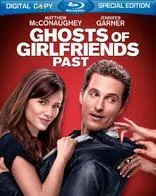
'Ghosts of Girlfriends Past' Blu-ray Detailed
Fri Aug 21, 2009 at 02:00 PM ETTags: Disc Announcements, Warner Home Video (all tags)
As previously reported, Warner Home Video will release 'Ghosts of Girlfriends Past' starring Matthew McConaughey and Jennifer Garner on Blu-ray this September 22.
The disc will feature 1080p/VC-1, a Dolby TrueHD 5.1 soundtrack, and supplements will include Recreating The Past, Imagining The Future - Take a look at the past, present and future eras in the film to see how the memorable dialogue, styles and trends all come together to deliver the story; It’s All About Connor - Actresses Jennifer Garner, Lacey Chabert and Anne Archer reveal the differences between the real guy, Matthew McConaughey, and this cynical, commitment-phobic character, Conner Mead; The Legends, The Lessons And The Ladies - Matthew McConaughey and Michael Douglas take a fun and light-hearted look at what it takes to play the character of a legendary ladies man and the many lessons learned; Additional Scenes, and a BD-Live Exclusive: A Sea Of Women - Exclusive footage of the infamous Infiniti room filled hundreds of women as well as a digital copy.
Suggested list price for the Blu-ray has been set at $35.99.
You can find the latest specs for 'Ghosts of Girlfriends Past' linked from our Blu-ray Release Schedule, where it's indexed under September 22.
See what people are saying about this story in our forums area, or check out other recent discussions.
- Discs mentioned in this article: (Click for specs and reviews)
- Ghosts of Girlfriends Past (Blu-ray)
'Watchmen' Blu-ray Gets Steelbook Treatment in Canada
Fri Jun 19, 2009 at 01:00 PM ETTags: Disc Announcements , Warner Home Video (all tags)
There's yet another 'Watchmen' Blu-ray exclusive crawling out of the woodwork... this time for our friends up north.
An exclusive steelbook edition of Zack Snyder's 'Watchmen' is currently up for pre-order at Future Shop in Canada.
The steelbook packaging also looks pretty slick:
Currently the release is selling for $37.99CAD and includes a free Watchmen journal. Unfortunately, they don't ship outside of Canada.
You can find the latest specs for 'Watchmen' linked from our Blu-ray Release Schedule, where it's indexed under July 21.
See what people are saying about this story in our forums area, or check out other recent discussions.
- Discs mentioned in this article: (Click for specs and reviews)
- Watchmen: Director's Cut (Blu-ray)