BLU-RAY NEWS TAGGED "TOM LANDY"Receive Blu-ray News via RSS

Sickbay to Security: HDD Attends 2012 Calgary Expo Q&A with Star Trek's Gates McFadden and Denise Crosby

Thu May 24, 2012 at 05:05 PM ET
Tags: Fun Stuff, Star Trek, Tom Landy (all tags)

By Tom Landy

As this year marks the 25th anniversary of 'Star Trek: The Next Generation' (expect the complete first season to debut on Blu-ray on July 24th), the bridge crew from the TV show have even joined in on the celebration. On the last weekend of this past April, all nine principal cast members beamed down to the annual Calgary Comic and Entertainment Expo held in Alberta, Canada.

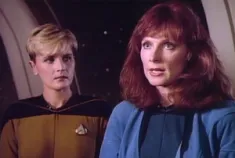
The first 'Star Trek' panel High-Def Digest was able to attend during the Expo was with Gates McFadden and Denise Crosby -- the U.S.S. Enterprise-D's Dr. Beverly Crusher and Security Chief Lt. Tasha Yar. Since 'Star Trek: The Next Generation,' both actresses have starred in several films and TV shows, and they continue to work together on stage in Gates' L.A. theatre company.

Below you'll find a transcript of the panel that I attended which was moderated by Teddy Wilson -- one of the hosts of "Innerspace" on Space (Canada's sci-fi network).

---------------------------------------------------

TW: Please welcome Denise Crosby and Gates McFadden!

(Applause)

TW: Here are some microphones for you. There you are. Ladies how are you?

DC: Dandy.

GM: Jim Dandy!

DC: Wow this is like being a rock star here.

GM: So were these seats up in front too expensive?

(Laughter)

GM: Oh! There are people sitting there!

(Laughter)

TW: (Inaudible) ... a lot of TNG cast members see each other from time to time, but you two especially since you work together in theatre in L.A.. So is it a bit strange to do that and then to come here and be with each other in this different context?

DC: No.

GM: No.

DC: Theatre is really normal.

GM: Theatre is very normal.

DC: I mean, not that this isn't normal, believe me, but I mean it's very much a part of who we are as actors and what we like to do as artists and it was just this unique, rare opportunity. I don't know anybody else who's had the chance to do a kind of iconic television show and then years later do... you know.

GM: I remember...

DC: She's my boss! She's the artistic director of the theatre company that I, you know, get to belong to and work in.

GM: It's been really fun. You should Google our company 'cause actually we'd love to hear feedback from you and you can always e-mail us and everything, EST-LA Ensemble Studio Theatre Los Angeles and we just built -- there's another sister company in New York City and I'm a member of that and some of us migrate back to L.A. for television shows, and so we built, we started...

DC: we built a new space.

GM: The company's been going for about 15 years (inaudible) so we just did our first year of (inaudible) this past year and won lots of awards and Denise, I directed Denise in a play and she was AMAZING!

DC: Thank you.

(Cheering)

DC: And Gates was an amazing director. I truly -- I was just thinking about this last night, you know, I really want to say this and I want to say this in front of everyone, that you really brought us as actors into finding our own (inaudible). A very extraordinary original play we did about JonBenét Ramsey and, I don't know if you guys, I'm sure you know of her as well. She was a young beauty queen in Colorado in America and was found murdered in her own home and they never discovered who did it. So it was an extraordinary look…

GM: Denise wore one of my wigs. Seriously. She played--

DC: I played the mom. And boy did I use that wig that Gates happened to have lying around by the way. But anyway, you were just an extraordinary director and I really regret that I didn't get to be on the next (inaudible) that you were directing because that would've been extraordinary.

GM: Actually, I think that was my favorite time in the whole seven years was directing that episode. Genesis, yeah. I know it wasn't the classic Star Trek episode, but I mean seriously, I got to direct an iguana and a Spot really...

(Laughter)

GM: And it was kind of a cool, like creepy fun show. I don't know, the makeup was extraordinary what Michael Weston did. He really should have won an Emmy for that.

TW: Which is harder to direct: a cat or an iguana? Or Denise Crosby?

DC: Or me? With a wig on.

GM: No, no. I don't want to hurt her feelings. The iguana -- I just felt I had trouble reaching the iguana.

(Laughter)

GM: I thought he was very, you know, I was just like okay fine, just do it your way.

(Laughter)

GM: But with Spot, Spot I could definitely, you know we did a little. Whatever. And he always helps. Always helps..

TW: Okay we're going to ask the floor for some questions and the way it's going to work is there are a number of intrepid mic runners running around. Give it up for the mic runner volunteers.

(Cheering)

TW: So if you want to put up your hand just put it up and they will find you with the microphone. So don't be shy and feel free to toss in a question.

Q: I want to ask, you've probably got a fun answer to this, and I want to ask you as well Denise, you've both gone on to do amazing work. Was there one thing that you took with you that you learned in your roles on 'Star Trek: The Next Generation' that you really carried with you as an actor?

DC: Never wear spandex!

(Laughter)

GM: And I actually really learned how to handle that spaceship. So that's helped me in a lot of things I've done since then.

(Laughter)

GM: No I actually had someone, seriously, who said where do they park the spaceship when they aren't using it?

(Laughter)

GM: And I said, oh no, it's pretend. Well I know it is, but where is the ship part when they aren't using it? Like okay...

(Laughter)

TW: I'm sorry I just never thought about it before that's why I asked you.

DC: At Paramount!

TW: Okay so we got a question on the floor and it's mic #4. And it's to the right -- Joseph. Can you give us a big wave so we can see you there? Where are you Joseph? Oh there! Hey Joseph!

GM: Hi Joseph.

DC: Hi Joseph.

Q: Denise the question is for you, was, was, was your death... planned on the show?

DC: I'm sorry, what? Was it planned my death?

Q: Yeah, when your character diiiiied.

(Laughter)

DC: Wow (laughing) yes it usually is! When someone dies it's planned. Once it was decided--

GM: They just decided to kill her that day.

DC: Right. You know, I'm going to break it to you. I would not sleep with Gene Roddenberry so...

(Laughter)

DC: You guys are the first to hear it and I've been sitting on it for 25 years and it's finally come out.

TW: Well that explains why Gates was not killed off.

(Laughter)

DC: I'm not touching that.

GM: You gotta do what you gotta do. Thanks for bringing it up.

DC: (Inaudible) for women, OK? You do what you got to do. No, once it was agreed upon that I was leaving the show Gene Roddenberry had the idea that he wanted to kill this character. Not to punish me, per se, but to make it so radical and dramatic as no regular character had ever been killed. But, I wasn't really killed... as we saw. I mean, I'm still here now, right?

(Laughter)

TW: What was it like to come back in the Yesterday's Enterprise episode when you came back in that alternate timeline?

DC: You know, first of all that episode, for me, was my favorite episode that I did. But also (inaudible) it was a complete a surprise and was so well written and I just had so much fun. And I never thought that would ever happen. And so it just opened the door for the character Sela, and so you know, I just got to keep on being a part of it in a way that I had never anticipated and in a way that made a lot of sense for me.

TW: What did you think when you read the script for Skin of Evil -- the episode where Tasha Yar dies?

GM: I thought it was about time.

(Laughter)

GM: No, I thought but I can SAVE her! Just give me a chance! I can save her! I brought someone else back, some other creature from some planet, but they just didn't let me use that vial. Remember all those vials I had in sickbay? There were very interesting things in those vials. But you know.

DC: A true alchemist.

GM: It was actually a memorable night because we were all there, we stayed really late so we could all, you know, (inaudible) by the camera, like our scenes had already been shot and she was there looking at us and it was nice. It was nice. But you know what was really interesting, and we talked about this, we didn't know each other very much at all on the show because it really wasn't written for women to have scenes together and we were kind of like something else, and it was the guys, we had scenes with the guys or my son, and so I didn't really know Denise and we got to know each other later. And then she became a member of the company and both worked together. It's been a blast. And we were like, why didn't we get scenes together? You know? It was interesting. And now we're really close friends. But then, you know, we didn't have any scenes together.

DC: Then I was dead.

(Laughter)

DC: She tried to save me. She did her best.

(Laughter)

TW: We've got another question on the floor, mic #5 on the left, it's Sherry. Hey Sherry!

Q: Hello. I was just wondering if there was a certain genre that you guys like to act? Do you still do drama or do you like to do comedy, or what do you really enjoy doing now in theatre?

GM: In theatre? Specifically in theatre?

DC: Or anything? Wow. You know, to me it's about the writing. And what is provocative writing and what I can bring to this that excites me and I'm excited about and can transfer to the audience. And so if it's comedy it doesn't matter.

GM: And I echo that. I think a lot of the work that we've done -- Carol Churchill -- a play in New York, a lot of different things actually, even Taking Care of Business, I like it when it's mixed, when there's some comedy and there's drama. I don't think they have to be separate. I also do happen to really love stupid comedy -- I love slapstick. And so I like to do all that kind of stuff.

DC: Yeah, I mean, that's so true with Gates. I mean she has a clown background so, you know, what was wonderful about the play we did together, this specific one, was finding the humor in absurd dark moments. I mean, I loved when that would happen and we were able to find some very uncomfortably weird comic moments in some very dark material.

GM: And yeah, and we got to do things, dark things, and there'd be this funny little car that would actually drive on stage and there was lots of multimedia and I worked with an animator from Seattle named Drew Christie -- he's totally brilliant you should check out his animation he's a brilliant guy, and we had animation because it was a very dark subject matter and I wanted people, it wasn't to be so much of the story of Patsy -- I mean JonBenét Ramsey, it was more looking at the way parents exploit their children in these child pageants. It was also about bullying, there was another character who was bullied by these gorgeous looking men called the Apollonian Boys, and everyone just always looked at how beautiful they were and all the athletics they did so they never saw how they were also bullies. So anyway, it's things like that, it's subjects that matter that really gets me. And I love it when it's -- that's what I love about Star Trek. Star Trek was the same thing. We're in a morality tale and deal with things that really make you think. Like what would I do in that situation? What if there wasn't money anymore? What if? What if? And that's what gets people to think. And it's a good thing, I think.

(Applause)

TW: Uh, mic #2, right there. Yes?

Q: Hello Beverly and Lieutenant Yar...

(Laughter)

Q: I was just wondering in the period you and the other actors were in Hollywood did you have trouble sometimes finding other jobs because people thought they would identify you with your characters on Star Trek? And also what does it take to get into your theatre company? Do you do lessons and stuff for actors?

GM: The theatre company you have to kind of be (inaudible) by us. You have to participate we have to see, know your work. I would say it's a very high level. We have a lot of people who've done a lot of stuff -- Broadway, off-Broadway, film, television, but we're always open to new members and we also have an affiliates program where people can audition and take classes but it's generally people who have already done a fair amount of work. And for me, the other part, when I didn't come back in the second season I went off and did a play in New York and did a movie. I mean, I think yes there are times when that happens, but I think for me it had more to do with I had parents who were ill and I was raising my son so therefore I wasn't going out on jobs that much because, you know. I don't think it really held most of us back for being seen in these roles. Maybe, I don't know. But I don't think so. I didn't feel that.

DC: I think that Hollywood tends to compartmentalize easily. And if you're known for comedy, they oftentimes write you on the comedy list. If you're known for drama, well she can't come in and read for this because she does drama. Which is absurd. So there's always a kind of trying to prove them wrong going on quite a bit. For me personally, with Star Trek, once I left I fortunately got work right away. You know? Right away I went and did Pet Semetery. Then I did another series called Key West which was a very odd comedy. So I was trying to shake it up quite a bit. What I didn't do was go right back into a sci-fi thing. But I've had times where people have just made assumptions, well she's so fierce or strong or driven like Tasha Yar (inaudible) so I've encountered that a little bit.

GM: But it is fun, right after I did Star Trek, I did a series, I think they showed the first season, it was Richard Greico and myself, and it was like this is a real boohoo story, they sent me to Hawaii. I had never been to Hawaii. And they put me up in an incredible house right on a protected reef. And we had to shoot in a gorgeous location every day and they had to pay me a lot of money and I had my three year old and he could come with me every day because it was so beautiful there. It was so amazing. I love the island. And I fell in love with the island and the people and then something happened and they didn't go on with the series. And I can't believe the life that we had. It was extraordinary to first have done the cast with Next Gen and we are friends and we do get along and we see each other and it's really fun. You know? We do a yearly Christmas thing. We often see each other during the year and Brent supports the theatre, Patrick is a big supporter of the theatre and donates money. And it's really great. And I go over to see Patrick. LeVar and I went to go see him do The Merchant of Venice which was, to me, absolutely brilliant. It's my favorite thing I've ever seen Patrick do was The Merchant of Venice. It really was incredible. So I don't know, I feel very blessed with everything that's happened and I think it's still going on, you know? There's like new material we're reading, we're talking about next year what we're going to be doing, it's great. Life is good, we've been very lucky.

TW: You got through that tough assignment.

GM: I got through that tough assignment.

TW: What do you guys do at Christmas when you get together?

GM: Well we usually, one of us has the party and then we, you know, it's just casual. It's like friends and we sort of do the Star Trek...

DC: We try to reenact a couple episodes.

(Laughter)

GM: We pull out our action figures...

DC: We take out our action figures and play with each other.

(Laughter)

DC: And, you know, it's what you guys do.

(Laughter)

GM: You know, that new action figure of me, I swear to god, that face looks like Erin Gray. I swear to god! It's got my uniform on, but I don't know...

DC: You should talk to Erin. She's here.

GM: I'm going to have to. Yep.

(Inaudible)

DC: I look like a transgender gone wrong.

(Laughter)

DC: So we need to talk whoever these people are. Something's gotta give here, folks.

TW: We'll make a call.

DC: Okay.

TW: There's another Eric, on mic #4 on the right. Is this a new Eric? A new Eric!

GM: Hi! You're so far back. Yes?

Q: Hi folks. As women in Star Trek, I know that if we go back to the sixties, the short dresses and such, how do you feel you portrayed the role of women on Star Trek: The Next Generation? Do you feel you guys were role models for women looking forward to the future (inaudible)?

GM: I think we were more role models for men.

(Laughter)

GM: You know, I absolutely, I mean to be serious listen, I've met so many, so many women who were inspired to go on and be nurses or doctors and I think it was fantastic to have female role models in the way they were in the show. I know that's true because there were so many little girls who are now full adults and I'm just an old lady...

(Laughter)

GM: And I see that it really has made a difference. In the same way that I think it's extraordinary that people of my son's generation really don't see color in the way I grew up people saw color. I don't know what color, he's got friends of every color, and everyone's color blind which is FABULOUS. So go Star Trek! I think the world's getting better hopefully that way.

(Cheering)

TW: Have you met any security chiefs? (To Denise) .

(Laughter)

DC: Um, the last time I spoke to NASA, you know, I mean look, that was a great way to go to make the chief of security a woman. I mean, there's no question, you're bending, gender bending at that point. However, I feel that... they didn't go far enough, personally. You know? I don't think it's enough to say that it's 1987 or whatever and of course a woman should be made chief of security, but you still better make her ass and tits look good. And there's gotta be some... some... and I'm not against sexuality! You want to be sexy and you want to still have that color in your rainbow, of course. (Inaudible). But you also want to actually do your job and be a decision maker and I don't feel that we went far enough.

GM: I think, we've talked about this, I agree with you about this, it's a wonderful having iconic roles for women. But on the other hand, when you look at the scenes, whenever the women would be together, like they finally put Troi and I in a scene and we were like exercising in a workout place. You know, it's like come on?

(Laughter)

GM: And I have to say that one of the reasons I've argued with one of the producers and that was one of the reasons why I fired was because after the first season I felt I was a mother and I've taken care of children a lot in life, I was a governess and I taught for 40 years -- that's how old I am. Oh my god. But at any rate...

TW: You started when you were two...

(Laughter)

GM: Yeah, I know. It was amazing. But I think (inaudible) people don't, like the way the relationship with Wil Wheaton's character was, I felt it was always the men giving him sage advice, yet my character was the one who raised him. Single, single raised him. And obviously there was advice he could have come to me for because, you know, he only just met these guys and he was always saving our ass every single episode...

(Laughter)

GM: So I felt why am I only the worried mother kind of thing? What about also really having a talk like the way my son would and the way your son would which is really talking about things that mean a lot? And I felt that was always given to one of the male characters. So there definitely were places...

DC: Yeah.

GM: In fact we didn't have a scene. On the other hand, I think I did get, as Dr. Crusher I did get to have authority and I got to fly that ship a couple of times anyway and that was fun.

DC: Yeah, yeah. I got to kick some butt on occasion and that was okay. And it wasn't just about that, though. You know? But anyway. We always brought all that we could to these roles and that was our job as actors and, you know, intelligent actors looking in that direction. What I always like to do with these things is I always call it acting in white spaces. It's not really the lines, it's what is going on in between there so we try to fill these characters with complex personalities.

GM: And also I don't know if anybody realizes it, but one of the hardest things as an actor, I would think most people would agree with this, when you have a lead character come on and give lots of speeches -- yes, it's a lot of things to memorize, yes. But to have a clear through line and it's very clear the intention you're playing, when you just have an occasional line here and there, there's a lot of that white space and it's actually really hard to stay part of it and think the intention. To have a tiny role at something can be actually really challenging. You know, like sometimes. Right?

DC: Yep.

GM: Or boring.

(Laughter)

TW: Um, mic #3 to your left. We have Sarah. Hey Sarah!

Q: It's Sar-rah actually.

TW: Oh Sar-rah. We're using this intense Microsoft word system.

DC: Wow.

TW: The future is now. It's like Star Trek.

DC: Very.

Q: Um thank you both so much for coming and I was wondering what your favorite episodes were to be in and why?

GM: For me, let's see, it sort of shifts sometimes, I think one of the ones I really had the most fun doing, as I said, was directing Genesis. But then I loved doing, I loved the dancing doctor and I was almost four months pregnant when I did that so it was fun to do something different. That was, the choreography, we had this amazing tap dancer Chance, I forget his last name who was Brent's double, and he was awesome.

TW: And you were pregnant?

GM: I was pregnant, yeah. (Inaudible). But then I really loved the one, I keep forgetting titles pardon me, but the one (inaudible) what is love? The one that introduced the Trill, I thought that was a beautiful episode because it really did question what is the nature of love? I also love the episode that I hardly had any part in called First Contact which later, you know we went further with the movie. And I think the philosophical questions that got brought up by the shows were quite wonderful. So anyway those were two of my favorites.

DC: Uh for me, as I mentioned before, Yesterday's Enterprise for me as an actor was the most fulfilling and complex sort of storyline for my character and kind of gave me some redemption. Apart from the fact that I had such a great time working with Christopher McDonald who played my love interest in that, we went on to do two -- one movie and one other series together. Yeah, we played husband and wife in (inaudible) film called The Divorce -- a contemporary western, and then he was doing a law series where he was a lawyer -- not Private Practice but LA Practice or something and I was a guest star. We had one of those relationships where we couldn't look at each other without cracking up. It was really bad and we actually broke up one of Patrick's long speeches in the back, we weren't even in this scene with him we were in the background and Patrick had this long monologue and I started pretending I was coughing and Chris covered for me. It was really... scary.

TW: How did Patrick react?

DC: Patrick just thought I was choking to death but little did he know I was laughing my ass off and wetting my uniform.

(Laughter)

DC: Over nothing, over just looking over at this man's face. So Yesterday's Enterprise was great for me, but I also like the pilot oddly enough, Encounter at Farpoint, only because it's so tacky.

(Laughter)

DC: And we didn't know what we were doing. And if you look at some of those early episodes, I, at least for myself, our designer Michael Okuda, who designed all the props and gizmos and bridge stuff, and we were so deliberate. I remember the first time I pulled out my phaser I dropped it. And then I pulled it out a second time and actually made a sound: Bzzzzzzzzzzzzzzzz! Bzzzzzzzzzzzzzzzz!

(Laughter)

DC: And you know, I didn't know what...

TW: You made a sound?

(Laughter)

DC: I made a sound! It was soooo ridiculous.

GM: The prop stuff was really hard. And like with the medical stuff you had to press something that no one was supposed to know you were pressing so you couldn't hold it like you really were pressing it but that's the only way the light would come on. And then you'd have to do something and couldn't touch the plastic because for some reason anything you hit that was plastic you'd have to reshoot, you'd have to dub it.

DC: I used to push like a bazillion buttons on the horseshoe and Michael Okuda finally said to me, " I believe by then you'll only have to hit one."

(Laughter)

DC: To launch first strike, or something. Okay Captain, I've got it! (Pushing lots of buttons). And then later in the season, I would just go aye-aye, Captain. (Only pressing one button).

(Laughter)

DC: We didn't know what we were doing. Pressing communicators...

GM: That too.

DC: You had to press them so hard.

GM: It really was bad because in The Naked Now, I got in so much trouble for unzipping the front of my spacesuit because zippers don't exist in that century and I didn't know that.

(Laughter)

GM: So I was just like, what can I tell you? And they were like, NO ZIPPERS! Don't ever do that again. And I'm like, okay sorry.

TW: What were you thinking??!

DC: Speaking of The Naked Now, that outfit was like literally glue and spit so I couldn't even...

GM: Oh come on, the chief of security for Obama wears the same thing.

(Laughter)

DC: Exactly. Exactly.

GM: No, those were the prostitutes...

(Laughter)

GM: They work with Obama. I know, I know. (Inaudible)

(Laughter)

TW: You've been talking about cracking up on set was there another regular cast member that you had that same dynamic with?

DC: We all did.

GM: It was very funny. We would do things, the hours were LONG, especially when you to cover for everybody, so we would be looking at the same thing and there was this guy named (inaudible) who was adorable and he would read every... alien... like... this... and he would do all of the alien voices and we would be having to react and he was so slow we were like, we'd just start laughing. We'd be pretending we're looking at something like (inaudible) and one director took a stick and would have us look at it and we're all in a line, all of us and we'd be like this (looking up and down and up and down). And we did it for about 30 seconds, you know, and we just all lost it.

(Laughter)

DC: Oh god. My favorite of course was when the ship encountered a storm and got hit and you had to go... (shakes back and forth).

(Laughter)

DC: And everyone had their own thing with that. So that, you know, Jonathan would barely, would just go (barely shakes).

(Laughter)

DC: Everybody would have their own wiggle. I can't tell you how idiotic it felt.

GM: But then you'd go out, go to the ocean or something, and you would lay down and maybe you were in Maine or I don't know where, maybe Alberta, and you'd look up and I'd see all these stars and go, "oh my god!" It's like (inaudible).

(Laughter)

GM: Are there really Rockies around here? Because when I came in I swear to god there were none. There was nothing but fog. My son said there were Rockies and everyone has told me but there aren't really, are there? Are there?

(Cheering)

GM: Are there? Okay. Because I have not seen them I just want you to know, okay? I'll go on your word.

TW: Holodeck mountains. We've got to wrap up. Time flies, unfortunately. But I wanted to ask you after all of these years, it's been 25 years since the first episode back in 1987, what is your fondest memory -- what's the one thing that you've really kind of carried with you, is there one thing or one event or (inaudible) that after all of these years you look back on and it kind of fills your heart?

DC: Um...

GM: No.

(Laughter)

GM: Actually I'd say it was absolutely because I was involved with the show, but I think it was when we had a Make-A-Wish child -- we had quite a few Make-A-Wish children who came in -- but there was a particular six-year-old who came in and was a huge fan. And he loved the doctor. And he was so happy and parents were so happy. And I just got, I wanted to be able to do what Dr. Crusher did, to fix him up but I couldn't and I just realized -- his parents said, "that's okay he just believes in it, that's all right." And I just felt wow that's pretty cool that that could help someone who's going to die and they could still believe in a future like that, the parents. I was so impressed by this little kid that I've never forgotten. And that would not have happened had I not done Star Trek. So I had a lot of things like that that really changed my life.

(Applause)

GM: And you know what? And also when I did a (inaudible) tour in Bosnia, I did it solo by the way, and it was incredible to see soldiers who had carried Star Trek stuff on their backs, like a book of Star Trek things or something, and to see how important it was to people really blew my mind. And I felt kind of privileged to be involved in something I hadn't appreciated until I started meeting some of you all. And I hope to meet more of you today.

(Applause)

DC: You know, that I thank you for saying that because I really you know, doing the show as an actor is one thing, I've been so grateful to be able to earn a living in the profession, the only profession I've ever really wanted to be in. And I'm always, always grateful whenever I continue to work. And I thank you you guys for that. So that's that, but then there's this whole other aspect to doing this particular show and that is the interaction with the fans. And it's been an ongoing, and will continue to be, relationship. And when you mentioned Bosnia, it reminded me -- one of the most profound things that happened to me and I actually hadn't left the table because I was so emotionally moved by this -- was when I was making 'Trekkies' the documentary...

(Cheering)

DC: Thank you. Thank you. I had the unbelievable gift of going to Serbia to shoot, and when I was first contacted by some fans because I put it out on the Internet that I was looking for unusual fans, big fans who wanted to tell their stories about Star Trek, I got an e-mail back from a guy in Serbia. And I thought... really? Because this was just after NATO had lifted the embargo in the world -- United Nations, you know, people were allowed to go back into Serbia. So I began this relationship with this group of Star Trek fans in Serbia which then led me to get there with my film crew. And they of course had never had a Star Trek convention, nor did they ever believe they would ever have a Star Trek convention. And they set it up in the university in Belgrade, and I was the only person there and in begins to walk some Serbian fans. And in comes this giant guy. I mean, his hands were the size of catchers' mitts. And he was a Serbian farmer. And he comes up to me and shakes my hand with this grip and looks me in the eyes with tears... (tearing up) and said that they were being bombed... and that this show saved their lives. And it was right then when I realized this is not just a TV show. This is -- this reaches into people's hearts and into their minds and it keeps them going. He told me that the show gave him faith in humanity. That this bombing would eventually stop and people would find peace because it said so on the TV show. If they can do it, we can do it!

(Cheering)

DC: And (inaudible). So I thank you. All of you.

GM: Thank you everybody very much for coming and listening to the panel. And come see us and I'll be, there's a special (inaudible) from the theatre company Denise and I have and all the proceeds go to the theatre so check it out if you want to.

DC: Yes, please come to our table...

TW: Thank you so much for coming.

(Applause)


(Pictured left to right: Denise Crosby, Gates McFadden, and Teddy Wilson)

If you're a big fan of 'Star Trek: The Next Generation,' be sure not to miss our previous Q&A transcripts with Jonathan Frakes (2011 Central Canada Comic-Con) and Michael Dorn (2012 Winnipeg Comic and Toy Expo).

See what people are saying about this story in our forums area, or check out other recent discussions.


High-Def Digest Attends 2012 Comic and Toy Expo Q&A with 'Star Trek's Michael Dorn

Wed Mar 07, 2012 at 06:05 PM ET
Tags: Tom Landy, Fun Stuff, Star Trek (all tags)

By Tom Landy

Can you believe 'Star Trek: The Next Generation' is already celebrating its 25th anniversary this year? Man, time sure flies at warp speed. The entire bridge crew will be joining the festivities over the next few months and the first to beam aboard is a certain temperamental Klingon!

Michael Dorn is best known for playing Lt. Commander Worf on all seven seasons of 'Star Trek: The Next Generation' -- a role which he would later reprise on 'Star Trek: Deep Space Nine.' Dorn has also lent his voice talents for numerous animated projects including 'Gargoyles,' 'Cow and Chicken,' 'I Am Weasel,' and 'Family Guy,' and has guest starred on several TV shows such as 'Heroes' and 'Castle.' Most recently, Dorn has a romantic comedy in the works called 'Through the Fire' that he wrote and will star a handful of 'Star Trek' alums.

Last weekend, Dorn stopped by to sign autographs and chat with fans at the annual Comic and Toy Expo here in Winnipeg, Canada. He's a great guy and I had a lot of fun meeting him. I also attended his hour-long Q&A session on Sunday afternoon so I've included a transcript below.

(Applause)

Michael Dorn: Is anyone going to introduce me?

Expo Rep: (shrugs)

(Applause)

Michael Dorn: Oh thank you very much that's very nice. Oh Michael (talking to himself) would you like to sit here? Oh thank you very much that's very kind of you. Michael is here in Winnipeg enjoying our lovely weather and we're happy to have him here. Michael how do you like the weather here? Well, it's just great. There's snow and there's ... snow.

(Laughter)

Michael Dorn: Very eloquent. Hello! How is everybody doing today?

(Applause)

Michael Dorn: Please... I know if I had only been here a week ago I would've had really good weather so from now on nobody say that to me. Okay?

(Laughter)

Michael Dorn: That's all I've heard so far. This is the guy that's supposed to introduce me...

(And this is where some apparently stoned out of his mind teenager approaches the side of the stage area and holds up his fist up at Michael Dorn ranting something about his "million dollar bracelet" and being a "self-made man" before being hauled off by security. Totally bizarre.)

(Laughter)

Michael Dorn: Oookaaay...


(Laughter)

Michael Dorn: If I had only been here like 5 minutes later...

(Laughter)

Michael Dorn: So anyway I want to thank you for coming out, for, I guess this is nothing for you guys. This is like, this guy has a little shirt on and I'm freezing to death. I want to thank you for coming out and I also want to thank you for supporting the show all these years. As we all know, I don't know if you know this but this year is the 25th anniversary of the beginning of 'The Next Generation' of the first year. '87.

(Applause)

Michael Dorn: And we are celebrating, I think there's maybe going to be three or four conventions this year with all of us. The whole cast. And Canada, which is one of our favorite places with some the biggest fans we've seen over the years, they're going to have a big one in Calgary where all of us are going to be on stage at a couple of panels. And it's really nice. I mean, if the studios and the producers don't realize this, they put the tickets on sale in Calgary for the panel and they were sold out within 24 hours. I think there was 3000 or something like that, I forgot how many people so it really is turning into a great thing. But you know, 25 years is just amazing when you think about it. I mean, I had an interesting little thing that happened, talk about years gone by, I had a commercial agent in Los Angeles, Commercials Unlimited, that I had for probably a little less than ten years and they were very good. We did very well, I got some great commercials, but when I started doing 'Star Trek' we had to stop because I could never work for a commercial because I was working all the time. Which is great. So I decided this year I'm going back to commercials so I went back to my agent and we were happy to see each other and they said okay Michael we want you to go out on an audition today. I'm like, wow! That's amazing! Great! So I go out there, you know, and I'm all dressed looking around and the lady comes out and says, "okay Michael, you'll be playing a GRANDFATHER."

(Laughter)

Michael Dorn: Huh? They said yes, a grandfather. I said, wait, you don't understand. I'm... oh my god.

(Laughter)

Michael Dorn: I'm playing a grandfather. You know, it was pretty intense. In fact, I saw two guys there who were like contemporaries when I first started the business back before 'Star Trek' and everything and we all were like these young guys playing the boyfriends and all that kind of stuff and now we're all grandfathers. And we're looking at each other going "Mike, how you've been?! Look at us! Can you believe this? What happened??" It's just years gone by. You just don't think about it. You just don't realize until something like that happens that time has gone by. But it doesn't seem like that long and of course 'Star Trek' has been great. Someone just asked me today about the difference and I said, you know, 'The Next Generation' was over in '94 and 'Deep Space' was over in '99, and it's been a long time. But the only connection that we really have these days to 'Star Trek' and the whole universe is coming out and seeing the fans and doing conventions which has been amazing. I mean all of us look around and say can you believe we're still doing conventions after all this time? So it has been great. The tough part is the people that watched our show, now their children are coming up to me and saying, "Oh my dad used to watch you."

(Laughter)

Michael Dorn: And it was the same thing that the people when we started were talking about the original people so now we're the original characters. So if anybody has any questions... please ask. Yes, sir?

Q: I noticed that while you were doing 'The Next Generation' you also had a cameo in the last original movie: 'Star Trek VI.' Um.. I'm wondering how that came about. Like who's idea was that?

Michael Dorn: That was Nicholas Meyer who wrote and directed the movie. He just came up with this thing, that wanted to have this, not a little segue, but a little tie-in to 'The Next Generation' and they had this idea, Gene loved it, and that's how it happened. I mean, I was working on 'Next Generation' and Herrman Zimmerman who was the set decorator came by with Nicholas and said, "Hey Michael, this is Nicholas he's directing the next movie." Wow that's great. "Oh yeah, and we wrote a part for you." And that's kind of how it turned out. But it was wonderful. I mean, I love working with Nick and the original people. It was great. Also with Christopher Plummer who played the prosecutor, he was fantastic. So that was how it kind of turned out.

Volunteer: Anybody else?

Q: How was the entire makeup that you had to wear for the thing? Like, it must have taken quite a while to put on each day and to wear throughout the day while shooting?


Michael Dorn: It was horrifying. The makeup was not fun at all. I mean, that was probably the one dark spot in the whole thing was that makeup. It was pretty tough. It started out to be 3 hours, 3 1/2 hours, because it was something that they were doing that was brand new. They haven't had time to really perfect it because I was the last one cast and within about two days from being cast I was in makeup and I was shooting so they were kind of doing this on the fly. And for about three or four years it was 3:00 in the morning until right 10:00 at night. In fact, the really funny thing is between the time that I got 'Star Trek' I was living in an apartment and then I bought a house and I think it was maybe a year or two years after I bought the house and during the hiatus when I wasn't working all of a sudden I'd wake up in the morning and I'd go "oh my god it's so bright! What is that?"

(Laughter)

Michael Dorn: Oh my god, it's the sun! It's you know, because I didn't know that I needed drapes in my bedroom, because I'd be up by 3 in the morning and I'd come home at 10 and I never saw the sun. Except at work and stuff like that. So it was an odd thing. So that was, those days it was like doing anything. I mean, it was a great job so you kind of like sucked it up. Yes?

Q: First of all, we're huge fans. My wife is a huge fan. I was wondering if you could say hi to Coreen?

Michael Dorn: Say hi to who?

Guy in audience: Coreen.

Michael Dorn: Oh hi Coreen.

(Laughter)

Q: I was wondering if you could tell us a little bit about 'I Am Weasel.'

Michael Dorn: There's not much to say about 'I Am Weasel.' I had a lot of fun. The fun part of that was these guys always kind of pushed the envelope with the things that they wrote. It was kind of like a game between them and the censors about the things they wrote. And sometimes they would write stuff and I would go "oh my god, are you sure you can say this??" And they'd say yeah, there was certain things you could say and certain things you couldn't. And if they said it in a funny way or twisted -- like for instance, I don't know if you guys know what a Tezla coil is?

Audience: Yeah.

Michael Dorn: Okay, I'm sure you do. So this was a show that had something to do with Tezla coils. And of course Weasel knows it and knows how to say it and everything like that. But Baboon, as we know, always mangles the words. And so he says, "oh weasel, you messed with my testacoils."

(Laughter)

Michael Dorn: And I was like, REALLY? Can you say that? And the censors, they didn't get it.

(Laughter)

Michael Dorn: Okay so that's what I remember about it. They were pretty wild. And one of the guys, Charlie Adler, who was just out of control, he did all of the, almost all of the voices to Weasel--I mean he did them to Cow and Chicken and Baboon. He was just a hoot. Yes?

Q: Did you audition specifically for the character Worf and what was your favorite playing him? Obviously the makeup was the downside, but what was the upside?

Michael Dorn: Well yeah I did, it was specifically for Worf. The way it turned out, the way it happened was that I heard they were doing 'Next Generation' and I said god I'd love to do the show and called my agent and manager but they called and said ah, too late. They've already had everybody cast and if anything happens in the future we'll let you know. And to me that's a big brush off and you go okay thanks goodbye, later. And then two weeks later I get a call and my manager says hey Michael they want to see you for the role of a Klingon. And I knew, I was a fan of the original so I knew what they wanted and that's how it happened. And I walked into, I was in this acting class at the time and had a wonderful teacher who taught me to walk in the building, you walk in the set, you walk wherever you going to go to audition as the character. And so I walked in and very stern and not very talkative to people and people were like, "Hey Michael, how you doing?!" And I was like (silent)...

(Laughter)

Michael Dorn: So I went up to the secretary and said is there a place where I can go and be by myself? And she said yeah right over there. Thank you. I went over there and sat by myself and then I went into the audition. I knew, I've seen Gene Roddenberry, and all of these people they're sitting there and I want to go "Hey Gene! Hi!" You know, but I was very stern and didn't crack a smile and just did it and said "thank you very much" and just left. And that's how it happened. I guess they probably just went 'he's nuts.'

(Laughter)

Michael Dorn: We like him. Just keep him off the street away from our children.

(Laughter)

Michael Dorn: But interestingly enough, I had two auditions. The first one was with about 20-30 guys. The second one there was only three of us so they narrowed it down the next day. And that day, before I left they said oh Michael could you wait we want to talk to you. And they had the other guys leave and the director came out and said okay you're hired. You know? And that day I went to makeup and did all my makeup tests, and within about two days after that I was on set. So nobody knew who I was. I mean, I walked on the set and all of the other actors had been working together for a couple of weeks and I was just standing there and people were going "Excuse me, who are you sir?" and I'm just standing here. And that's how it happened. But I think the best part about doing the show was that we laughed so much. I mean, it's hard to believe that we actually got any work done because we were just out of control most of the time. Patrick, too. Don't listen to Patrick saying, "oh no I was the serious one." He was out of control too, and that was the best part. And then when I went to 'Deep Space' the best part was kissing Terry Farrell and Nicole DeBoer.

(Whistling)

Michael Dorn: That was fun.

(Laughter)

Q: Did you have to do a lot of retakes with those?

Michael Dorn: A lot of retakes? The kissing part? Um... yes.

(Laughter)

Michael Dorn: I don't know why, but I just kept saying I need another one I think I wasn't looking... right. And finally they'd say Michael, just shut up. Just get out of here. But yeah, it was a blast.

(Laughter)

Michael Dorn: Terry was great. I think that the Worf and Dax thing was a great storyline and even when Nicole came on she was wonderful, too. Although I still think she should have ended up with Worf. At the very end when he's leaving she goes to Julian, "I'm sorry Julian I can't do this. I belong with Worf." And goes off with him. But that didn't happen. But otherwise that was the best part.

Q: I was just wondering if you found yourself having any similarities with your character Worf?

Michael Dorn: Did I have similarities with my character? Um, you know, at first when I got the job and started working I didn't think so, but then all of a sudden I realized I'm kind of the same. I'm a little gruff and surly at times, I didn't think I was but I am. The other thing is I actually learned a lot, or admired a lot about Worf because he was really a strong character and all that, but he was also learning and trying to understand Klingons, aliens, and things like that. He was struggling with it, but he was learning. And also Worf wasn't exactly the brightest bulb in the world. I mean, it wasn't that he was stupid, but he was just sort of like, he didn't understand people in general. You want me to do that? Really?? You know, and I'm kind of like that, too. One of my dear friends in Los Angeles calls me Captain Naïve.

(Laughter)

Michael Dorn: She goes, oh Michael, that guy he was talking about you. And I go, REALLY? She goes you are so naive. You know? So it's kind of the same. So I think there's a lot of Worf in me.

Q: Do you go swimming yourself, or is it too much like "bathing?"

Michael Dorn: Too much like... "bathing."

(Laughter)

Michael Dorn: Actually I like to bathe. He was a great character I really enjoyed him. Somebody asked me if I could choose a character that I wanted, that's the one I would want. It was a dream character. Yes?

Q: How did you end up doing the voice on 'Gargoyles?'

Michael Dorn: The voice on 'Gargoyles.' That was, the producers of that show were big fans of the show. Big fans of 'Star Trek.' So they just kind of started hiring all of us. And you know, we needed the work at the time, so...

(Laughter)

Michael Dorn: We said yes. Anybody else? Yes?

Q: You've done a lot of voice acting, I love it, do you prefer the voice acting to the actual acting?

Michael Dorn: I've got that question today and voice acting and regular acting is apples and oranges. You just cannot compare them. It's just two different things, two different animals. The thing is, when you're doing Worf there's a lot of makeup, but when you're just doing regular acting or regular sort of like shows, there's not a lot of makeup. So you just can't compare them. Voice acting is fast and your kind of out of there after a short time, you don't have to get dressed up and come in jeans and a T-shirt and that's it. So it's really different. I couldn't choose one or the other.

Q: Mr. Dorn if you had one piece of technology from the show now, what would it be? There's the ultimate geek question for you.

Michael Dorn: My favorite piece of technology was on 'Deep Space Nine' which was the Defiant.

(Laughter)

Michael Dorn: That's a very cool ride.

(Laughter)

Michael Dorn: I mean, can you imagine? I'm going to take off and do a little cruising. I always thought that was a cool ship.

Guy in audience: Tough little ship.

Michael Dorn: Tough "little" ship.

(Laughter)

Q: What was your favorite line from 'Star Trek' overall?

Michael Dorn: Gosh. That's a tough one. I know some people's favorite line is "I am not a merry man."


(Laughter)

Michael Dorn: That's always fun. But I'm not sure, let me think about that and get back to you. There's been a few lines i've liked but I'll have to think about it.

Q: When 'The Next Generation' ended, did you know you were going to 'Deep Space Nine' or did that come about later?

Michael Dorn: When 'The Next Generation' ended I had no idea about 'Deep Space Nine.' I mean, our last two years was their first two years so they were right across the alley from us on a different stage. And when we were done, I was like that's it. In fact, I was so happy to be done with makeup. And I was like NEVER! I'm NEVER going to do this makeup ever again! Maybe in the movies, yeah, but that's it! I'm done! No more! You know? So when the producer called the next year and said hey Michael how would you like to reprise your role on 'Deep Space Nine?' I went FORGET IT! Not a chance! Forget you, you think I want to do that makeup again? How much?

(Laughter)

Michael Dorn: That's okay, yeah. I got to tell you, when he said that, there was a lot of things going through my head. It was a very good idea because I could open up the character. That's what I really wanted to do. Have him be more than just a guy who had his ideas shot down all the time. Have you guys seen that You Tube video? When you get a chance, you got to go on there and see this video somebody put together of Worf getting shot down every time he says something. It's pretty funny. "Captain I think we should..." "No Mr. Worf, shut up. Stupid Klingon."

(Laughter)

Michael Dorn: "But Captain..." "No Mr. Worf." You know? It's a very funny video you've got to see it. Yes?

Q: I'd like to know were there any guest stars from either show that were really memorable and made an impression on you?

Michael Dorn: There was a bunch but my absolute favorite, well there was two. There was a one named John Anderson and he was the older couple that were down on the planet...

Audience: Survivors.

Michael Dorn: Survivors. I'm a big fan of his for many years because he was in everything you could imagine. And I talked to him and said you know, I'm a big fan of yours and all the work you've done, and he says "Michael, I've killed some of Hollywood's biggest actors."

(Laughter)

Michael Dorn: Because that's all he did was kill people. But my absolute favorite was John Colicos who played Kor.

(Applause)

Michael Dorn: Canadian! And he was, the last episode which was "Once More Unto the Breach" that he did was as epic as you could imagine. I mean, it was just a beautiful episode. Martok hated him and he just wanted to die a warrior's death at the end and it was just, it was just amazing. He was the best, I mean out of everybody, and everybody was fantastic so believe me that's a hard question because everybody that came on were just fantastic actors.

(Inaudible crowd comment)

Michael Dorn: I'm sorry? I'm not done yet.

(Laughter)

Michael Dorn: I still have about 10 minutes to go on John Colicos. But yeah, he passed soon after that which was too bad. But I was fortunate that I did two episodes with him. "The Sword of Kahless" and that one and he was as brilliant as any actor that's been on the show. Yes?

Q: I was just wondering if you could say for us, "Photon Torpedoes?"

(Laughter)

Michael Dorn: Photon... Torpedoes. SIR!

(Laughter)

Michael Dorn: Stupid captain.

(Laughter)

Q: Can you say "today is a good day to die?"

Michael Dorn: Well, if you're going to say that, you have to say it like this... Today IS a good day to die!

(Laughter)

Q: Did you really smash an egg on Patrick Stewart's head?

(Laughter)

Michael Dorn: Did I really smash an egg on Patrick's head?

Q: That's what Jonathan Frakes said.

Michael Dorn: I wanted to... so bad.

(Laughter)

Michael Dorn: So bad. And I think he was waiting for it too. But I just couldn't do it. But you know, because I'm behind him all the time and you look down and see that bald head and you just want to do something.

(Laughter)

Michael Dorn: But Patrick would always do something. Whenever he and Jonathan would be standing at the screen and I'm back there trying to be all serious, when they walked back to their seats they'd make faces at me.

(Laughter)

Michael Dorn: But I've got to be serious! And you'd see in a couple episodes I'm like this, I go (looks down and starts pressing buttons) like I'm doing something on the console.

(Laughter)

Michael Dorn: But one of the things I did do was sometimes the camera would be there and Patrick would be sitting there and they know I was going to do this so the camera would be filming and it's I'm sure it's somewhere in the archives, but Patrick's head would be down there and I'm go... (pretends he's smoking, reaches down and unscrews the top of Patrick's head, puts in the ashes, and then screws it back on.)

(Laughter)

Michael Dorn: That's what I would do. My favorite thing. "Oh what are you doing up there?!" Nothing Patrick... I love you.

(Laughter)

Michael Dorn: Talking about Patrick, he would always walk back to his chair and he would always get this look in his eye and I could tell he was going to do something, he would look at me like there were times when he says "you know Michael, I was in the Golden Gloves when I was in England and one time he actually ran back, jumped on his chair, and jumped over the horseshoe to get at me!

(Laughter)

Michael Dorn: I don't know why, but he jumped up and I caught him.

(Laughter)

Michael Dorn: I'm holding him like this and he looks at me and says "Oh I love you Mr. Worf."

(Laughter)

Michael Dorn: He's a silly captain. Anybody else?

Q: What's the latest project you are working on now?

Michael Dorn: The latest what?

Q: Project.

Michael Dorn: Actually that's a good question. I just wrote, actually I didn't just write I wrote it a couple of years ago, but it's a romantic comedy that I wrote and we're trying to get it funded now and it's interesting story because Marina plays my best friend in the movie, Nana Visitor is in there, Armin and Kitty (sp?) his wife -- Armin Shimmerman who plays Quark, they are in it. So it's kind of like a 'Star Trek' you know, cast, without the makeup, the science fiction, guns and stuff like that. And people were interested they loved the script, but they said they weren't convinced that the 'Star Trek' fans would support the actors outside of 'Star Trek.' And it's a valid question. It's not something, because if you're not a member of this community that's, well, will they do that? And I said, well, I know Paramount in the beginning when they were doing the original movies with the original cast they had a formula. And the formula was if they did a movie for $10 or $15 or $20 million, they knew that they were going to get $25 million from the 'Star Trek' fans. They knew that that was their base. And if the movie was good and by word of mouth, they'd make more. But they knew that they were going to get that. So I said, well look, you know even if we get half that, then that would make it a popular movie. That would make it profitable. So we decided to kind of, oh what's the word for it, I'm losing my mind these days, APPEAL to the fans whenever we go to these conventions to come out and support us when we get this movie done. What we're doing right now is going on Kickstarter, I don't know if you, well Kickstarter.com -- you go on there if you have this pitch, or this idea, or a product or whatever the case, and people donate. Just like donating for a candidate for office or something like that. And so that's what we're going to do, we're going to go on the pitch and hopefully you guys will see But the big thing for me, is just to kind of prove them wrong about us. When the movie comes out, I'd love for everybody to come out and support it because I think then they'd realize how wrong they are about the whole 'Star Trek' world. You know, we love science fiction, but we also love good movies. So that's our next project. Thank you!

(Applause)

Michael Dorn: And if you don't come out to support us... I'll find you.

(Laughter)

Michael Dorn: What's the word? Resistance is futile, sir.

(Laughter)

Michael Dorn: Anybody else? Oh hi yes?

Q: Hi I know you guys had a lot of fun on your shows. Did the directors appreciate how much fun you guys had?

(Laughter)

Michael Dorn: That was sort of, well, we're not very proud of those days. It was one of those things where we were having so much fun that the director had to kind of understand that. He didn't have to join in, he just had to understand that all he had to say was action and we'd do what he said. But in between time, we were just not that serious. There was one director, Joseph (inaudible), who vowed never to work with us again.

(Laughter)

Michael Dorn: And he didn't. I mean, it was pretty bad. It wasn't bad, we weren't serious in between takes. I mean, we could be singing and yelling and laughing and talking about people, and they say action and we're like "sir, yes Mr. Worf." and then they'd say cut we're like laughing again and you know, singing songs and stuff. But when Patrick directed, we were the same and he never forgave us for that.

(Laughter)

Michael Dorn: Because Brent and I, there was this scene and somehow Brent and I as we usually do, we just got CRAZY. We just thought that it was the funniest thing and we started doing voices, doing impressions, and Patrick is trying to get a shot and we're walking into a bar going, (British accent) "Eh! We're looking for a woman..." over and over again. And to this day, he still says "Michael, I've never forgiven you for that." And I said I know Patrick, we were bad. But for the most part I think there were some directors that weren't able to deal with us and some that were just great. Had a great time and they worked a lot, but I think you just have to be, you just have to have a little confidence especially with a crowd like us. You just let us do what we're going to do and call action. And hopefully, because we're going to hit our marks. In fact, we were known for being able to hit our marks precisely. And if you noticed on 'Star Trek' we never talked until the doors closed. Because we know if you talked while the doors (swished) you'd have to do it again and again and again. So we were good about that. But some directors, we ran a couple of guys out.

(Laughter)

Michael Dorn: I'm not proud of that, but that's the business. Yes?

Q: Brent Spiner, I got the idea that his first movie was a Woody Allen movie. Are there any stories about that or who is the best Hollywood director that you've ever worked with?

Michael Dorn: The best director that I worked with, well Jonathan in 'First Contact' was brilliant. There was another director, Gabrielle Beaumont, a little English woman, but she was tough. She's done a lot before she did 'Star Trek' and she was excellent. But I also worked with Richard Marquardt (sp?) who directed one of the 'Superman' movies and worked on a show, on a movie called 'Jagged Edge.' And he was a wonderful too. But we've worked with a slew of great directors, Rob Bowman, who directed the first Klingon episode was an excellent guy. In fact, he's an executive producer on 'Castle' right now and he was wonderful. The ones that I liked were the ones who were very confident and knew what they're doing and allowed you to grow, and do your own thing, and experiment. So that was great. Yes?

Q: For the 'Family Guy' reunion that you guys did, were you guys all together or did you do your lines at separate times or?

Michael Dorn: We did all our lines at separate times. I thought it was funny too. Thought it was a funny episode. Did you have your hand up?

Q: You were talking earlier about the You Tube video shooting Worf down and Braga and Ronald Moore actually commented about this in the 'First Contact' DVD commentaries, but there seems like there was this running gag of humiliating Worf. Like how do you show and alien is big and strong on the show? You have him kick Worf's ass. Did you notice a running gag humiliating Worf?

Michael Dorn: Well, the first year was a lot of that. The first year, two years, and I talked to Gene Roddenberry about that. And yeah, there was a bit of that because everybody else was so smart and good and friends and stuff like that, and he wasn't so they needed to have some sort of foil I guess. But in the end, that's great and perfectly fine, but in the end Worf turned out to be this great character that almost overshadowed a lot of the other characters. In terms of, well not in terms of he was better or more popular, not about that, but his storylines were pretty epic. The stuff about being discommendated, the Klingon Empire, his son, his mate, and all that stuff. Although he didn't have a lot of that, when he did it was pretty amazing. Like I said, that's the thing I've always learned is that things will always work themselves out. I never went up there and yelled and screamed at them. The only thing that I told Gene, I said Gene, I've got a problem. Every alien that comes on this ship... beats up Worf.

(Laughter)

Michael Dorn: You know, Patrick is standing there when we beam in and says "hi I'm Patrick Stewart the captain of the Enterprise this is counselor Troi and this is Mr. Worf -- would you like to beat him up?" And it was constantly and he says well you know Michael, we have to show that these aliens are very powerful and if they can beat up Worf they can beat up anybody. And I go, well Data is the most powerful thing in the galaxy, why don't they try and beat him up? And he went, "Get out of my office, Michael."

(Laughter)

Michael Dorn: Yes, that's an answer. Thank you Gene.

(Laughter)

Michael Dorn: But luckily, once again they were very good about, I said why don't you change him into something that's not so out of control. Something that's more like a warrior, a Japanese samurai warrior kind of thing. You know, martial arts to where all his anger and brute force is controlled and focused. And luckily they did that and that turned into Klingon martial arts and kind of turned the whole Klingon world around which was great. But after awhile, you go oh come on you know? And you know that you're in trouble when they start off a conversation with you know Michael, wouldn't it be cute if...

(Laughter)

Michael Dorn: That's when I know I'm in trouble. Like you know, the mud bath. They didn't need to do that but that's OK. Yes?

Q: Did the set get more out of control with background antics when John Delancie was on board?

Michael Dorn: No, it was always the same. It stayed at a fever pitch for seven years. So nobody actually kind of topped us.

Q: Was 'Deep Space Nine's cast the same?

Michael Dorn: No! 'Deep Space Nine' they were, they were serious. They were a serious cast... until I got there.

(Laughter)

Michael Dorn: And I guess it was because they were very (inaudible) about Avery Brooks, they called him Mr. Brooks, you know? Mr. Brooks, we're ready for you. All of the actors were very serious. In fact, the crew -- I told this story just the other day -- the crew we worked with a few years before and they went over to 'Deep Space' so I knew them very well and when I got there they were like oh my god! Thank god Michael you're here! Now we can have some fun!

(Laughter)

Michael Dorn: I said, you're kidding? When I first walked on the set it was like that old Monty Python thing (chanting, chanting, chanting).

(Laughter)

Michael Dorn: It was so quiet and I was like, you're kidding??? Come on! So it took about a year and then everybody started having fun. But it was great work they're all lovely actors, really lovely actors. But it was just a really serious set. Yes? Hi!

Q: I was just wondering how you felt working with a child when you found out Worf all of a sudden became a father to Alexander?

Michael Dorn: It was, I love children -- but it's tough working with them because they're not adults. Although they're very good and they know their lines, but it's just a little tough because you have to be careful around them. You can't get too out there. But it was very cool. There was three kids that played Alexander. The first one was a very young kid, and then there was Brian, and then there was another kid I think he was in his twenties that played him on 'Deep Space Nine' and he was a good actor too. I had a great time with him. But you know, it's like W.C. Fields said: you never work with dogs or kids because they steal the show.

Q: What about working with cats? Data's Spot? "I will eat it."

Michael Dorn: I love cats so that was fine. I love them so that was cool. But I'm very wary of working with animals in general because they kind of get the attention away from, okay the cat has to lie down this certain way, and it may take two hours waiting for the cat to do that. And I said why don't you just drug him?

(Laughter)

Michael Dorn: And it goes down, but they wouldn't do that. But no, we didn't have a problem with animals. Anybody else?

Q: What are your thoughts when they did that episode on 'Deep Space Nine' "Trials and Tribulations?

Michael Dorn: I hated that "Trials and Tribulations!" I thought it was a stupid, stupid episode!

(Laughter)

Michael Dorn: Sorry. Let me put it this way, I never really liked the original episode. I just hated it. So when they said oh Michael, wouldn't it be cute if we did "Trials and Tribulations?"

(Laughter)

Michael Dorn: I mean, I just hated it. The whole thing, with the Klingons (rubs his forehead) and you know they didn't even deal with that. Oh god. It wasn't even like, it wasn't even like fun. Somebody over here?

Q: Was it awkward or fun to play the Regent?

Michael Dorn: The Regent? Oh I loved it. You mean in the alternate universe? I thought it was fun. And it's funny, Andy Robinson who I had on the chain and everything, I worked with him before on 'Chips.' I did an episode with him on there. And then we did that, and then we did another show called 'Martial Law' and I got to shoot him. It's funny, I shot him and I knocked out the Sergeant on 'Chips' on a movie I did with Brian Bosworth. I just love that you know? You get to kill your friends later on. I love that stuff. Yes?

Q: I love comedy, and I think my favorite's 'A Fistful of Datas' I just couldn't stop laughing through the whole thing. Were you prepared to see Data as a woman or did they just spring that on you?

(Laughter)

Michael Dorn: Michael, wouldn't it be cute if Data was a woman?

(Laughter)

Michael Dorn: I love Brent, he's like my brother, but he's the ugliest woman I've ever seen... in my life.

(Laughter)

Michael Dorn: You know? I wasn't prepared for that. Let me put it this way, I knew it was going to happen, but I wasn't prepared for how he looked. And it was frightening. It was just... frightening. But he and I are big John Wayne fans, big western fans, so we definitely got a kick out of doing that. And there was a big homage to John Wayne in a lot of, because I had a shirt that John Wayne always kind of wore, and the hat and everything. But I love westerns. In fact, I wrote a little short right now that hopefully we're going to, if we can get the budget down to a manageable level, but yeah it was pretty frightening.

Q: Hi, how familiar are you with the Klingon language and could you speak Klingon for us right now?

Michael Dorn: You know, the only thing I know anymore is "nuqneH" which is "what do you want?"

(Laughter)

Michael Dorn: At first there was an effort to kind of do it, to kind of learn the language, but after the first season you just didn't have the opportunity, they just didn't use the language that much. But the cool thing was on 'Deep Space' it got to be a little more, because we had Klingon drinking songs, we had a song in the show I was talking about with John Calicos where he goes off for one last battle and they do this Klingon dirge which is just amazing. And there's another Klingon fighting song so they did, they actually opened up a lot more. But that's all of the language that I know. Because it's not a language, really, or something that you use every day, so once you learn it and the episode is over it's gone. You know? You're on to something else.

Q: Would you consider a guest spot on 'The Big Bang Theory?'

Michael Dorn: Would I consider a guest spot on 'The Big Bang Theory?' Yeah.

(Applause)

Michael Dorn: But I think they're going to wear out, I think they've worn out the whole 'Star Trek' thing. They've kind of worn it out. Did LeVar do it? He did? And Brent? And Wil Wheaton? I think they've worn it out. I always thought that the storyline should be, what's the tall guy's name? Sheldon. I always thought Sheldon should hire me... to kill Wil Wheaton.

(Laughter)

Michael Dorn: And he just doesn't know that we're great friends, you know? I thought you were going to KILL him! Um... no.

Q: Did you get to keep any souvenirs from 'Deep Space Nine' or 'The Next Generation' or was there something that you wanted to keep but you couldn't?

Michael Dorn: You know, I didn't really keep any souvenirs from either show. The only thing that I have is I have the last headpiece that I used ever, and that's the only thing that I kept. There was a time where I was going to keep the false teeth, but that didn't work out. I'm just not big on keeping stuff like that. I think Marina has the bridge in her house.

(Laughter)

Michael Dorn: I mean, she was trying to steal as much as she could from there.

(Laughter)

Q: You mentioned Richard Marquardt who directed 'Return of the Jedi,' but my question was Klingon cuisine -- what was the best thing about it?

Michael Dorn: There was nothing good about it. Once again, wouldn't it be cute if... Klingons loved worms.

(Laughter)

Michael Dorn: You know, there was one time that they had me eat, I think it was octopus. It was, not calamari, but it was actually a real tentacle of an octopus and they set it out, it was sitting out for like hours, and they wanted you to like look like and I was I'll try to pretend as much as I can but Klingon cuisine wasn't good. The only thing I kind of liked was blood wine. That was pretty good.

Q: What was it made of?

Michael Dorn: It was just cranberry juice. Yes?

Q: I know Nathan Fillion is a big nerd...

Michael Dorn: Sorry? A big what?

Q: A big nerd.

Michael Dorn: He's a nerd? Do you know him very well?

Q: No but I've seen a lot of his stuff and he references a lot of stuff on his shows. When you first appeared on 'Castle' what was he like?

Michael Dorn: He's a guy. He's a guy's guy, you know? We came up, and we talked briefly because he was leaving and I was coming in, we talked briefly. And the next time, he says hey Michael come over here, I want to show you this car. And so we sat there and started talking about cars. Because he's a gadget guy and is building, has built an electric car. And it's like a super fast electric car. And so we sat down and talked for a long time. He's a good guy. He's just really cool which is great. Yes?

Q: Another memorable episode a lot of people remember is "Far Beyond The Stars" and what was it like to come in at a decent hour and wear not necessarily street clothes, but Earth clothes?

Michael Dorn: Oh it was terrific. People don't realize, like when I worked on 'Castle' they just don't understand why I'm so happy to get into makeup. I'm so happy because they do a few little brushes, a little eye thing, and go okay you're done. And I'm like THANK YOU SO MUCH!

(Laughter)

Q: Because in the episode with Paul Sorvino I think maybe you didn't have the whole forehead thing.

Michael Dorn: No, I didn't have the forehead and just had a little mustache but that was it. It's very funny but another thing that happened that was just hilarious was between 'Deep Space' and 'Next Generation' I did a sitcom with Thelma Hopkins and Cindy Williams and I was playing a coach for one of their sons, basketball or baseball teams, and I was coming over to their house and I'd walk in the door and I was supposed to turn around and close the door and continue with the scene. And so I'd walk in and go "hi, how are you doing?" And that first they'd say, oh Michael could you close the door? And I'd say yeah sure and close the door. And then in more rehearsal I'd walk in and they'd say Michael can you close the door? And I'd say yeah sure. And finally at like the third or fourth rehearsal and we're just getting ready to shoot or something like that and I'd walk in and say "hi, how are you doing?" And the director's jumping up and down and says Michael, WILL YOU SHUT THE FREAKING DOOR?! And I go but you don't understand, I haven't shut a door for seven years. Where I come from, doors close on their own! You know?

(Laughter)

Michael Dorn: And it just hit me because I kept walking in, hi! I don't even know why I said that. Okay, thank you guys for coming out. How is the weather out there now?

Q: Sunny and cold.

Michael Dorn: Sunny and cold. Where am I? Sunny and cold.

(Laughter)

Michael Dorn: You know I got to tell you, in Los Angeles if it gets to be like 54° F we're like insane. We're like going to commit suicide. We're like lemmings running off a cliff. Oh my god it's so cold! And then I get up here and people are running around in shirts and slacks and I'm like look it's cold! You can see your breath! And people are like oh this is nothing.

(Laughter)

Michael Dorn: So anyway I want to thank you guys for coming out. I want to thank you for bringing the cold. I mean, bringing the regular weather.

(Laughter)

Michael Dorn: And I also want to thank you guys for supporting us and definitely when this romantic comedy comes out, come out and support us. Go on Kickstarter.com you know? You'll hear about it. It will be on all the websites so you'll hear about it and once again I'll see you when I come back next year.

(Applause)

See what people are saying about this story in our forums area, or check out other recent discussions.


High-Def Digest Attends Central Canada Comic-Con Q&A with William Shatner

Mon Nov 21, 2011 at 03:15 PM ET
Tags: Comic-Con, Star Trek, Tom Landy (all tags)

By: Tom Landy

Previously we've posted Q&A discussions featuring 'Star Trek: The Next Generation's Jonathan Frakes and 'Star Trek: Deep Space Nine's Nana Visitor and Chase Masterson. Although I guess if we really wanted to get technical, Frakes could also count for 'DS9' thanks to his character Thomas Riker.

Our final installment in our Central Canada Comic-Con 'Star Trek' Q&A series spotlights none other than the legendary Captain James Tiberius Kirk!

Does William Shatner even need an introduction? Throughout his fifty-plus years in showbiz, the Montreal native has done -- well, pretty much everything, and at eighty-years-old he's showing absolutely no sign of slowing down. Bill's most recent accomplishments include hosting TV's 'William Shatner's Weird or What?', writing and directing 'The Captains' documentary, writing another book: Shatner Rules: Your Guide to Understanding the Shatnerverse and the World at Large, releasing another album: Seeking Major Tom (where he performs Queen's Bohemian Rhapsody among many other classics), touring for his "one-man show," and still finding the time to participate in competitions with his horses! Seriously, does the guy even sleep?!

I recently had a chance to meet Mr. Shatner on Sunday, October 30th when he was the main headliner for Comic-Con here in Winnipeg, Manitoba. Since his security was tight and his people kept meetings brief, I didn't get to spend a lot of time with him but was able to make it to his Q&A that afternoon. Below you'll find a transcript of the hour-long session.

The Shat: Hi everybody! So glad to see you.

The Shat: So I was here two days ago doing my one-man show, how many of you here went to my one-man show?

(Applause)

The Shat: So here's what I thought we would do. Rather than repeat myself, other than (gurp) dinner, that just repeated myself…

(Laughter)

The Shat: Funny. Just trying to be funny. Warm the crowd up. What I'll do is take your questions and you'll ask what you're interested in me talking about and I'll try and give you an intelligent answer. Can you hear me back there? The sound sounds a little fuzzy so are we good back there? Okay good. Do we have a microphone? There's this whole lack of organization here…

(Laughter)

The Shat: I'll pick your hands so hands up for a question. Yes sir? In the glasses over there. Nice and loud. Yeah you. (Inaudible) and seven people stand up and ask the same question. It's incredible. Osmosis. Yes? What's your question?

Q: Your recent documentary 'Captains' had you interviewing previous actors who played captains on 'Star Trek' and your interviewing style is really interesting. My wife is a social worker and wanted me to ask did you have specific training, practice or special preparation for it?

The Shat: I have three daughters.

(Laughter)

The Shat: And as a father, you know, where were you tonight? And who did you see? And what did you talk about? I'm kidding, but there is an element of truth in having a family dinner and I would take my children everywhere I could and have adventures with them. But also, it was deemed an unsatisfactory dinner night with the Shatners if someone would leave the table crying.

(Laughter)

The Shat: You know, what did he say? Why did you…? Whah-whah-whah… So there's no style and there's no training to any of these interview shows I do but what is involved is a really basic and passionate interest in the person. I want to hear their story. There's nothing more fascinating than the human story and what journey people are taking. Even the slightest thing tells you reams of things about them. The seating arrangement in 'Raw Nerve' for example is no accident. I wanted, in the beginning before we had a seat made, a sort of love seat made, I had the chairs facing each other (inaudible) with the idea to see and hear about two feet away. We in the western world have a bubble of convenience around us. It's about 18 inches and you violate that bubble and you feel awkward. Other cultures get right into your ear and maybe, maybe it's because we have wider spaces to live in that we're not jammed up in people. But in North America, it seems to be about 18 inches away. If you're further away than 18 inches like all of these talk shows have, and you're seated in a chair and there's a desk over there, and you're sort of saying well okay then and you're having this conversation, it's hard to be intimate. If you're jammed right into the person you're violating their space and they can be intimidated. But somewhere in between that, and that's where I tried to find it on these talk shows that I did, that I was doing, I tried to find that perfect distance that is really--if you're at a dinner and you're talking to somebody and you're leaning forward 'cause you're interested in your dinner partner, if you're this distance away it's really intimate and I was loving because you can see the nonverbal language which is so important. People blink, people react to what you're saying. The colors, if you listen to a message on your phone, you can't get it with a text, but if you listen to the voice, the voice of somebody leaving you a message--I'm going to the store and I've got to get some milk--however prosaic the message is, that person feels about the milk, and you can hear the emotion in each of their words and that's what I'm listening to. I'm listening the prosaic word and their coloring it by the emotion they feel because everybody feels different about a word. Um… The word "snow" means something different to Winnipeg…

(Laughter)

The Shat: Than it does to an Eskimo. Thirteen words I think it is in their language for what "snow" is. So the words as common as they are have meaning, and in these talk shows that I've conducted, I've seen, a momentary look into their soul, and that's the exciting part of one human being to another. To go on their journey and conversely, to share your journey with them. And that begins an intimate relationship with somebody in that you're interested in them and they are interested in you and all of a sudden -- you've got a friend. And if she's lovely…

(Laughter)

The Shat: Yes you?

Q: You've done so many things in your career what are some of the things at the top of your bucket list?

The Shat: Um... Let's see, there's so much here going on. I can't tell you what the APP, the IPhone APP is, I've got this one-man show, I've got this record, I've got this book, and actually the DVD of 'Captains' all going on at the same time. And the record by the way, just while I think of it, there's a limited number of the LPs, this large version of 'Seeking Major Tom,' they are collector's items and there's only been so many pressed and there will be no more pressed. So if you're interested, they are there, and the LP is unique so if it strikes you, you should get it now because they'll be gone and no more.

The Shat: So if you want to talk about this APP, I can't tell you what the APP does, but there's going to be this APP for the iPhone that's going to be totally different than anything you've seen. And we're working it and it's astonishing what technology can do. The nerds here know about it.

(Laughter)

The Shat: The kids know about it far better than the people over 25 because they're growing up with computers at their fingertips. They know about everything that happens, like voice recognition technology for your phone, so you say get me so-and-so and it comes up, you're literally speaking in the world of 'Star Trek' all those years ago. It was like sure, come into a room and say "lights on" you know? Or "help I've fallen…"

(Laughter)

The Shat: Or something. That was all somebody's imagination. Beaming down was an invention to avoid docking procedure--okay we're docking, a little to the left now a little to the right let's walk more--I mean, sure you could shortcut in editing, but the question of how you get down from the spaceship to wherever you're going if you beam down and press a button, that's essentially why we thought of the transporter. Wow, they can now transport at the molecular level between two electrodes I guess it is, two points of energy they've been able to move a molecule. Well that's the first step. Who'd have thought out of the necessity of writing for editing purposes, an electronic invention would start. And if you could move one molecule, you could move… two. And you'd still have nothing but…

(Laughter)

The Shat: It's liable to take off. Solar power. I was just reading about solar power. Solar power costs have halved in the last few years and they expect them to halve again in the next few years. Solar power is coming! Solar power, a panel on our roof, will supply us with more and more of the electricity we need and power outages will be a thing of the past if we live long enough. That's the other part. We have to preserve the environment. So I like this APP for iPhone and it's fascinating what can be done with this technology. Look for it because it's going to be interesting. I've also gone out there the last several years, a web site called myouterspace.com okay? I'm going to go to a meeting in two weeks, I'm going to Toronto and Montreal to finish up the one-man show tour and then I'm back in L.A., and I'm going to a meeting with the guy, oh what's the name of the singer who owns part of MySpace? The singer? What?

Audience: Justin Timberlake.

The Shat: Justin Timberlake. Thanks. I'm going to a meeting at MySpace with Justin Timberlake to talk about a game show. The game show we want to put on is called "Top Spot" and it would involve you guys with any kind of camera shooting a 15 second--it would get to you by Internet--a 15 second commercial. You send it to us, our board pick out the most promising of the hopefully thousands that come in, we notify you your commercial is funny (inaudible), we bring you to Los Angeles--I think we bring you or else you stay at home and we give you some money to make a 30 second commercial--that's it, you're gonna stay home and make a 30 second commercial of a subject we give you, say Coca-Cola. You're gonna make a 30 second commercial for Coca-Cola uniquely yours, you send it to us, we bring you to L.A., and we have "Top Spot" -- 1/2 dozen people vying for the best commercial for a product that's in common so it becomes the best commercial if you will. Along with "You Think You Can Dance" and all that "You Think You Can Shoot a Commercial." So Justin Timberlake owns a large part of MySpace and a large group of us are meeting about the possibility of having that game show called "Top Spot" on MySpace. I was gonna say hang on but you were just brushing your hair back, you weren't raising your hand at all.

The Shat: I've got a web site called MyOuterSpace. It's been on the air, been on the web a couple years now. We've been running contests on it. Everybody interested in science fiction is invited to go to MyOuterSpace and it's organized along the lines of what do you want to do? Do you want to direct a science fiction movie? Do you want to write a science fiction movie? Do you want to do the animation? We're having contests to find the best people and our mission MyOuterSpace is to make a movie voted by you. What do you want to see? You vote on it. Do you want the bad guy to beat the good guy or the good guy to beat the bad--do you want it to look like this? Let's see animation. And we use the audience to build ourselves a movie which I think will play on Space Channel here, Syfy channel down in the states. That sort of thing is truly fascinating to see what people want to do.

The Shat: There is a game, now this is done the contracts are signed, there will be an electronic game on MyOuterSpace which will also play on the web on Facebook and all, but there's a new space game, a new electronic game that's being invented right now and I'm helping invent it and that's totally fascinating, too. The invention of an electronic game is like making a movie and there's so many aspects to it that I don't understand. One of them which is interesting that I do understand is branching. If you give a "yes" button to this thing then you have two possibilities--"yes" and "no." So if you press "no" to that one, you then have two more "yes" and "nos" over here. And so this branching is what the game is all about. That's what the logarithms are written about. See "yes" and "no," "open" and "close," but they branch--and the invention of that branching is what makes the games. I don't play the games, I've never played games but I know the stories. My grandson plays the games all the time. He never comes out of his room.

(Laughter)

The Shat: At least he tells me that's what he's doing in there.

(Laughter)

The Shat: I mean there are guys, my grandson being one of them, who play all the time. They're totally involved in this other world. And how they get involved, people from all the other countries and places to be on the same team I have no idea. I just know it exists but I don't know how they do it. How do they get Joe Smith in London and Francois in Paris and Jack over here in Winnipeg to all be on the same team, I don't know. But it's an extraordinary new invention. So I'm involved in all kinds of other things. New series. I am, I am involved in trying to invent shows. One I'll tell you about because I'm in the process of doing it right now. I've written, I wrote the outline and sent it to the head of A&E in the states, which is a branch of what we have in Canada, we open with a monologue by someone--maybe me--like 'The Twilight Zone' where the guy says, "I think people are basically bad. They scheme, they plot, for their own invention. They conspire all the time, and here are some of the conspiracies…" and the hour would be a conspiracy that may or may not exist. Was there a JFK conspiracy? And this is from the point of view of the conspirator. There was! There was three men involved in the JFK conspiracy and I'm going to tell you about it. The guys at Roswell, the little green men at Roswell that happened! There's a conspiracy to stop us from knowing that UFOs exist! There's a CONSPIRACY to stop us from knowing that UFOs--did you know that? You didn't know that. The AIR FORCE doesn't want us to know because we're gonna PANIC if we know that there's a UFO! See I got ya.

(Applause)

The Shat: So why I am lately in creativity and ambition, why I'm doing this when I could be sitting on a stage talking to people I don't know.

(Laughter)

The Shat: I don't know. All I know is that you hear about as we get older our brains mortify, they get sticky and you lose, it doesn't have to happen. I'm here to tell you it doesn't have to happen. If you just align yourself to be creative in your own way, whatever it is you're doing, be creative. Your brain grows. You get better. Your brain is better with age if you allow yourself--my book--says say yes to opportunity. Say YES! To the hell with it. You might fail so what? You might feel bad for a day or two, five or ten days, then you're over it and try again. Meanwhile the dead cells in your brain are growing. They're growing because, here's what I think, since we know that if you take drugs and you become uh, uh, uh, what's the word? Addicted, if you become addicted, your brain is becoming addicted. Your brain is growing the need for drugs. And that's why it's so difficult to give it up because your body is saying I need this now. Why can't the same thing happen with creativity? Saying yes and doing and going and being, maybe that grows (inaudible) positive. Why wouldn't that be the case? I know, I think I know that is the case so that is what my book is about by the way. Yes?

Q: Mr. Shatner I'd like to ask two questions, one you've alluded to already. The first one is what is it that drives you to be so involved, so creative, and secondly, what in all of your experiences in all of your life, what are one or two things that you can share with us that have touched you and motivated you...?

The Shat: I'm doing all of this because I have the opportunity to do it. People are saying would you like to? And I'm thinking hey, I would like to. I'd also like to ride my horses, but I just rode in competition yesterday. I rode seven horses in a reigning competition and I had bad luck. You know, reigning is so delicate, if your stride--change of leads is already up half a point, and it's just, there's practice to perfection and there's an element in every sport which is luck and I had a lot of bad--not a lot, I had some bad luck yesterday--so out of 107 people competing in this huge class, I was first up yesterday morning at 7:30 AM on the horse and I got on the horse at 3:00 PM in the afternoon, and all that time I was running and 3:00 PM was the last horse and I dashed to my airplane to get here. Why would I do that? Because the opportunity is there and I feel I can. So I'm riding four horses in competition and then I'm running here to talk to you and sign autographs and I don't know--it's such an exciting life, isn't it? I come from a very poor family in Montreal. I've struggled for twenty years to try and put a couple thousand dollars in the bank and brought up three kids. It was tough. I got ahead in a last several years. I have a little money and I've got a little prestige so when I tell you what I've done--and I'm going to tell you right now--understand that I, where you are looking that way thinking holy cow I wish I could do that, but I'm doing it. Yesterday I got on a private jet--no, start off at home--woke up, took a shower, got into these clothes…

(Laughter)

The Shat: A limousine comes for my wife and I, drives us to a private Airport, we get on a private jet--lent to me by Bombardier--private jet flies me here. Doing--talking to you, signing autographs, and tomorrow morning and get on the private jet--a limousine comes for me at the hotel and takes me to the private jet--I get on the private jet I CAN'T BELIEVE IT!

(Laughter)

The Shat: Plane takes me to Toronto, I do press in Toronto, then I do a one-man show at a great hall--a legendary building that when I was living in Toronto I said wow, that's a great theatre. Going there, doing the one-man show--it's gotten pretty good the one-man show--I'm getting pretty good reviews people are giving standing ovations and here in Winnipeg people standing up--WOW! Look at that! I can't believe it! Then I'm off to Montreal, and after Montreal fly back to L.A. all on a private jet. It's like LUXURY! It's... It's... THE ONE PERCENT!

(Laughter)

The Shat: I've never been part of the one percent! I'm telling you...

(Applause)

The Shat: If you can ever get a limousine to drive you to a private Airport to get on a private plane to go someplace, DO IT!

(Laughter)

The Shat: So that surprised me. As for the things that touched me most, well, I'll tell you one that is very close to all our hearts. When I was a kid in Montreal, Polio was one of the worst things that could happen. It's one thing to die of the disease. Boom--you catch it. Boom--you're dead. Okay, you're dead. You don't really know about it. I don't have to tell you what Polio did to the kids of two generations ago. It was a scourge every parent thought about. What am I going to do if my child catches it? They invented--the March of Dimes started and began to fund the cure, the vaccine for Polio. When I had my first child, and Tiny Tim did the walk across--not Tiny Tim--the poster child for, for, for, the March of Dimes, when I was a young man and watched the child walk across the television screen I'd feel very badly for him. But when I had my first child and I saw that kid walk across the television screen, I would weep. Weep for the child, and how lucky I was that my child was whole. So the March of Dimes was instrumental in funding this cure. The March of Dimes--I'm a spokesman for the March of Dimes in Canada--so if you want to know something that's touched me all of my life, it's the knowledge of that child, I see if with my eye, from my eyes all the time. It's all so--overwhelming sense of luck, that's all it is. That it hasn't touched me or my own personally, and I will always have that sense of gratefulness, gratitude, because that answers your question. I need a lady, a lady to embrace. Yes, the lady in the suit.

Q: When filming 'Weird or What,' was anything you found or your crew found that you did start filming but it just got way too involved or too large to actually put on film?

The Shat: 'Weird or What' is a terrific show that I know Canadians are enjoying and by the way it's sold into the states on the Travel Channel, it will appear next year on the Travel Channel. 'Weird or What' stemmed from a show... What? You embarrassed to speak out loud?

(Laughter)

The Shat: There was a show I did, I was asked to do a show they wanted to call 'How Star Trek Changed the World.' So I said great, that sounds great, and all the stuff that Star Trek did like the transportation thing and I agreed to do it. And then stupid Paramount said well you can't use the word 'Star Trek.' Huh? It just promotes 'Star Trek,' no, sorry, you can't do it. Okay, so let's call it 'How Captain Kirk Changed the World.' No, you can't use "Captain Kirk." What the heck? Alright, so then our third choice was 'How William Shatner Changed the World.'

(Cheering)

The Shat: It was totally embarrassing. I kept thinking oh my gosh, I hope they understand it started off "Star Trek" and then "Captain Kirk" before me. I was unable to tell that story too much. So it became 'How William Shatner Changed the World' and it really did well. As a result we did another show something like that, and then I wrote a book, or else I wrote the book before 'Shatner Changed the World' called 'I'm Working On That' and 'I'm Working On That' tries to deal with how things work. So all that was the preamble to this series that tries to explain strange phenomena. There's something--the world--the world is awesome. The world that we can perceive is awesome. It's so mysterious. Start with the thought, the first thought, the basic thought is that we know nothing. We know absolutely nothing. We know less than nothing, because whatever we know, is in all likelihood is not valid anyway. So we're in a negative position. I'd like to speculate on the speed of sound--of light. The speed of light is the basic mathematical thing in (inaudible) where we are in space. It's the speed of light, whatever that is, 450 miles, light years, whatever that is.

Guy in Audience: 182,000 miles per second…

The Shat: 182,000 miles per second? No, it's faster than that.

(Laughter)

The Shat: That's nothing. 182,000? You know that for sure? What are your qualifications?

(Laughter)

The Shat: You're teaching that? What? You're teaching it? So you're spreading the rumor…

(Laughter)

The Shat: But here's my thesis: WE KNOW NOTHING! We perceive light, you know our eyes perceive blue--uh red to blue--our machines perceive a greater length, but how do we perceive (inaudible) our machines perceive? I mean, we know nothing! And I would bet, WILLING TO BET, (inaudible) that we'll someday find that light is not the last word in what the speed of whatever is going--how does that work when two crystals vibrate thousands of miles apart? What I'm saying is, and I know you'll agree with me--and if you don't you have to leave...

(Laughter)

The Shat: That everything is mysterious. It's so bizarre that we can't even begin to understand how weird, I use the word weird but I don't mean weird. I mean how strange, and inviting, and awesome all knowledge is. We've canceled the space program because of finances, and I understand that. But the end result is knowledge out there. What's going on? What is dark matter? What is dark energy? What is--why--one of the things I've mentioned in the one-man show is I've read (inaudible) scientists talking about how they are finding the universe is expanding, and that was bad enough, but then they are finding it's expanding at an increasing rate. It's expanding so quickly, that it's like the 10th to the power--EXPONENTIALLY! One scientist was saying that it's expanding so quickly IT'S SCARY!

(Laughter)

The Shat: What's he scared of?

(Laughter)

The Shat: Five million years from now something scary is going to happen? What's he scared of?! And then the other guy said, nothing IS EVERYTHING! What do you mean by that?

(Laughter)

The Shat: What does he mean nothing is everything? Is there nothing in between everything? Like we know how wide space is between the electrons, the mol--and the stars and galaxies they pass through each other there's so much space (inaudible)--I mean it's just crazy! What we don't know, the knowledge, it's weird! And so 'Weird or What' attempts to explain, in some fashion, what little we know. Yeah you've got the apple and it falls to the ground so yeah that's one explanation. Why does it fall? What's the apple? What's the ground? What's the space--there's so… many.. questions in the world that to not participate in the mystery of it is to lose your life! So 'Weird or What' does a little bit and tries to explain--the first one that comes to mind is how did cocaine get into the Egyptian mummies when we didn't know that in South America where they grow the coke leaves and we didn't know they existed back then? Or did they? I mean, just the mystery of history is profound. So 'Weird or What' is a show after my own heart based on the bewilderment and wonderment of everything about us--including human nature. Yes?

The Shat: Can you speak louder so everyone can hear? That's not louder that's the same voice.

(Laughter)

Q: Everyone knows you got your start on stage, talk about why stage works for actors coming up and writers...

The Shat: Right, so here's a giant screen and you're going to see a movie. A Sorbo movie on Hercules.

(Laughter)

The Shat: So you sit there and watch that and he's good-looking, he's handsome, but I'm on stage and I come over to you and I say, you--did you know that I love you?

(Laughter)

The Shat: You don't know that? I love you. I really do. You're mine and I'm yours. That's stage.

(Applause)

The Shat: Okay next question? Way in the back, in the vest?

Q: You're going to be on 'Psyche' right?

The Shat: I'm going to be what?

Q: On 'Psyche' the TV show.

The Shat: 'Psyche!' Yeah!

Q: What episodes are you going to be on?

The Shat: What?

Q: What episodes?

The Shat: Oh what episodes. I'm on something I did, I don't know.

(Laughter)

The Shat: I don't know what episode it is. I thought they were going to play it, I think, they're thinking... November? I guess. Have you heard that it's going to be on?

Q: Yeah I heard you were going to be on because you did that promo.

The Shat: Well, I tend to forget all that stuff I'm just not...

(Laughter)

The Shat: I came to Vancouver to do the episode of 'Psyche' and it's an interesting part. You know I've grown, as an actor. I'm growing all the time. I'm finally finding out how to do it. You know it's such a shame.

(Laughter)

The Shat: How many of us have said oh boy if I knew then what I know now I would do it differently, whatever it is? I feel that way every time I do something on film or on stage. My god, I think I got control of the material now, I wish I could do that better (cough) whatever it was last week, let alone years ago. So I think it's good--(cough) excuse me I'm just getting over a bit of a cold--I think the 'Psyche' thing is really good. I hope you like it. But I'm not sure when it's on, I don't follow it.

The Shat: Yes you? No, you. You.

Q: I've read once that to sort of steady your nerves you often do math problems in your head?

The Shat: That I do math problems in my head?

Q: I've read that.

(Laughter)

Q: How do you psyche yourself up?

The Shat: I think I understand what you mean. You know, what I'm learning, I guess (inaudible) it sounds so simple I wish I knew more how to do now than I knew how yesterday, let alone all those years ago, is to be yourself. To be true to yourself, if you're feeling shy or badly or something hurts, not to disguise it. I mean you don't want to be whining--oh this hurts--but I guess I mean more in a psychological fashion. Let it happen. Let it go. Be yourself and you don't have to psyche yourself up. Like I'm really enjoying myself answering these questions and I'm not, obviously I'm not prepared for any question that you're going to ask, so the answer just sort of flows out of me. And I'm trying at the same time to put it in context so that you get a sense of the feeling where the answer is coming from. But also the answer (inaudible) to be free and suddenly not only are you psyched up, you're like into it. And you're--I'm like at one with you guys. I'm having the best time, and I can see by your faces you--we're all having a good time. We're having an event right now. We're having a moment. This audience and me.

(Applause)

The Shat: And that was bad English. This audience--and I.

(Laughter)

The Shat: Yes?

Q: I was just wondering, you got your start on stage doing Shakespeare did you ever want to go back to Shakespeare and is there a role that you really want to--?

The Shat: I was asked to do a musical recently on Broadway.

Some Guy: Whoo!

The Shat: Yeah.

(Laughter)

The Shat: Yeah, that's what I said.

(Laughter)

The Shat: I love music. And I love, I love, have you ever thought of what music is? I mean, can you imagine a violin, you got horse hair and cat gut and it's making this sound? Or blowing through a tube? And a clarinet--or that's a reed--a trumpet sound? I mean music is extraordinary. The whales sing and other animals make sounds of talking, but we, we invent instruments to make music. I mean, think about how we accept it. Here's a piano, (inaudible) and it's, it's wild that we make music. And then we train our voices to make this effortless sound that sounds like some of the instruments we make. I think the whole mystery of music is so much fun. I love the music. I wish I could sing, sing at all let alone sing well. But what I can do is the musicality of the words so since words have a music to them, the pitter patter of little feet, it's got a musicality to it. It's got a rhythm to it. And if you keep doing it, it then becomes something that is musical. Now if somebody writes a melodic line, I'd bet the pitter patter of little feet become music and suddenly you're singing, in a way.

(Laughter)

The Shat: And by the way, that's exemplified by one of the great pieces of music in the last many years is Bohemian Rhapsody so Freddie Mercury had this glorious voice and Queen was a great group of musicians and they performed their iconic Bohemian Rhapsody -- it's gorgeous. People say well what does it mean? The lyrics? So I kept the lyric of Bohemian Rhapsody which is a strange song about a tortured individual and I performed it and then there was this--the name of the musician now escapes me I can't remember it right now--playing Brian May's guitar solo with Freddie Mercury. Our guy, his guitar solo, echoed the agony of the character that I play on Bohemian Rhapsody. So there's this guy, someone has shot, I don't want to go, don't want to go, and at the last moment I raise my voice knowing that the guitar, and (inaudible) that voice and the instrument melded together as the guitarist took off playing this great guitar solo on Bohemian Rhapsody, which is in my record, the CD is sold out so you can't buy it now...

(Laughter)

The Shat: But there is the LP version. Alright, so a musical would be fantastic for me to do. But eight shows a week -- again, and moving to New York -- again, is beyond my capacity right now. So no, there's nothing I'd point at and say I'd like to do that, but every so often somebody comes to me and says would you like to do this? And that's when I take a look at it and say yes or no and that's where I am with that. Yes?

Q: I'm curious as to what your spiritual views are...

The Shat: What my spiritual views are?

Q: I know you've had a lot of up and downs and I know you've mentioned (inaudible) meditation...

The Shat: Meditation? My spiritual views are that the mystery out there is unanswerable. We humans cannot answer that, what that mystery is. I envy the people who say I have a faith that that mystery is such and such, we'll call it God or whatever name you want to apply to it. I know that there's a mystery, but I wish I could buy into the answer that people have. So many people say this is the answer, I know this to be true. Well, you don't know it's true, you take a leap of faith. We all talk about that. I can't get to that leap of faith because my mind says well, why would there be, why would that happen? Why would there be a heaven? You know, do we all go to heaven? And I love my dogs, are my dogs coming to heaven with me? I mean, why would you leave them, my dogs, and my horses! Horses nuzzle up to me and they say, hey Bill, I'm here lets go. My dogs, when I left you know how they know when you pack and you're going and so my dogs know Elizabeth and I are going and they just don't want to have anything to do with us. You're leaving again? I can't believe--they're saying, they're saying, I've got a ten-year-old Doberman and I say to him when I leave, now listen, I'm coming in a week, you be here when I'm--I don't want you dying on me when--and he goes (inaudible) okaaaay...

(Laughter)

The Shat: I mean, all love and soul, that can't disappear can it? And yet where are all the loved ones that I loved, why haven't they visited me and said it's okay? All I want, we were talking about ghost stories and some of these hotels have got ghosts in them and one of the people working on the one-man show said the ghost came last night. The door to the cupboard opened slowly in the hotel room -- it's the ghost. Huh? It's an old hotel.

(Laughter)

The Shat: Why would the door--and he said another time I was in a cave and it was dark, and something went and blew my my hair... YOU'RE IN A CAVE!

(Laughter)

The Shat: There are holes all over the place. The air, the wind just blows, I mean, they want to believe. And I want to believe, but my mind goes to its just a cave. So that's where I'm at. I think there's nothing more noble than the human spirit. And I think it's impossible to believe that this thing that exists in us would die the same way we've all seen death, whether it's a pet or a human being, death is the most frightening thing to see. Where the animation of that body, so vital, and it's living, and suddenly there's nothing there. What happened to it? Where did that vitality go? In that instant it's all gone. Where did it go? And that also is a leap of faith. You know? Where did that human being go? Where did that soul go? I wish I could make that leap, but I can't. And I ache--again on the one-man show I say about, what's his name, the drug guy, the drug guru, Timothy Leary, so those of you who saw the show heard me say this, Timothy Leary, on his last breath--took a breath and said… "of course." And died.

(Laughter)

The Shat: He died saying "of course!" He SAW SOMETHING and he said, and he knew something when he died OF COURSE! It all made sense! HE DIDN'T TELL ME!

(Laughter)

The Shat: He died without telling us! I promise I'll come back and tell you about "of course."

(Applause)

Q: Before you were talking about saying yes to opportunity, were there any opportunities you regret?

The Shat: Were there any opportunities I regret saying no to? Or saying yes to that turned out to be bad?

(Laughter)

The Shat: I can't--of course there must be. OF COURSE!

(Laughter)

The Shat: There must be, but the thing about failure what we're saying if I regret having failed at something because I said yes to it or something that has succeeded and I had said no to it. The problem with regret is you don't know, talking about the games branching out, you don't know if the thing that succeeded that you said no to, what it would have done to you. You don't know where your life would have gone as it branched out. Here was success, the next thing might have been failure because of that success. Or you were expected to do something and everything else, I mean you don't know what would have happened would have had success. You don't know that having that it would have been successful for you because somebody else did it, whatever we're talking about. So the problem with regret is that you don't know what would have happened. All you know is that you're in your position now. So if you're dissatisfied with your position now, because you think it would have been better had you said yes, then do something about it. Go say yes to something else. Opportunity abounds! Whether it's crossing the street or meeting somebody. It's always there. Opportunity is always there so do something about something that didn't work out. Or... (to a sexy announcer in costume) five minutes? You're all stomach!

(Laughter)

The Shat: That's fabulous! Look at that! Just parade around.

(Laughter)

The Shat: That is so neat. Can you do the (Vulcan) sign? I can't do that. And Leonard will kick me if I do.

(Laughter)

The Shat: That's great. So yes? You, waving your hand?

Q: I remember the time when I first saw your biography on A&E. You said--I was a kid at the time--and you said you brought your kids on one of the Star Trek episodes...

The Shat: I brought my kids to a Star Trek episode, yes.

Q: Because you wanted to show them the rigors of show business...

The Shat: I wanted to show them the rigors of show business.

Q: Now forty years and a lot of successes later, what are your thoughts on that now?

The Shat: What are my thoughts on the rigors of showbiz and having brought my daughters to the set? Well you know I have a granddaughter, she's eight, nine now. Or is she ten? My lord. No, she's nine. Wants to be an actress. A beautiful little blonde girl wants to be an actress. And what they don't know--I like when I hear athletes or models say, you know I think I'll be an actress or actor--what they don't know is the travail any profession that you're dedicated to bring--if you're single-minded enough to want to do something, whatever it is, you give up a lot. Relationships, you don't have time. If you're dedicated to whatever it is you're doing, whether it's show business or making a car, or farming, or whatever it is that you're doing, if you're single-minded enough to want to DO IT, the passion, then other things, you have to be prepared to give up a lot of stuff. Whether it's relationships or whatever. Whatever it is, you've only got 24 hours in a day and a lot of that is required for sleep. Your body requires sleep. So you only have so many waking hours in a day. So if you're dedicated to someTHING, a lot of other things are going to fall by the way. That's just a given.

The Shat: And a lot of people who get an idea of being something, like saying I'm going to be a race car driver, don't fully comprehend what it is to be a great... whatever. What the time entails, is involved. So I tried to show my kids that dedicating yourself, which I think is great because only by dedicating yourself can you accomplish something, something large. Uh, after looking at that statement… Well, I mean what happens if you don't do something (inaudible)? You have a nice family and lead this wonderful life. I mean that's good, too. It's just whatever your aspirations are, well, come to think of it if you decide to have a family and work a 9-to-5 job and have this wonderful normal family life full of family and friends, you're giving up being dedicated. So everybody gives up some aspect by choosing to do something and that frequently is missing in a decision about what you want to do. You have to consider all of the various aspects of making that decision. I wanted my children to understand if that if they were going into show business because they thought it was glamorous, it's anything but glamorous. It's a lot of work and a lot of travail.

The Shat: Ladies and gentlemen, thank you for being patient with me.

(Applause)


See what people are saying about this story in our forums area, or check out other recent discussions.


HDD Attends Central Canada Comic-Con's Q&A with Jonathan Frakes

Wed Nov 02, 2011 at 05:30 PM ET
Tags: Comic-Con, Star Trek, Tom Landy, Fun Stuff (all tags)

By Tom Landy

Forty-five years of 'Star Trek' were celebrated this past weekend at this year's Central Canada Comic-Con in Winnipeg, Manitoba. One of the main guests we beamed over to meet at the explosive event was Captain Jean-Luc Picard's "Number One" himself, Jonathan Frakes!

Best known for playing Commander William T. Riker on 'Star Trek: The Next Generation,' Frakes has done voice work on Disney's much-loved 'Gargoyles' as well as 'Family Guy' and hosted 'Beyond Belief: Fact or Fiction.' Frakes has also been busy behind the camera directing big screen projects like 'Star Trek: First Contact' as well as numerous episodes for television series including a recent run on 'Burn Notice,' 'Leverage,' 'NCIS: Los Angeles,' and 'Castle.'

At the Con, Mr. Frakes (who is an awesome guy by the way) held a very lively and entertaining Q&A for the fans, and fortunately, I was lucky enough to get a front row seat. But for those who couldn't make it to the event, I've provided a full transcript of the session below.

Announcer: Mr. Jonathan Franks! (Yes, she actually said "Franks.").

JF: Thank you very much! Thank you VERY (yanking microphone cord) MUUUUCH!

JF: Oh, I'm going to be limited. I can feel it already. It's so nice to go to a convention where people actually are happy to be here.

JF: When I first started on 'Star Trek,' I went to a convention in a little town called Syracuse, New York and everyone was still indignant that our show had come on the air because they were very heavy into Kirk and Spock and they really didn't like the idea of a new 'Star Trek.' I was waiting in the dealers' room to go on stage and at a dealer's table they were selling those action figures of the thinner versions of all of us...

(Laughter)

JF: ...with Geordi LaForge $35, Picard for $50, a limited Data for $50 and the sign at the end of the table said, "buy any action figure and get Riker for free."

(Laughter)

JF: Brutal! Painful! Sort of like, remember Wil Wheaton who used to play Wesley Crusher on the show? He grew up into a fine young man. He once said, and we watched him grow up obviously, and he finally grew up and got the same car that Patrick got. They were both driving these brand new Hondas and we were on our way back to the garage after work and Wheaton is walking next to me and says, "you know Frakes, I can tell by the clothes that you wear and the music that comes out of your dressing room that, you used to be cool."

(Laughter)

JF: Little shit.

(Laughter)

JF: Um... I should plug some of the things I've been doing. I've been working on a couple shows as a director. There hasn't been much interest in having Riker act on things anymore which is kind of a blessing since I'm currently the third best actor in my household.

(Laughter)

JF: I do 'Burn Notice'...

(Cheers)

JF: I do 'NCIS: LA' with LL Cool J and Chris O'Donnell...

(Cheers)

JF: I've worked on 'Leverage'...

(Cheers)

JF: I do 'Castle' with Nathan Fillion...

(Cheers)

JF: And I'm about to go to New Zealand where Mr. Sorbo has recommended to hopefully develop a new movie for the Christopher Pike series of novels.

(Cheers)

JF: At any rate, that's what I've been up to. I can tell you a little about old baldy, he's been out there very busy playing...

(Lights unexpectedly go out, followed by laughter)

JF: Happy HALLOWEEEEEEN!

(Laughter, lights come back on)

JF: You're probably wondering what happened during that dark period... Did you see the movie 'Inception?'

(Laughter)

JF: All right, are there any questions? Do you feel at all different? Someone once asked me, "What does it feel like when you beam in?

(Laughter)

JF: I was more interested in where do you go to the bathroom on the Enterprise? What do you EAT? And why no POCKETS in the space suits?

(Laughter)

JF: Don't get me started on my space suit. And what about this... (does an exaggeration of Riker's walk). Why did he walk like that all the time?

(Laughter)

JF: What is up with that? Does anyone have any interesting questions for me?

Q: How does it feel to be the guy who wrapped up the whole episodic Star Trek series as a whole?

JF: (Seeing a Klingon in the audience) GARTOKKKKK!

(Laughter)

JF: Klingon women I like.

(Laughter)

JF: Do you want to know the truth about that whole Enterprise thing as the show was called? Rick Berman, executive producer of all things Star Trek, called Marina and myself and said "we'd like you to do the last episode of 'Enterprise...'" that was unfortunately--(microphone ringing) -- That's annoying isn't it? That ringing? You hear that?

Audience: Yes.


JF: VOOOOOLLLLAAARRRAAAYYY!!

(Laughter)

JF: They said it would be a Valentine to the fans, but all of it ended up doing I think was hurting Scott Bakula's feelings. He was such a gentleman about it and I said to Scott this is weird for me to be on your show and your show is being taken off before it should be taken off and he was such a gentleman about it and said "no, glad you're here" so it was awkward on all accounts, except with working with Marina again which is always lovely. But I wasn't crazy about it. And it was so thinly connected, I thought too. Thanks for bringing up such an unpleasant memory.

(Laughter)

Q: In real life do you have problems with that trombone note?

JF: In real life, I play the trombone but I don't play it well. And on the show when you hear somebody playing the trombone and it sounds sort of not so good it's me.

(Laughter)

JF: When you hear the trombone and it sounds really good on the show, that's Bill W--(inaudible) a genius. I wished I still had my lip, as they say. Next question?

Q: Kirk or Picard?

(Laughter)

JF: Picard. Come on. Pfft, Kirk or Picard. You saw 'Generations.' Two captains in search of one good hairpiece.

(Laughter)

JF: NO VIDEOTAPING!!! I've got Klingon friends!

(Laughter)

JF: You've got a video camera too dude! It's "just a camera," yeah right.

(Laughter)

Q: what was it like to be voice acting for 'Gargoyles?'

JF: I wish 'Gargoyles' was STILL on the air!

(Cheering)

JF: The greatest job. First of all, you go to work in your pajamas. Secondly, they've always got bagels and cream cheese. Thirdly, you sit around in a circle with other funny actors. It was a great gig. Marina, Data, um, Kate, Keith David, it was a great group. And it was one of those jobs where they would gather us all, like when we do the 'Family Guy' stuff they'd find us and we'd just have to do our lines. But with 'Gargoyles' we'd actually get together in the room and do the show. I liked that gig. I want it BACK!

Q: What's it like working with John Rogers?

JF: John Rogers? John Rogers is a genius. The creator and executive producer of 'Leverage.' John Rogers, if you don't know him, is a former stand up comedian, Harvard graduate, physicist who wrote 'Transformers' before and uh he's a real renaissance man and a very, very good drinker.

(Laughter)

JF: But I'm a big John Rogers fan and I was just with him doing the DVD commentaries for the end of this next 'Leverage' season. Does anybody watch 'Leverage?'

(Applause)

JF: We just did an episode that's a total ripoff of 'The Office' on 'Leverage...' (microphone ringing). What is--? Sorry?

Some guy in the crowd: Nana Visitor had the same problem.

JF: I wish we all had the same problems as Nana Visitor.

(Laughter)

JF: Beautiful legs… She's still got it, doesn't she? Holy cow. Whoo!

(Laughter)

JF: But while we bring her up, do you remember Thomas Riker? From Deep Throat Nine--Deep Space Nine?

(Laughter)

JF: Nana Visitor, I thought something was happening, but she sends Thomas Riker to some Cardassian prison for YEARS! YEARS I was in that prison. STILL on that bloody prison!

(Laughter)

JF: I'll speak to her about that this evening. Did I miss a question? Oh I know, 'Leverage' and John Rogers. Did you want to know what John Rogers was really like? Was that the question?

Q: ...And being a famous Canadian.

JF: Oh a FAMOUS Canadian! Like… Shatner. Wow. Bill tomorrow. From McGill. When I was young, and the Vietnam War was going on, my father, the wonderful James Frakes, had put some money aside in case my draft number came up so I didn't have to go and get shot up and McGill was where I was going to go. A little known fact. Revealed. Past. Sad. Next question?

(Laughter)

JF: Hey, okay I saw this outfit earlier, stand up? Lots of chains, what's going on with all this? With hat? Go ahead. I have the same needs.

Q: what do you think of directing compared to acting?

JF: There's no control like total control!

(Laughter)

JF: I prefer it, I'm better at it, and thank god I learned how to do it because I wouldn't want to make a living as a 50 something actor I'll tell you right now so I'm very blessed to continue to work and I love what I do. Yeah it will sometimes suck but in general it's a good gig. Except for all the actors you have to work with.

(Laughter)

JF: Have you ever eaten with an actor before? Whoo.

Q: What was it like directing yourself?

JF: Frakes?? That's all you got?? That's how your gonna do it? (turns left) I-I-I… (turns right) Do it again! Act better!

JF: It was unnerving. Fortunately when I started I was on our show so I had a couple of people whose opinions I trusted. Patrick and LeVar was wanting to direct so if I was in scenes with them or if they were around we'd have a little signal. And then when I was doing the movies Mack Lionetti, who was the director of photography who had a very good eye, and I was in a shot he'd sort of give me the, like "you want to go again it sucked" cut it. He'd give me that sign, but in general my wife thinks the stuff that I direct I'm better when I'm acting because I'm so exhausted and not thinking about things and being uptight. Remember how uptight Riker used to be? When he started to direct he calmed down a little bit.

(Laughter)

JF: So I like it. I hated the space suit days, though. So glad they're over. Ahhh. Have you seen Ethan Phillips? Has he been up here?

Audience: Not yet.

JF: Is he coming?

Audience: Tomorrow.

JF: Tomorrow? That is a silly man. Anyone else?

Q: What was it like to direct 'First Contact?' It seems to be like the best star trek movie ever.

JF: It seems to be like what? Better than 'The Wrath of Khan?' Better than the movie with the whales?

(Laughter)

JF: I like the whale movie and I love oh, um, what's his name's last movie (laughs). J.J.! J.J. Abrams. I think that movie was spectacular and I think Karl Urban as Bones was un-be-lievable.

(Applause)

JF: Well, First Contact was great for a lot of reasons. Obviously it was my first movie and I was thrilled to do it but I was lucky enough to get James Cromwell, the brilliant Alice Krige who sold that whole thing with the spine going into -- she was a genius, and my godmother Alfre Woodard agreed to do the movie who is spectacular in the film. That scene she had with Patrick around the glass case was just one of my favorites. And Marina was hysterical in the drinking scene.

(Laughter)

JF: I have very, very, very fond memories of 'First Contact.' Ahh, the good old days.

Q: You mentioned you were the third best actor in your household?

JF: Well, I'm married to Jeannie Francis who's currently on The Young and the Restless who is probably better known as Laura from Luke and Laura on 'General Hospital' and from 'North and South.' And now my wonderful daughter Liza who's fourteen has got the gene from her mother.

(Laughter)

JF: I try to encourage actors to find any other career.

(Laughter)

JF: I think it's, and I'm serious, I think it's unjust, it's based on so many factors we have no control over. Luck -- which is great if you've got it and not if you don't, being in the right place at the right time, the whim of the casting director, the whim of the director, the whim of the producer, whether you remind someone of someone else that they liked or didn't like, and it's a career that unless you can do nothing else and unless your core demands that you become an actor I recommend that you try to find anything else to do. 'Cause it's brutal unless you can handle rejection every week which is part of the deal, the whole thing of aging -- age is huge in acting, it's a very, I mean it's wonderful when it works and we've been blessed in our house which makes me worry about my daughter certainly in terms of numbers and averages and all that stuff. So I discourage people unless they have such passion they can't do anything else. Or as Brent Spiner's favorite line is, "make sure you learn how to type."

(Laughter)

JF: Which is also good advice I think, but it's not for the faint of heart. That's my advice. A bit of a downer, huh? It's a really GLAMOROUS profession and it ALWAYS works out! EVERYBODY gets rich and you stay young FOREVER!

(Laughter)

JF: That was a brutal, cruel, unjust, strangely unjust, but it is what it is.

JF: You, John Rogers fan again. Second question, you got to step up guys.

Q: What made you decide to work on the show 'Roswell?'

JF: 'Roswell,' 'Roswell' is a television series I don't know if you've ever seen that show from the '90s.

(Applause)

JF: When I was on 'Insurrection' someone brought me a series of teen novels called Roswell High. We then sold it to Gail Berman at Regency who then ran Paramount, Gail Berman made the show, Jason came on and wrote the show who now does Friday Night Lights or is almost finished Friday Night Lights, but actually on 'Roswell' another famous Canadian actor Brendan Fehr whose birthday is… today. Just saying I read it in the paper this morning. A little known fact.

JF: I really liked 'Roswell.' I think we made a big mistake with it in that we revealed to too many members of the cast the secrets of who was an alien so by the time we were midway through the first season everybody in town knew that these three kids as a matter of fact came out of a pod. Aside from that, though, I kind of enjoyed that show. I liked the mythology and speaking of the mythology we brought Ron Moore who wrote 'First Contact' and then went on to 'Battlestar Galactica,' Ron Moore came in to develop the mythology for Roswell, but we struggled to stay on the air. We had a campaign of hard core Roswell fans who sent little miniature bottles of Tabasco to the network to keep the show on the air to show that they were rabid fans sort of in the way the original 'Star Trek' was kept on the air. They sent little phasers to the network.

Q: Wil Wheaton has done it, Brent Spiner has done it, and --

JF: Yeah, what's up with that?!

Q: Are you going to go on 'The Big Bang Theory?'

JF: LeVar Burton and I are waiting for the phone call. We are a little insulted that it hasn't come yet.

(Laughter)

JF: Did you see it the other night with Brent?

Audience: Yes.

JF: Brent and Wil, Wil's a regular on there. Wil's a regular on Leverage. Wil's got a career going again. And a rabid tweeter. Do you guys follow him on Twitter?

Audience: Yes.

JF: I need some more followers by the way.

(Laughter)

JF: Spiner's got a million and a half, LeVar's got a million and a half, I just, I just joined, feel free to sign up. Jonathan S. Frakes. Who is that pretty girl who called me Franks when I came up here??

(Laughter)

JF: She was too young. She didn't r-r-remember the sh-sh-show. Um, I'll share with you before I go to my --(looks at watch) -- oh wait, I'm not done yet. More questions… this cord is working out well for me. In OUR country we have WIRELESS mics!

(Laughter)

JF: Sorry, too easy. Way, way too easy. Yes sir?

Q: What's your favorite current science fiction TV show, movie, or book?

JF: I'm not much of a sci-fi guy, oddly enough. But I enjoy, been enjoying 'Persons of Interest,' I've been working with James Lapaglia, from 'Eureka,' 'Eureka' just went off the air, he and I are working on a project called 'The Grid' which is about virtual reality so I'm involved with that sci-fi project at the mo.

JF: What else? I liked Battlestar when it was on. I loved Edward James Olmos I thought he was a genius on that show. I liked the look of that show.

JF: But oddly enough when Star Trek started, I didn't really know that we were joining part of the popular culture and thought we'd be under a rock or something. I didn't understand the power of the original Star Trek and didn't understand the passion. And then Roddenberry, may he rest in peace, was so great. He believed so heavily in his optimistic view of the future.

JF: I auditioned for 'Star Trek: The Next Generation' six times over several weeks, and each time as it got closer and closer to them finally making the decision I'd have to go into Gene Roddenberry's office and I'd sit there and he's sort of you know, he was like a coach. And he'd coach and say your audition is going to be great today, you're the guy I want to play Riker, and he said to me in the 24th century there will be no hunger, there will be no greed, and all the children will know how to read.

(Applause)

JF: And I've never forgotten that, and he believed with such a fiery passion that then I started to look at the original show and at that time got the VCRs of the show and watched those. And my wife Jeannie Francis who is a big Kirk fan she had Kirk posters on her wall when she was a kid.

JF: And then I go home for Christmas after the first season to see my mom and dad in Bethlehem, Pennsylvania and I went out to the refrigerator to get a beer and a refrigerator was on the back porch and I go to the refrigerator and on the door is a poster -- this big -- a picture of Patrick Stewart.

(Laughter)

JF: Oh, I just love Patrick Stewart. Mom??! I'm in THE SAME SHOW! The other half of that picture is ME!

(Laughter)

JF: He's so beautiful. And that voice… numba one… to BE! (Imitating Patrick Stewart). Humbling.

Q: What was your favorite episode from an actor's perspective?

JF: My favorite episode of the Next Generation was 'The Best of Both Worlds' between season three and four or four and five or whenever that was I thought that was great television. I have a soft spot obviously for 'The Offspring' which is the first one I directed where I was lucky enough not only for Rene's script who is now writing 'Terra Nova' and was on 'Castle' with me and went on to Deep Space and all that stuff, but he wrote a script for 'The Offspring' which is the episode Data builds himself a daughter and it was a Spiner episode which is always a good break and Brent is so compelling to watch. So I have a soft spot for that one. But I think 'The Best of Both Worlds' was really, really good television. And what was your favorite episode?

Q: The one when you were in the (inaudible)…

JF: Oh, 'Frame of Mind?'

(Applause)

JF: That was a little off the edge. I feel like we have a little class room vibe here. Have you all been taking notes?

Q: On your show 'Castle,' Nathan seems to really be a natural, very easygoing, and happy-go-lucky, so I was wondering on the TV show behind-the-scenes does he goof around?

JF: Yes. He's a very, very silly man.

(Laughter)

JF: We get along very well. And here's another little connection, Stana who plays Beckett on 'Castle' was on this series of movies called 'The Librarian' I do with Noah Wyle and Bob Newhart and Jane, Jane, from 'Saturday Night Live,' Jane Curtin and Olympia Dukakis and Stana was our sort of our Bond girl. Each movie has a girl who becomes a second lead and the one before was Gabrielle Anwar. She finished and went on to 'Burn Notice,' Stana finished and went on to 'Castle.' So the girl who gets the next Librarian job will ultimately get a series. That's the pattern. That's how we see it.

Q: When did you know that Next Generation had legs and you could eventually relax?

JF: That's a very good question. They were so skeptical about us. First of all from what I understand, Paramount tried for years to convince Gene to do another Star Trek and when he finally gave in, he created our show. But Paramount made three contracts. First of all, 'Star Trek: The Next Generation' was the first scripted hour drama made directly for syndication so Paramount and there wisdom was able to make the shows for a price, sell the shows with half of the advertising attached, and pay us 40 percent of the SAG minimum all at the same time. So the shows were made for a million and a half, but each show was already worth seven million by then. They were brilliant, and sold it to 217 markets. At the beginning, we had a contract for the pilot, which was Encounter at Farpoint. Then we had a contract for the first 13 episodes if that went well. Then after the first 13 we had a contract for the first year. And at the end of the first year, we had a contract for four. they really hedged their bets.

JF: And I would say, somewhere around the third season maybe, we got our legs sort of under us don't you think? Because we were all sort of awkward and weird and trying to figure out who we were, and once we got our rhythm and once the writers got to know who was playing the parts that sort of helped. We fit into the roles a little better as the seasons went along. I was also very sorry to see it come to an end. I know Marina and certain others of us we'd still be doing it if given the choice. It was the best job ever. It was one of those deals when you got up in the morning that you'd look forward to going to work every day no matter what was going on so it was a real blessing.

Q: What are your thoughts on the 'Nemesis' movie and why it wasn't as well-received as the other movies?

JF: Very good question. The 'Nemesis' movie was, my thoughts on why it didn't do well, awkward, be very careful Jonathan you are using your outside voice…

(Laughter)

JF: Speak diplomatically. I think that the core audience of our movies, which was you guys, wanted to see the Star Trek family which is Patrick and Brent, etc., And that movie was sort of about Thomas Hardy's character. The guy who was by the way, not only Inception, he's like the hottest thing. He's like a huge movie star now. And it's fabulous. He got his start in that movie. So I always thought that that movie, in addition to not being directed by me…

(Laughter)

JF: Was problematic because it was about a character who none of us really knew. I'm not sure that's what the problem was. I also think that Paramount with their infinite wisdom was really, incredibly, greedy, in terms of we had our show on the air, that they put Deep Throat--'Deep Space Nine' on the air, no, they put 'Voyager'then 'Deep Space' then 'Enterprise' and then we did 'Generations' and 'First Contact' and 'Insurrection' and there was just too much Star Trek. And 'Nemesis' was the first star trek movie to lose money. We made nine movies that all made money and as you know that's what projects into the future, so when 'Nemesis' stopped to make money the franchise came to a screeching halt until J.J. rebooted it brilliantly a couple of years ago. What's your theory about why it was a stinker? Or was it a stinker? Some people liked it.

Q: It definitely had a different feel from the other Next Generation movies because it didn't focus on the cast as much.

JF: Yeah. It was interesting because Stuart Baird who directed it was for some reason interested in, or at least the feeling on the set was that he wanted to reinvent the wheel a little bit and we really knew how the ship ran if you will both metaphorically and literally.

JF: There's a whole opening sequence to that wedding where Whoopi is there and Wil is there and Brent is singing and I'm playing trombone and it was the whole opening was so much fun and it got cut down to a nub.

JF: And by the way, Data is not dead. Let's just get that that whole thing straightened out. Yes my dear?

Q: I would like to know some of the pranks you've been up to throughout your career?

JF: You've got the wrong guy. I'm serious. It's all work with me… Except for this one time.

(Laughter)

JF: Michael Dorn, dear sweet turtle head, is up on the, you know, back end of the bridge, and old baldy is sitting there and I'm over here and the beautiful and talented Marina is over here. And Dorn had in his hand, because for years he's wanted to do this -- raw egg. So he leans over the bridge, and SMASHES it on Patrick's head. Albumin everywhere. Yolk down that British face.

(Laughter)

JF: That's a lie. That's a boldfaced lie. It never happened. It would've been great though, right?

(Laughter)

JF: But I did hear this, though. You know how we use to get hit by phaser fire from enemy ships? And we'd all rock around and be thrown around the bridge, and Marina would be over in her seat, and when we got hit her hair would lay back and she'd look over and her breasts would be full, and I'd be over here rocking and throwing my self around like Riker, and Patrick would be sitting over in his captain's chair, the ergonomically built for his back captain's chair, which was stolen by a fan at one point…

(Laughter)

JF: And he would all be, very stoic. And under his breath, I heard this many times (imitating Patrick Stewart), "Oh Jonathan… Jonathan… 25 years in the Royal Shakespeare Company… FOR THIS??"

(Laughter)

JF: Thank you very much. I'll see you outside.

See what people are saying about this story in our forums area, or check out other recent discussions.


High-Def Digest Attends Virtual Roundtable with Pixar's Rob Gibbs

Fri Oct 21, 2011 at 12:20 PM ET
Tags: Tom Landy, Disney, Pixar (all tags)

by Tom Landy

The director of the all-new Mater short included in the upcoming DVD and Blu-ray release of 'Cars 2' recently hosted a Q & A roundtable and High-Def Digest was there!

Rob Gibbs has been a director for numerous shorts found in Pixar’s 'Cars Toons: Mater’s Tall Tales' featuring the lovable rusted tow truck voiced by Larry the Cable Guy. Gibbs co-directed 'Rescue Squad Mater,' 'Mater the Greater,' 'El Materdor,' and 'Tokyo Mater' with John Lasseter and Victor Navone, and also teamed up with Lasseter again on 'Unidentified Flying Mater,' 'Monster Truck Mater,' and 'Heavy Metal Mater.' But that's not all, he also buckled up in the driver's seat for 'Moon Mater,' 'Mater Private Eye,' and 'Air Mater' -- the latest addition to the "tall tales" series that also serves as a sort of tie-in to the upcoming 'Cars' spinoff, 'Planes.'

After treating us to a sneak peek of the full 'Air Mater' short, Rob spent a good two hours answering questions at the virtual roundtable (including a few submitted by High-Def Digest). We've included a full transcript of the Q & A session below for our readers.

Q: Your daughter Mary is the voice of Boo in 'Monsters, Inc.' Her performance of the voice of Boo was really great, and we were so moved. What is she doing now?

Rob Gibbs: She is now 15 years old and in her second year of high school. She has been doing cheerleading and gymnastics and recently started playing ice hockey. You can also hear her voice in the 'Monsters Inc.' ride at Disneyland.

Q: What is your impression of John Lasseter? What is he like to work with?

Rob Gibbs: Besides his nice collection of Hawaiian shirts, he has been a great mentor to me. He knows everything there is to know about animation and filmmaking, and watching him direct has helped me develop my craft.

Q: What is the difference between directing short films and feature films?

Rob Gibbs: The biggest difference with short films is that you have to setup the situation quickly and "pay it off" in a short amount of time. In a feature you can go a little deeper in developing the story and characters. The attention to detail and quality of work is the same as working on a feature.

Q: Would you be interested in directing full length feature films? If so, what kind of feature films would you like to direct?

Rob Gibbs: Yes. I've enjoyed the short format, it has been fun, but if given the opportunity, I would jump at the chance to direct a feature project. The kind of film that would interest me would be one that's awesome!

Q: What is the attraction for you to create short films?

Rob Gibbs: I have always loved short animated films from Popeye to Bugs Bunny. I love going to the theater and seeing a short before the movie. I have always admired the Pixar shorts and I'm glad they continue to make them.

Q: You have been directing a lot of 'Mater’s Tall Tales,' would you please let us know the how you were assigned the Mater’s Tall tales projects?

Rob Gibbs: It started out with developing short ideas for the 'Cars' world. I drew the storyboards and worked with an editor to create story reels. Fom there, they thought it would be a good idea for me to direct them.

Q: Do you think you resemble Mater yourself? Are there any similarities or do you relate more to another character in Cars?

Rob Gibbs: Sure, there's a little Mater in all of us. My teeth might not be as big, but like Mater tells his tall tales, I like to tell a few tales of my own. I'm a little rusty but all my stories have a hook.

Q: What is your most favorite character in Disney animation and in Pixar animation?

Rob Gibbs: In Disney animation, I have always admired Pinocchio but one of my favorite characters is Thumper from 'Bambi.' In Pixar animation, Boo from 'Monster's Inc.' shares a special place in my heart.

HDD: What is your personal favorite character in the 'Cars' universe and why?

Rob Gibbs: I've worked more on Mater then any of the other characters, but in the world of 'Cars,' Guido the little fork lift is always fun to have around. He even has a small part in 'Air Mater.'

Q: My six year old twins who are big fans of the "Tales" wanted to know "How did they think up the idea to have them [Mater's Tales]?"

Rob Gibbs: We were exploring a lot of ideas for shorts with the 'Cars' characters. One of our animators, Bobby Podesta, suggested that the shorts could be about Mater telling tall tales. That opened the door for endless possibilities. I don't think we could ever run out of situations to put Mater in.

Q: What is your favorite "tall tale" and why?

Rob Gibbs: 'Heavy Metal Mater' is an awesome one because of the music and how over the top it goes. 'Mater Private Eye' was a fun one to work on because of the dialogue and homage to film noir. However, the most recent one always becomes my new favorite, so, right now, that's 'Air Mater.'

Q: Do you still love creating these Mater shorts or are you hoping to do something new?

Rob Gibbs: I love being involved in the Mater shorts but I'm always open to exploring other possibilities.

Q: What is your favourite Disney/Pixar film of all time?

Rob Gibbs: 'Toy Story' blew me away when I first saw it and it remains my favorite Pixar film.

Q: What do you believe is the most rewarding aspect of your job/career?

Rob Gibbs: I've been drawing storyboards for Pixar and Disney films for years, and I love doing that, but when I've completed a sequence it's out of my hands. As a director I get to stay involved past the storyboard process and work with the people that make these films so beautiful.

HDD: How long does it usually take to complete an animated short like 'Air Mater'?

Rob Gibbs: 'Air Mater' was unique in that we were starting a new studio in Vancouver, Canada and it was to be their first project, so it took a little longer then the previous shorts. From start to finish we worked on it for about a year.

Q: What was the inspiration to get Mater up in the air?

Rob Gibbs: We've taken Mater so many places so to the air seemed like the next step. We loved the idea of Mater becoming a part of an elite formation flying team. One of the challenges was turning Mater into an airplane and a jet, while still keeping him Mater. In order to show Mater's progress, we designed him as an airplane keeping him rusty with a leather cap and goggles. When he becomes a Falcon Hawk, he has a shiny new paint job with awesome graphics.

Q: You've cited 'Looney Tunes' as an influence on your work. How do you think it's made its way into 'Cars' and 'Air Mater?'

Rob Gibbs: As with 'Looney Tunes,' we've tried to maintain that quick comedic timing for 'Mater's Tall Tales.' We also enjoy putting Mater in ridiculous situations.

Q: Since you are dealing with known characters in 'Cars' is there a fine line between not introducing anything new that could interfere with the main story, but still continuing to develop their character, or do you try to just stick with their established character?

Rob Gibbs: At first, we set out to create ideas using only the characters that we had from the original 'Cars.' John Lasseter pointed out, there's no reason to continue these shorts unless we expand the world of 'Cars.' So that opened up all sorts of possibilities to create new characters and fun environments.

HDD: Have you ever run into a situation where you had an idea in mind for something to look a certain way in an animated feature, but just couldn't get it the way you wanted to?

Rob Gibbs: With 'Air Mater,' we went through a lot of different steps. Our production designer started with sketches where Mater looked more like a jet than a tow truck. John Lasseter's input was, "don't lose Mater in the design." It was a big challenge to make it believable that Mater could become a plane. With all the films, we get there eventually, but it's not always where we started.

Q: When a new Pixar release is going to be released in both 2D and 3D, is any of the storyboarding process centered around the 3D element, or is it just handled as its own element after 2D production?

Rob Gibbs: We don't make our films with the idea that it will be in stereoscopic 3D, but at the time we're working on them we may think "oh this will look awesome in 3D!" We don't intentionally do gimmicky things such as jumping out of the screen at you. We use it to add depth to our films.

Q: 'Finding Nemo' is being re-released theatrically next year. Are you excited to see it on the big screen again? How do you think Pixar films have evolved since 'Finding Nemo?'

Rob Gibbs: I loved 'Finding Nemo,' and can't wait to see it on the big screen. With each film, we try to build off of what we learned from the previous film and make it better. For example, what we learned in making water for 'Finding Nemo' we were able to utilize in 'Cars 2.'

HDD: I love all the different styles of textures in Pixar animation. Is that a complicated process?

Rob Gibbs: We have a lot of really smart people who work at Pixar that figure out a solution to our complicated requests. So when an artist goes to them with an idea like how to make a car's paint job extra reflective, they figure out a way to do it.

Q: What kind of an audience did you have in mind when you make a movie like 'Cars 2?'

Rob Gibbs: We try to make our films appealing to audiences of all ages.

Q: Was directing this animated short any more demanding or challenging than other productions you have done?

Rob Gibbs: 'Air Mater' had different challenges then any of the other shorts that I've worked on. We had to design the world of Propwash Junction, not only from the ground, but what you see in the sky. Another challenge was getting a sense of movement in the sky without it being a cloudy day.

Q: Mater and Lightning McQueen's friendship came under fire in 'Cars 2.' What do you think kids can learn about the value of friendship and teamwork from these characters?

Rob Gibbs: Mater and Lightning McQueen are very different from each other, but are able to look passed their differences and accept each other for who they are.

Q: Will Pixar Canada ever do a full feature film?

Rob Gibbs: We started the Pixar Canada studio to work on the 'Cars' and 'Toy Story Toons.' At this time there are no plans for them to do a feature.

Q: I know there are a few Pixar employees with flight experience, and Mark Andrews knows an F-18 pilot. Did you pull in their knowledge to make 'Air Mater?'

Rob Gibbs: Our lead story artist on 'Air Mater,' Jim Capobianco, has extensive knowledge of planes and flying. Bob Pauley, our character designer, also knows a lot about planes. So much of the attention to detail came from their knowledge of airplane design. Even the language was heavily researched. Knowing that we can't slip anything past John Lasseter keeps us on our toes to remain authentic.

Q: What first inspired you to want to work in animation?

Rob Gibbs: My passion for drawing as a kid and a love of cartoons inspired me but it wasn't until I discovered the animation program at Cal Arts that I learned this could actually be a career.

Q: Is there a sequence in Air Mater you're particularly proud of? Why?

Rob Gibbs: So many of the aerial shots that showed off Propwash Junction. Pay particular attention to all the corn!

Q: Are you a big fan of cars in real life? What car do you drive yourself?

Rob Gibbs: I love cars, although I'm not mechanically inclined. I can change a mean flat tire. I've had more sporty cars in the past, I currently drive an Acura MDX. In the past I've had a convertible, Volkswagen and Jeep. But my first car was my grandmother's 1964 Plymouth Valiant.

Q: Rob, any final thoughts on 'Cars 2' and 'Air Mater,' as we close out this virtual roundtable?

Rob Gibbs: What I enjoy so much about 'Cars 2' and 'Air Mater,' is how we've put our characters in exciting situations and brought them to new worlds.


See what people are saying about this story in our forums area, or check out other recent discussions.

Discs mentioned in this article: (Click for specs and reviews)
Cars 2 (DVD Packaging) (Blu-ray)
Cars Toon: Mater's Tall Tales (Blu-ray)

HDD Exclusive Interview: Writer/Director Troy Duffy Discusses 'Boondock Saints I and II'

Mon Mar 01, 2010 at 06:00 PM ET
Tags: Sony, Tom Landy (all tags)

The long awaited return of the MacManus brothers hits Blu-ray on March 9, and High-Def Digest's own Tom Landy talks 'The Boondock Saints' and its sequel with writer/director Troy Duffy!

TL: Hi Troy, thanks for setting aside some time to answer a few questions for High Def Digest today. We really appreciate it.

TD: No problemo.

TL: How have you been lately?

TD: Run ragged, thanks for asking.

TL: For some of our readers and site members who may not be familiar with 'The Boondock Saints,' would you mind telling us a little bit of what the tale is all about?

TD: Vigilantism, executions, catholic ritual -- and cool Irish guys doing cool Irish shit.

TL: Did you have any inspiration to write and direct the movie?

TD: Poverty and frustration. I was living in a dump with my brother Taylor in Hollywood. Drugs, violence, and crime all around us. You start to feel helpless after a while, like you have no recourse. That was where the seed was planted.

TL: That makes sense. Were you also influenced by other films or filmmakers?

TD: Yes and no. Influenced by particular films I’d say. Got my favorites like everyone else. But if there is a director who I’d try to model my career after it would be Clint Eastwood (minus the acting angle of course).

TL: Was there anything you wanted to do in the movie that you weren't able to, either due to budgetary constraints, time factor, or other reasons?

TD: Yes, real in-camera stunt work. I’m a bit old school that way. Don’t like blue screen and it never looks quite right. Fans are very sophisticated these days. They can tell. I also like the excitement on set when you’re doing a big stunt. It raises the game for everyone.

TL: On the writing front, the movie is loaded with snappy, clever dialogue. Did you have most of it scripted or did you encourage improvisation?

TD: Not much time for improv on small indies like 'Boondock,' more is the pity. 95% of it was written but we’ll all come up with a good line in situation a couple times. Would love to have the time to experiment with improv in my next one.

TL: The Latin and butterfly tattoos add a nice touch to your characters. What is their significance, and how did you come up with that idea?

TD: Veritas and aequitas, truth and justice in Latin, respectively being on the brother’s trigger fingers is a bit literal, but what the hell. I’ll take it. Besides, not many know Latin so if your flick is good enough they will find out on their own. As for the butterfly, ripped it off from Papillon but extended the meaning in the sequel.

TL: Was it a hassle to keep them from smudging?

TD: They were what’re called transfers. Held up pretty nicely, if you got good make-up peeps. My wife Angela was doing make-up with a few other gals. She had that stuff tied down.

TL: At last, the MacManus boys are finally back in the long awaited 'Boondock Saints II: All Saints Day.' What does the story involve for the follow-up?

TD: A priest is murdered in Boston and the body is ritualized to make it look like the brothers did it, pennies in the eyes etc. They come out of hiding looking for some payback.

TL: Revenge is a dish best served Irish, I guess heh. Were you always intending to make a sequel and how long was it in the works?

TD: Yeah. But the fans actually made it possible. Boondock I is a financial juggernaut because of their support. The studios took notice. We were also involved in a lawsuit that lasted five years in which the sequel rights were tied.

TL: I didn't realize there was so much hassle. It's great to see that most of the original cast has returned, though. It must have been a blast working with everyone again.

TD: You said it. Like a damn family reunion!

TL: Is there anyone who survived the mayhem in the last film that you wanted to bring back this time but weren't able to?

TD: Nope! Got ‘em all, even Willem. Rocco died in the first film and we even brought him back in a couple dream sequences.

TL: That's great to hear they're back in some form at least. Where did filming take place?

TD: Toronto. A lot of indies go to Canada to stretch their budgets. We need it.

TL: What was your biggest challenge while shooting?

TD: We did a lot of new stuff that 'Boondock Saints' fans aren’t used to: female lead, period piece, flashbacks etc. Those were the nail biters to shoot because you just don’t know it they're going to fit until editing.

TL: What kind of bonus features should fans expect to see on the DVD and Blu-ray release?

TD: Massive. We shot virtually everything. People messed around with cameras on their own as well. I honestly feel that our behind the scenes stuff is very unique. Makes you feel a bit of what it was like. People have become skeptical of featurettes, with good reason. We decided to do it our own way.

TL: Is there a funny story that you have from filming that didn't make it into any of the bonus features?

TD: No.

TL: I've heard you're also in a band, correct?

TD: Was in a band. Now we’re out on a Boondock 10-year anniversary tour with a tour bus and everything. And yes, I jump on stage with my brother Taylor and do a few songs. We used one of his tracks in the sequel called Plastic Jesus. I have no intentions of changing careers but it's nice to have more than one creative outlet sometimes.

TL: Cool. Are any of your tracks included on the sequel?

TD: Yes. One from my old band which was also in 'Boondock Saints' called Holy Fool.

TL: Any plans to have the Saints go marching into a trilogy?

TD: Got some ideas percolating. Would like to spread my wings a bit and do a few others that I have written. We’ll see what happens.

TL: Well, thanks again for the interview. Do you have anything else you'd like to add?

TD: Seeing 'Boondock Saints: II' is like taking a playboy playmate to your senior prom and banging her afterward!

TL: Take it easy, Troy.

See what people are saying about this story in our forums area, or check out other recent discussions.

Discs mentioned in this article: (Click for specs and reviews)
Boondock Saints (Blu-ray)
Boondock Saints II: All Saints Day (Blu-ray)

Review of the Harmony 720

Mon Apr 20, 2009 at 03:35 PM ET
Tags: HD Gear, Tom Landy, Remote Controls (all tags)

Tom Landy give's us a detailed review of the Harmony 720.

Reviewed By Tom Landy

Up until a couple of years ago, I had one hell of a time trying to find a decent universal remote to control my home theatre system. I must have gone through three or four different brands and without fail there’d always be at least one device in my setup that those remote codes just couldn’t recognize. I suppose having a remote that controls most devices isn’t entirely bad, but it kind of defeats the purpose of being universal then, doesn’t it?

I had nearly given up on my quest to find the ideal universal remote control that suited my needs when I came across Logitech’s family of Harmony remotes. Logitech has quite a few different models available ranging from about $60 to several hundred, and each one looks and functions a little differently depending on what kind of features you’re looking for. The best part about them, though, is that they are all so easy to use they’re virtually foolproof.

The first Harmony remote I ended up purchasing was the Harmony 890. It’s one of the more expensive models, because it doesn’t just have infrared (or IR) functionality like most remotes, it also has the ability to use radio frequencies (RF). This enables the remote to control devices hidden from view, perhaps tucked away inside a cabinet or closet. This was perfect for me, since at the time I had an awkward setup with my stereo (and receiver) in a different area than my TV.

However, shortly afterwards I ended up buying a new flat screen LCD with a multi-level stand, which completely changed the entire layout of my system. Now I was able to put all of my components together in one place so I didn’t really need the RF ability any longer. I was a bit bummed that I spent so much money on a remote for a feature I was never going to use, but at the same time I still loved that remote. It was easy to program and use, it controlled every single one of my devices, and most importantly, made life much simpler.

Anyway, to make a long story short, tragedy struck one day and my beloved Harmony 890 passed away. Luckily for me, it was still under extended warranty, and instead of the store fixing it or giving me a new one, they just gave me a gift card for the full value of the remote. Rather than upgrading to a higher model, I actually decided to downgrade to one with less features since I wouldn’t require RF anymore. I even saved myself a ton of cash, as for about ¼ of the cost I paid for the 890, I purchased the Harmony 720 – and it was one of the best decisions I’ve made in a long time.

First, as you’ll notice (in the image above) the Harmony 720 has a sleek black design. It also comes with a full color LCD screen for the buttons owners can customize to their liking. Like most of the Harmony remotes, the 720 has a rechargeable battery and is packaged with its own cradle for charging. The battery lasts approximately a week or so before needing recharging, and the screen displays when the battery is running low.

Set-up:

Most of the Harmony remotes include software for programming and customizing them on a PC. First install the CD program onto a computer and follow the instructions. One thing that does get a little bit tricky with the program is that an account must be created first, and a separate account should be created for each remote and/or setup. For example, if you have a home theatre upstairs and another downstairs made up of different devices, you should create an account for each one. The screen should look like this:


After creating an account, the very first thing to do is to add all of the necessary devices you wish to control with the remote. The Harmony database already has thousands of brand names and model numbers, and it’s continuously growing all the time. Simply click the DEVICES tab, then ADD DEVICE, and follow the instructions. Once you have all of your devices added to your account, it should look something like this:


This is just a screenshot from my account. As you can see, I’ve added a TV, DVD Player, Blu-ray Player, PVR (satellite receiver), and my receiver. A little below is my cable box, radio, and CD player for my stereo, but those aren’t really important for the purpose this review.

The next step is to create activities for your devices. This is what makes the Harmony remotes so great, because you can set the remote up to turn multiple devices on and/or off simultaneously with a simple click of one button. For example, if I wanted to watch a Blu-ray movie, I can create an activity called WATCH A BLU-RAY, and all that is required is to add the devices for this activity (Blu-ray player, TV, and AV receiver). Then, when I press that button on the remote, the 720 will turn on my Blu-ray player, the TV as well as the receiver, and even put them on the appropriate inputs (if any). Once you’ve created all of the activities you want, the screen should look something similar to mine below:


Each activity is very clear listing what the activity is for, what devices are used, and there are a few different buttons to modify settings, troubleshooting, and even customizing buttons. This allows the remote to be tweaked just the way you want it.

The final tab is for REMOTE SETTINGS. This area is pretty straightforward, and allows a user to change remote settings such as the clock and screen glow time, upload wallpaper for the screen background, and modify button themes.

Once all the devices are added, activities have been created, and settings have been customized, the final step is to update the remote. All that is required is to plug the remote to the provided USB cable and hook it up to the PC, and then click UPDATE REMOTE (in yellow). This takes a few minutes, and once it’s done the screen will ask that the user test out the remote to see if everything is working properly. If it is, you don’t need to do anything else. If not, just simply go into the program and change whatever is off and then try updating again.

Ease of Use:

The entire purpose of the Harmony 720 (and other models) is to do away with all of the remotes for every device and just have one remote that does everything. As previously mentioned in the setup area, the activities a user can set up have the convenience of one-push access and it just doesn’t get any simpler than that.

Users can also go into remote settings and change what the buttons do, and even make new buttons that are displayed on the screen. This is great for original remotes that may have a certain button on them that the Harmony doesn’t (such as PVR for personal video recorders). It can learn from the old remote itself if you have it handy, and if that doesn’t work there’s always the option to call tech-support. Just to show how good their customer service is, I had to call about that PVR button I mentioned since I have a Canadian satellite service provider and couldn’t get the Harmony to learn it, but the representative had it working for me within a couple of minutes. That was the only real hiccup I encountered.

Another cool thing is that when my 890 died, I just changed my account status from 890 to 720 within the program. All of my devices and all of my activities remained the same, and all I had to do was update my new remote. I didn’t have to do anything else, and it worked like a charm.

The Downsides:

Even though I truly love virtually everything about my Harmony 720, there are a few minor downsides to these kinds of universal remotes. The big one is if you own a PlayStation 3, the 720 won’t be able to control it since the PlayStation 3 is Bluetooth. I don’t believe any Harmony models currently have this capability, but this is more of an issue with the PlayStation 3 than Logitech as most remotes are IR anyways.

Another issue some may experience is that when using activity buttons, the devices are turned on in sequence so it takes 2-3 seconds for everything to activate. Impatient people who press the button and set the remote down quickly may find that not every device is turned on properly. Again, this really shouldn’t be much of a problem since it still does it much faster than if you had to control each device separately.

The Bottom Line:

While I wholeheartedly recommend the Harmony 720 and even the 890, I still strongly suggest doing a little bit of research to find the right model number for you. If you don’t have very many devices or a PVR, you might opt for the cheaper 510 model. Likewise, if you want a really spiffy high-end remote, you could always spring for the Harmony 1100 with a touch screen display that looks like something out of Star Trek. But as someone who has owned two different models from their line-up, I can tell you that Logitech delivers quality products and you’ll be easily be ecstatic with whatever model you choose.

See what people are saying about this story in our forums area, or check out other recent discussions.


» High-Def Digest home page