BLU-RAY NEWS TAGGED "HIGH-DEF GAMING"Receive Blu-ray News via RSS

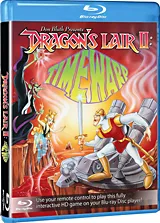
'Dragon's Lair II' Headed to Blu-ray

Fri May 01, 2009 at 02:30 PM ET
Tags: Disc Announcements, High-Def Gaming, Digital Leisure (all tags)

The '80s arcade is coming back to Blu-ray, with Digital Leisure setting a June release date for the videogame sequel 'Dragon's Lair II: Time Warp.'

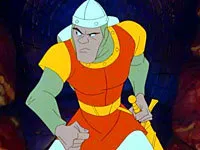
A follow-up to the landmark animated arcade adventure 'Dragon's Lair,' 'Dragon's Lair II' combines hand-drawn 2-D animation from the Don Bluth Studios with laserdisc-based technology. 'Time Warp' again allowed gamers to pilot the heroic Dirk the Daring on a series of adventures using simple joystick commands, only this time with a futuristic theme.

Digital Leisure will release 'Dragon's Lair II' on Blu-ray June 23.

As with their previous high-def releases of 'Dragon's Lair' and 'Space Ace,' 'Dragon's Lair II' has undergone a frame-by-frame restoration in 1080p video done by Digital Leisure and authoring studio Infinite HD. The disc will also include a restored Dolby Digital 5.1 surround track taken from the game's original audio elements.

Supplements exclusive to the new Blu-ray include brand-new interviews with game creators Don Bluth, Gary Goldman and Rick Dyer, a picture-in-picture track, animatic of a rare scene, and the ability to play the game as in the arcade, or watch the animation uninterrupted.

Suggested retail price for the Blu-ray has been set at $28.95.

You'll find the latest specs for 'Dragon's Lair II: Time Warp' linked from our Blu-ray Release Schedule, where it's indexed under June 29.

See what people are saying about this story in our forums area, or check out other recent discussions.

Discs mentioned in this article: (Click for specs and reviews)
Dragon's Lair II: Time Warp (Blu-ray)
Dragon's Lair (Blu-ray)
Space Ace (Blu-ray)

Anchor Bay to Bring Game Prequel 'Dead Space' to Blu-ray

Wed Jul 23, 2008 at 09:00 AM ET
Tags: Disc Announcements, High-Def Gaming, Anchor Bay (all tags)

In a rare Blu-ray-videogame tie-in, Anchor Bay has announced an October Blu-ray bow for the animated direct-to-video game prequel 'Dead Space: Downfall'.

A full-length animated movie, 'Dead Space: Downfall' will debut on Blu-ray October 28 (day-and-date with the standard DVD), a week after the PlayStation 3 game it supports, 'Dead Space,' hits stores from Electronic Arts.

Tech specs for the Blu-ray include 1080p/AVC MPEG-4 video and a DTS-HD Lossless Master Audio 5.1 Surround soundtrack.

Extras shared between both versions are limited, with only a single "Grave Robber" deleted scene.

Exclusive to the Blu-ray will be a pair of cheat codes for the EA game, and a Digital Copy (standard def) on a second disc.

Suggested list price for the Blu-ray has been set at $34.95.

You'll find specs for ''Dead Space: Downfall' linked from our Blu-ray Release Schedule, where it's indexed under October 28.

See what people are saying about this story in our forums area, or check out other recent discussions.

Discs mentioned in this article: (Click for specs and reviews)
Dead Space: Downfall (Blu-ray)

'Speed Racer' Revs to Blu-ray with Videogame, Digital Copy

Tue Jul 15, 2008 at 03:00 PM ET
Tags: Disc Announcements, High-Def Gaming, Warner (all tags)

In a studio first, Warner will bundle the September Blu-ray release of 'Speed Racer' as a 3-disc set with an exclusive videogame and Digital Copy.

Though taking a drubbing from critics and flopping spectacularly with a dismal worldwide gross of only $85 million (against a reported $200 million production and marketing budget), 'Speed Racer' seems poised to be as a high-def demo disc with its candy-colored visuals and elaborate CGI.

Warner will give the Wachowski Brothers-helmed flick a Blu-ray push on September 16 (day-and-date with the standard DVD), releasing 'Speed Racer' as a deluxe three-disc set.

Tech specs will see the main feature spread across a BD-50 dual-layer disc, with 1080p/VC-1 video and a Dolby TrueHD 5.1 Surround soundtrack.

The feature disc will be joined by a pair of bonus standard DVD platters exclusive to the Blu-ray release. The first bonus disc will include the fully playable videogame "Speed Racer Crucible Challenge," with the second containing a Digital Copy of the film (SD only) for viewing on PCs and other portable video devices.

There are no details on further supplements, but the full press release is due in the coming days, so as always we'll keep you posted.

In the meantime, you'll find the latest specs for 'Speed Racer' linked from our Blu-ray Release Schedule, where it's indexed under September 16.

See what people are saying about this story in our forums area, or check out other recent discussions.

Discs mentioned in this article: (Click for specs and reviews)
Speed Racer (Blu-ray)

Feature Article: HD Gaming Spotlight - Metal Gear Solid 4: Guns of the Patriots

Thu Jun 26, 2008 at 01:00 PM ET
Tags: High-Def Gaming, Wayne Santos (all tags)

Editor's Note: Columnist Wayne Santos is a dedicated gamer from the infancy of the medium. He is a contributor at IGN and associate editor of Southeast Asian gaming publication GameAxis. His columns for High-Def Digest examine the world of High-Def Gaming.

By Wayne Santos

This article is going to be a bit different from previous ones because it’s only going to look at one game. It’s not a review, more of a discussion. Games available on other consoles may also get this “spotlight” treatment in the future. It’s the first “classic franchise” to finally make its debut on a High-Definition console, and amongst the elder statesmen of console gaming, it’s also one of the oldest. Now spanning just a little over 20 years (not to mention seven different kinds of hardware before coming to the Playstation 3) the Metal Gear series is one of those rare intellectual properties in console gaming that manages to create a life, fanbase and mythology all its own. Its creator, Hideo Kojima, is often regarded as one of the elite creators in the industry, with a singular, unique vision that some critics have cited as making contributions in advancing the idea of Games As Art. His newest game, Metal Gear Solid 4: Guns of the Patriots is the latest-- and supposedly final -- in a series and genre of gaming that has had a huge impact on both game design and gamers themselves.

Of course, it wouldn’t do to simply look at MGS4 itself without properly putting it in context. Telling the whole story, in depth, would take sometime, but a quick summary is good for those readers who may be unfamiliar with the rich history of the series, and are coming to the game with fresh eyes. It all starts, of course, with the creator Hideo Kojima.


Hideo Kojima was born in 1963 in Tokyo, Japan. His parents both had careers which meant that young Kojima spent much of his youth as a latch-key kid, coming home to an empty house with television – and the programs and movies on it – as his friend. This close attachment to film and television initially forged an ambition in Kojima to become a director, but in his fourth year in university, he came to a decision; having enjoyed Famicom (The original Japanese name for the Nintendo Entertainment System) games such as Super Mario Bros. he felt he would rather create videogames. Because the industry was still in its relative infancy at this time, he had little difficulty in obtaining a position as a Designer & Planner for the company Konami, in 1986. It was his responsibility to work on games for the MSX, another of the many brands of home computers that flourished in the pre-PC/Mac era. Most of his ideas and proposals however, got shot down, and Kojima himself began to feel a sense of frustration with his job, until he finally hit on the concept that would forever be associated with him. He conceived of an American military hero who would fight against nuclear terrorism not through brute force, but through stealth. The code-name of that hero would be Solid Snake, and the name of the game would be Metal Gear, released in 1987.

Metal Gear was released to much acclaim in Japan and Europe though Konami’s limited distribution and marketing prowess in North America at the time hurt the game’s reception in that region. The game was hailed as an innovative title for taking the emphasis off pure, confrontational gun combat and putting it on sneaking, hiding, and not alerting opponents to the presence of Snake. The game managed to prove a modest enough success that Ultra, the publishers for the game in North America, actually created their own sequel without any involvement from Kojima. Dubbed Snake’s Revenge this NES sequel released in 1990, although officially, it’s not considered a canonical addition to the series, which would only come to the MSX2 computers in the same year. Metal Gear 2: Solid Snake was created when Kojima was informed of the sequel developed by Ultra, and urged to do his own, “real” version, but this title wouldn’t actually make it to any console outside of the MSX2 for 16 years, until it was included in Metal Gear Solid 3: Subsistence in 2006.

The two titles were notable for their high praise in the small circles of critics for games at the time, but it wouldn’t be until 1998 that the series – and Kojima himself – would be elevated to auteur status within the medium of gaming. It was eight years after MG2 that Kojima, working on the Playstation console, created a classic in gaming in the form of Metal Gear Solid a game that set a new high watermark for graphics, gameplay and narrative in gaming at the time. No other title looked as good, had so many innovative mechanics, played with the medium in such daring ways, or was bold enough to thematically address real world concerns like nuclear proliferation, the consequences of the post-Cold War political climate, or the ethics and implications of cloning. In terms of the maturity of games, it’s not unreasonable to measure the advancement of the medium as before and after Metal Gear Solid, because it’s influence on gamers – and even more importantly, game developers, who themselves still largely regarded their profession as juvenile entertainment incapable of social or political commentary until this title was released – would resonate for years to come. With this trail-blazing title, Kojima would move on to the Playstation 2 and release Metal Gear Solid 2: Sons of Liberty in 2001, and Metal Gear Solid 3: Snake Eater in 2004, both of which would continue the critical acclaim and commercial success of Metal Gear Solid and forge an iconic story and character for the rapidly growing circle of enthusiasts for games. Ancillary titles in the Metal Gear universe would also be released for various hand held gaming systems such as the Playstation Portable, Game Boy and even cellular phones. Which brings us where we are today with recent June 12 release of the latest – and final – adventure for Solid Snake.

MGS 4: The Achievement


One of the first things that is immediately apparent to viewers and players of the game from the outset is the technical achievement of MGS 4. As with previous MGS titles that have appeared on earlier generations of consoles, MGS 4 once again sets new standards for what can be done on a console in terms of both graphical prowess and, perhaps more importantly, art direction. While the lush visuals of this 720p game are considered amongst the best of the current generation of consoles, this doesn’t mean that they’re perfect. A scrutinizing eye, actively on the hunt for flaws will notice slight dips in frame rate during intense action, and lower quality textures for less critical visual elements such as environmental props like chairs, telephones, and other peripheral objects. These minor nitpicks aside however, the sheer attention to detail in both characters, environments, and scope make MGS 4 one of the elite titles this generation that delivers on the promise of what gamers should expect in High-Def gaming. There are a few reasons for this, such as the fact that Konami is using their own custom graphics engine built from the ground up specifically for this game. Another major factor is the actual exclusive nature of the title. Since MGS 4 was developed strictly for use on the Playstation 3, the combination of larger storage capacity of Blu-Ray, being able to take advantage of built in hard drives in every model and – perhaps most importantly of all – being able to optimize the game to operate with the cell processor system architecture without having to immediately prioritize easy translation over to other consoles, means that Kojima and his team were able to flex the muscles of the PS3 to the best of their ability at this time. Whereas other titles destined for operation across multiple platforms have to make concessions right from the start to ensure that games maintain a certain visual consistency and “ease of use” for developers when bringing games from one console or another, MGS 4 had no such constraints, and so was free to simply go as far as the hardware would allow.

The end result, at least visually, is easily one of the best looking games around. When the first images of the game began to surface a few years ago, some doubted whether the visuals would actually live up to trailers, so spectacular were the images that some wondered if they were pre-rendered. However, in the wake of its release, it’s obvious the promise has been kept, with spectacular cut-scenes rendered in real time, proving themselves to be so with little tricks like allowing players to manipulate the camera as cut-scenes play, or showing off the exact outfit the player was wearing before the cut-scenes began to further dispel any doubt that this is simply full motion video being spun off the disc. Combined with a high-standard of voice acting that includes veterans of gaming, anime and even celebrities like Lee Merriwether, and a Dolby Digital 5.1 surround sound audio set up and the whole game comes together to provide an experience that is – in more than ways than one – one of the most cinematic to ever grace a console.

The real stars of the show here are the characters. Large, ridiculously detailed, and fully motion captured for both gameplay and cut-scenes, Kojima has gone to great lengths to ensure a fidelity of character design not previously seen in real time graphics for games. Snake and his allies have a life and motion to them that manages to avoid falling into the “uncanny valley” trap of near life-like characters that disturb viewers more than engage them, and the fight choreography during some cut-scenes is easily the equal of the best that a Hollywood summer blockbuster can offer. Even little details like water droplets splashing on a virtual camera lens, or dust and dirt scratching the same lens during explosions are taken into account over the course of the game. As if that weren’t enough, a group of models was used as the basis of the chief villains of the game, the “Beauty & the Beast” unit, and their likeness has been meticulously captured with startling results. The visual world of MGS 4 is in many ways a male adolescent fantasy come true, providing high tech, glossy looking military technology, chop socky fighting taken to the extreme, and a digital appreciation of the female form so unapologetic that even a virtual (though it features clothed models) copy of Playboy Magazine is available for flipping through.

In short, for people that are into the technical prowess, art direction and visual lushness of games in High-Def, MGS 4 is an easy defacto demo piece to show off what HD gaming can look like.

MGS 4: The Movie


One of the defining characteristics of the entire Metal Gear saga has been its bold adherence to plot. It’s one of the few franchises in gaming that places its story on a pedestal of equal – some would argue greater -- height than gameplay. As a result, over the last 20 years, the game’s plot has grown into something of almost labyrinthine complexity, and MGS 4 is the title where all the questions raised during the series’ life are finally answered. This, of course, means that the game has a lot of explaining to do. And it does. Which leads to one of the more controversial features of the game, and one that will be hotly debated by fans and detractors of the series, the abundance of cut-scenes found within the game. It’s not an exaggeration to say that the game teeters right on the cusp of having 50% game and 50% cut-scene, and a lot of this story-telling in the cut-scenes has been told with the assumption that the player is a fan of the series that has a basic familiarity with the twists, turns and betrayals that have occurred in previous games. While anyone can play the game and get the basic gist of the story — that being, Snake is trying to stop a villain named Liquid Ocelot – that’s much like bringing a newcomer to a Star Trek movie with no knowledge of the franchise and saying “That’s Captain Kirk and he fights Klingons” without any explanation of the vast fictional history that lurks behind the simple summary.

The basic story is about Solid Snake, hero of the previous games, and his final mission. Having been born as a clone of the perfect soldier, he now finds that his fail-safe mechanism – a limited lifespan – has activated itself and his body is undergoing an accelerated aging process. But before he can allow himself to live out his few remaining months peacefully, there is one last job left to do. His long time nemesis, going by the bizarre moniker of Liquid Ocelot, has risen from being a simple operative to heading a parent corporation that controls the five largest private military corporations in the world. That domination of the war economy however, is just the prelude to a greater plan and Snake, despite his failing body, must step into action once more to try and put a stop to the scheme and whatever ultimate agenda it is in pursuit of.

It’s here that the game can potentially run into problems, particularly for those unfamiliar with either the style or the story of a Metal Gear game. Experienced gamers who’ve never played an MGS title may find themselves balking at the length of time they are expected to put the controller down and simply watch what unfolds, as in a standard movie. The cut-scenes, while phenomenally done, can be excessive, and the ending of game clocks in at over 60 minutes all by itself. For the less patient who aren’t comfortable with not actually playing their game for more than a few minutes at a time, this can prove intolerable. While these cut-scenes can be skipped, this can make for a disjointed, confusing experience as players suddenly find themselves thrust into the middle of action, and expected to know what to do next because they were informed of their objective in the elaborate, overly long cut-scene that was just skipped.

The other side of this equation is the actual comprehension of these cut-scenes. Kojima has repeatedly stated in interviews that this game is a swan song of sorts to the fans (some of whom actually sent death threats to Kojima if he didn’t work on another MGS game) to answer lingering questions that have persisted in the years since the release of the various titles. While the game makes a minimal effort to at least try to explain some of the nuances of the plot, there’s only so much one can do in trying to explain away six previous titles, most of which ran several hours in length with complex turns of plot. It’s pretty much guaranteed by the girth of the series mythos that while a barely functional understanding of past events can be gleaned, the wealth of names, locations and events referenced during these lengthy cut-scenes will be lost on the unfamiliar, which is a shame because for those that ARE familiar with the series, Kojima has created a potent mix of nostalgia, familiarity and closure that can really only be fully appreciated by those who have been with the series for years. This also means that newcomers playing MGS 4 for the first time are invariably “ruining” the previous games for themselves in terms of plot. While Snake’s accelerated clone aging is something revealed straight out of the gates at the start of MGS 4, for example, the discovery that Snake was actually a clone was a major plot twist of the original Metal Gear Solid, and this continues in similar fashion with references to the Patriots, and the fate of characters such as Meryl and Raiden, all of which are elements of previous games that are more meaningful and richer, experiencing them properly within the context of their own games and stories, rather than being hastily told second-hand by MGS 4 in order to keep the audience up to speed with the vagaries of the current plot.

And of course, for those gamers that have been with the series since Metal Gear Solid or, in some cases, as far back as the 1987’s original Metal Gear, the game’s story is one of the few that actually warrants the dictionary definition usage of the word epic. Fans with a long time emotional investment in the series and characters will not be disappointed, as there is a rich, nuanced and lovingly crafted tale waiting for them to experience. For those with a taste for complex plots and an affection for characters built up over the years, MGS 4 is an easy contender for one of the best stories told in this generation of consoles. In the same way that Metal Gear Solid is still regarded as one of the highlights in narrative for the fifth generation of consoles, MGS 4 is likely to garner a similar position for the current 7th generation of HD consoles. Few games are able to tell a story that actually taps into a sense of nostalgia, invoke a sense of shock, or pay through on an emotional investment placed in characters, but MGS 4 does all of these things for anyone sufficiently familiar enough with the series to recognize and enjoy all the story elements Kojima has lovingly placed throughout explicitly for the fans.

MGS 4: The Experiment & Commentary


Out of all the characteristics that comprise the Metal Gear series, probably the one that is most beloved (and most unusual) of all is the experimental nature of the games. Kojima, in this sense, runs completely counter to the conventional wisdom in gaming that states the goal of the medium is to immerse players in the virtual worlds being created, and make them forget that they’re playing a game. In this sense, Kojima has a mischievous side that willfully does the opposite, often for humorous effect and uses a technique known on the stage as “breaking the fourth wall.” In essence, normal dramatic theater pretends that the audience isn’t out there and the events are taking place as natural occurrences, but breaking the fourth wall means characters are aware of the audience, can address them directly and manipulate the knowledge of the artifice they are in. It’s a risky business to break the immersion for audiences in such a manner, and very few people pull it off with any kind of effectiveness. Kojima is one of those people.

In MGS 4, Kojima does this a number of ways. He even pokes fun at the limitations of his previous games with joke references to asking the player to take out the disc and insert disc 2, only to remember the game is being played on a PS3 and no longer requires multiple discs. The game’s mechanic for purchasing weapons is tied into the calendar of the console it’s on, so that on Wednesdays and Sundays, 20% discounts are available for all items found in the virtual gun shop. This carries on a long tradition that’s been a hallmark ever since Metal Gear Solid that tasked players with bizarre mechanics such as beating a mind reading opponent by plugging the controller into another port, or MGS 3, in which an opponent could die of old age by simply readjusting the internal clock of the console to two weeks forward. While it would be improper to discuss all of the ways in which Kojima gleefully, willfully breaks the fourth wall in MGS 4, rest assured that he does it in original ways, and is never above poking fun at himself or the series he has created.

On the other end of the spectrum are the themes and social, political and global commentary that Kojima explores in MGS 4, and these are things he takes VERY seriously. Not content to simply tell a tale of military action, espionage and perhaps a little romance, Kojima uses the Metal Gear games to educate, debate, and provoke thought in a receptive audience. This time around, he has taken on the very timely theme of the privatization of military forces. Ironically, though it’s been known for years now that he was tackling this as a major theme in MGS 4, the long incubation period of MGS 4 ensured that it was one of the later games to explore the idea as lower quality “me too” titles such as Army of Two sought to claim that they also explored the theme, when in reality the idea of Private Military Corporations was a barely tacked on story element that had little to no relevance or depth at all. Where other games seek simply to thrill gamers with non-stop action, Kojima, perhaps even at the risk of alienating the audience, insists on establishing a dialog with the audience; he informs them of the theme, he discusses the implications of an increasing reliance of corporate rather than state armed forces, he provokes and challenges the audience with ideas about nanotechnology, the ethics of cloning, the proliferation of data management into individual lives. In the midst of all the explosions, ninja combat and heavy ordnance being fired, he very nearly clubs gamers over the head with his concerns about technological advancement without conscience, motivated solely for profit and control. So crucial are these themes to the game, that even the New York Times has sat up, taken notice and actually evaluated the game as piece of political commentary, a cautionary tale that may be a thinly veiled criticism of American military and political policy that evades any controversy by being merely a videogame. In this sense, while some may bemoan the overload of information and criticism on the possible future of world affairs and the military culture, MGS 4 is one of the few games in the medium that steadfastly refuses to ignore these topics and attempts to discuss them in an intelligent manner. Many games make the claim of utilizing flavor of the month themes in an attempt to gain more credibility as a game of substance, but nearly all of them fail to actually ask any real questions of these themes, using them instead as a backdrop with no actual consequence. MGS 4 is clearly not one of those games.

It would be easy to talk at length about MGS 4, but that would involve discussing many things that are best left for players to discover themselves. Like any game out there, there are definitely flaws in it depending on your tastes, or simply how determined you are to find them. But for most, the game represents many things. First and foremost, for fans of the series, this is a fitting conclusion that shows Kojima obviously cares for and respects his fanbase, taking great pains to give them something that would reward their loyalty to the series. However, that aside, it is one of the most beautiful looking games available on any console right now, with cut-scenes that will not easily be surpassed for sheer audacity and entertainment value ANY time soon, and a wide breadth of game mechanics and styles that allows players to tackle a situation in almost anyway they’d like, their only limits being their own imagination and deviousness.

For the hardcore or enthusiast gamers, those who own a PS3 likely already have the game, for those that don’t own a PS3, it’s another check to add to reasons to get the console. For those who have PS3 but use it strictly as a Blu-Ray player, this may be the title to convince you to use your machine for its gaming side; if you believe games can’t be as cinematic as movies, this will be the title that completely dispels that belief. As stated earlier, titles that carry the qualities of a classic are few and far between, but Metal Gear Solid 4: Guns of the Patriots is one of those titles. While it’s still debatable whether MGS 4 is art, what can’t be argued is the incredible quality of the game, its visuals and its story. The other thing that can’t be argued is that while other titles in the PS3 library may or may not be worthy additions to a game collection, MGS 4 is, without a doubt, a Must Own title.

Wayne Santos's opinions are his own and do not necessarily reflect those of this site, its owners or employees.

See what people are saying about this story in our forums area, or check out other recent discussions.


Feature Article: Artful High Definition Games

Thu Jun 12, 2008 at 01:00 PM ET
Tags: Wayne Santos, High-Def Gaming (all tags)

Editor's Note: Columnist Wayne Santos is a dedicated gamer from the infancy of the medium. He is a contributor at IGN and associate editor of Southeast Asian gaming publication GameAxis. His columns for High-Def Digest examine the world of High-Def Gaming.

By Wayne Santos

In my previous article, I discussed games as a medium and an emerging art form and cited, very briefly, a few titles I felt were good examples of games being an artistic venture. Now if you think of games as a medium, like film, literature, or paint, then many elements factor in to what constitutes an artistic work. In the same way a movie can be hailed for ingenious art direction but not necessarily be considered thematically or narratively important, the same can be said for games. Various elements of a game can be considered to have made some kind of artistic contribution, while others may not. On rare occasions, every aspect of a game may be considered artful.

While games may have a long way to go before they can be considered full blown works of art, that doesn’t mean the groundwork isn’t being laid out. Ask certain observers of the medium and they’ll tell you that the groundwork has been in the process of being built up for quite some time, but it’s only in recent years that public scrutiny has grown outside of the world of gaming enthusiasts. Reasons for this range from the mainstream proliferation of games in greater numbers to the inevitable march of technology finally getting to the point where imagination is quickly becoming more important than technical prowess. After all, it’s one thing to have a graphics engine that presents awe-inspiring visuals, but it’s quite another thing entirely to have a vision and a team sufficiently talented enough to actually create visuals that can inspire awe purely beyond the number of polygons composing a single character model. In the same way, sound in games has been steadily evolving beyond basic beeps to MIDI compositions and now to full blown streaming of pre-recorded orchestral scores off the disc or hard drive. Even more forcefully than visuals, sound is now limited by only one thing; the talents of the musicians and audio engineers. If games still share an appreciable weakness with older more established mediums, they can be fairly criticized for the lack of depth in narrative and themes, but these are concepts from older mediums that are wrestling with the one thing games bring to the table that is entirely new; interactivity.

So for this article, we’re going to take a look at some of the games currently available on the current generation of home consoles that, in one way or another, make a fair attempt at advancing the notion of games as viable works of art. The games may have a distinct visual or thematic characteristic that puts them above the norm, much as some argue that movies such as 'Dark City' rise above mere popcorn conventions because of the visual feast at play, or how the animated adaptation of 'Watership Down' transcends the normal perception of animated features being “just for kids.” These games in some way go beyond mere commercial entertainment to provide gamers with something they can mull over beyond the simple act of being fun to play.

Beautiful Katamari

Xbox 360


While Beautiful Katamari is actually the fourth title in this bizarre series, it’s the only title available on the current generation of consoles, with the previous three having been available on the PS2 and PSP respectively. This first game is also possibly the weirdest one to appear on the list. For those unfamiliar with the series, the philosophy of the game is very simple; you roll stuff up. As the ball of matter you roll gets bigger, it attracts bigger and bigger objects until what began as a collection of paperclips and staples on a table, is now engulfing entire buildings, and eventually landmasses.

The Katamari series is the brainchild of Keita Takahashi, himself a developer who doesn’t even think of himself as a developer and who cites various sculptors, painters and authors of the Japanese arts as his primary influences. In interviews, Takahashi has gone so far as to admit that he doesn’t even like the gaming industry in its current state, and ultimately would like to go on to design playgrounds for children. The Katamari series is his response to what he viewed as an increasingly dark, serious atmosphere in the world of gaming, that seemed to have abandoned the possibilities for a more innocent, childlike form of fun and enjoyment. The Katamari series certainly lives up to his ideology, lacking any kind of conventional violence and having a simple, blocky, cartoony art direction that stresses the surreal, unreality of the entire situation Takahashi has created.

The basic story of Beautiful Katamari is simple. There is an incredibly muscular (think bodybuilder proportions) “King of All Cosmos” that invariably causes a hideous accident that removes the stars from the sky. In this case, the accident is a powerful serve during a tennis game that rips a hole in the fabric of the universe, creates a black hole and sucks away all the stars, leaving Earth alone in a black, empty void. As usual, it is up the miniscule Prince of All Cosmos to clean up his father’s mess, by going to Earth, rolling things up and creating spheres of sufficient mass that the King can use them to create new stars with which to populate the sky.

What makes Beautiful Katamari so difficult to describe as a Game That Is Artful is almost as troublesome as trying to describe art itself. It has one of the most bizarre concepts ever seen in a game, with an even more surreal storyline. While on paper the idea of simply rolling objects up to make a giant ball might not seem like much fun at all, there is a moment when an unsuspecting gamer first gets a ball big enough to roll up an elephant (and said elephant lets off a very surprised roar) that some how compels people to smile, laugh and keep going. It’s an anomaly in the medium of games in that there really hasn’t been anything quite like it. There are conditions for “winning” in that Takahashi has incorporated things like time limits and minimal size requirements to have considered “clearing” a level, but where the game really shines is the ability to create a crazed sense of whimsy out of its ridiculous conceit, making victory an afterthought in the face of the constantly rolling mass of matter that just gets bigger and bigger. In theory this is a game that should not work, and yet it has endeared itself to a devoted fanbase who, contrary to Takahashi’s own wishes for originality, continue to demand more and more of the same old Katamari fun.

Okami

Wii


There was a reason I used the term “this generation of home consoles” at the beginning of the article and this is it. Although not an HD game, the Wii must be included in the current generation of hardware, and this title in particular is one that should not be missed, but most likely will be.

This is actually the second time that Okami debuts on a console. The first time was during the previous generation, with the Playstation 2. Then, as now, Capcom was the publisher and developer, but sadly the original Capcom team that created the game, Clover, is no more. That is a direct result of the financial failure of Okami and Clover’s other concurrent title Godhand with the gamers. Okami seems to be the sad victim of that occasionally baffling occurrence in gaming where a product debuts to massive critical acclaim and praise, is strongly recommended by everyone in the industry and yet the public ignores it. Released in 2006 by a team comprising the original creators of Devil May Cry, Viewtiful Joe and Resident Evil the game had all the makings of a giant critical hit. And it was. But few people bought it and the game was considered a commercial failure.

The game itself is an action-adventure in the style of the famed Legend of Zelda games on the Nintendo consoles. It’s set in a fairytale version of old Japan, centering on the exploits of the earthly avatar of the Sun Goddess, Amaterasu, manifesting as a white wolf with incredible powers. An ancient evil defeated by Amaterasu during her last incarnation has been foolishly reawakened by humans that no longer believe in the legends of old, and Amaterasu must walk the Earth once more, restoring the world from the corruption of her nemesis the Orochi, and using the Celestial Brush technique to literally re-paint the world into order or combat the foes lined up against her. The Celestial Brush was a brilliant innovation in that players would literally draw bridges where they needed one to cross rivers, draw bombs to bring real bombs into existence, or pause the world and slash at enemies with a brush stroke to erase them from existence. On top of that, the world was huge, with plenty of things to do, and the story itself was uncharacteristically positive and optimistic, stressing friendship, love for nature, and the greater good over the usual vengeance motivated stories so common in games.

Where the game truly steps into the direction of the artistic is the art design itself. Eschewing the usual “photorealism=beautiful graphics” mantra that dominates the majority of game design philosophy in the industry, Okami went decidedly old school. Old school in this case means simulating the effect of the ink brush aesthetic that was so prevalent in Asia in earlier eras. As a result, Okami is a game that looks nothing like any other game on the market. The screen itself has been textured to resemble paper, and the graphics are then “laid on top” of this effect so that every screenshot looks like something illustrated for an old book. The resulting combination of brush work and highly stylized character design is so incredibly original by gaming standards that more traditional gamers, insisting on realistic art design may find themselves disgusted with this choice. For gamers that are willing to accept that there is a world of graphical fidelity beyond photorealism, Okami offers an incredibly rich world to marvel at. On top of its beautiful sense of art design, the narrative of the game itself is, like a fairy tale, a hearkening back to simpler times. The Japanese have always had a respectful relationship with nature, and this is clearly evident in Okami where the Orochi’s corruption leaves the world smoky and almost devoid of color. Whenever Amaterasu restores a region to its former glory, a gorgeous transformation occurs, showing the vibrant color wash across the world as flowers, trees and life itself are restored to the area, accompanied by traditional Japanese string instruments in a rising crescendo. Okami is a uniquely beautiful game that stresses positive values and embraces friendship. It’s the kind of game that has the potential to make a very positive impact on younger gamers, or even remind older gamers of the more idealistic side that lurks within their jaded, modern sensibilities. Even though the game is on the Wii and not actually an HD game, its rewarding gameplay, gorgeous art design, and more innocent themes make it a game well worth owning, and in this generation, gamers now get a second chance to see what they missed two years ago.

Everyday Shooter

Playstation 3


It should come as no surprise that if an original ideas are going to come from anywhere, they’re going to come from outside the established machinery of the industry. Everyday Shooter is the perfect example of this, as the game is the sole work of one man. Jonathan Mak created the game purely as a labor of love, and eventually won awards at Indie Game Development shows before getting noticed – and picked up – by Sony Santa Monica to have his game first appear as a PS3 exclusive before debuting on Valve’s Steam Digital Distribution network just a few weeks ago.

Like Okami, Everyday Shooter has its gameplay roots firmly planted in a very familiar genre, that of the shooter, specifically the top-down shooter. There have already been many games released in this genre since the advent of the Xbox 360 and Playstation 3, and, like Everyday Shooter, they are largely games available as downloadable content available on the respective console’s online store. The genre is nearly as old as the medium of games itself, hearkening back to Asteroids where the mechanics were as simple as “move around the screen and shoot anything that moves.” The simple fire and turn buttons have been replaced by the more contemporary and elegant twin analog stick control system where one stick handles movement and the other lets you fire in whatever direction you’re pushing towards. This should, in theory, be a simple, almost IQ-free exercise in reflexes that appeals to that reptilian hindbrain in our skull that responds to movement. Surprisingly, while Everyday Shooter can meet this requirement quite handedly, it does a good bit more, although in the most surprising of ways.

Everyday Shooter has no story, and, perhaps more intriguingly, has no consistent gameplay. Yes, you shoot everything that moves, that much is true, but Jonathan Mak thinks of his game as an “album,” in that the rules – like music of the game – change from level to level. While the first level teaches you how to shoot certain enemies to create an explosion which, when other enemies make contact, causes another explosion, encouraging chain reactions, another level dispenses with these rules entirely and has you simply avoiding a giant central eye and spits out dozens of tiny eyes out to get you. On top of this is the unique audioscape of the game, which is partially a programmed melody of simple electric guitar riffs, and partially created by the player him or herself as every action and explosion is actually another guitar riff which counterpoints the basic melody. In effect by playing the game, the gamer is creating part of the score, and no game session will ever sound exactly like the previous one.

Everyday Shooter is, one sense, easy to think of as art, because like some works of art, it leaves the audience baffled and unable to easily explain away what they’ve just experienced. Of course, the game isn’t for everyone and some will find the constantly changing game mechanics to be repelling, while others will ignore it simply because its functional, colorful -- and yes, even psychedelic – graphics will bore them because of the lack of photorealism. But for people willing to give the game a chance, Everyday Shooter offers an experience at once familiar and at the same time quite original. The simple mechanics of gameplay are challenged by a sense of discovery with every new level as gamers must puzzle out what the new rules of this “song in the album” are. The visuals, bold, colorful and largely randomized, react violently to the player’s actions with sudden changes in color and massive “explosions” that could be interpreted as rays of light or streaks of paint. Much to Mak’s own dismay, while he finds the actual gameplay to be tense and still very twitch-based, many critics have hailed Everyday Shooter as one of the most original, and strangely relaxing shooters they’ve ever played. The game is probably the closest thing that gamers have right now to being able to “play” an abstract painting in that the collision of sound and colors often resembles something out of the collection of a modern artist. At the same time, even when all the levels have been conquered there is still replay value here as points acquired during a session – even a failed one – can be spent on unlocking additional features or even buying extra lives to make the next game a little easier. Even though it’s easy to get caught up in the almost hypnotic visuals, music and simple movement of “move, shoot, kill or be killed,” there is still a sense of fair play in Everyday Shooter, and it never forgets that first and foremost, it is a game that should be fun.

Bioshock

Xbox 360, Playstation 3


Once again, Bioshock makes an appearance on High-Def Digest, with its first appearance being the second article for 5 HD Games, and a brief mention in that previous article, and now, for obvious reasons here. The most recent game out of all the titles mentioned so far, it’s also the only one mentioned capable of being played on both consoles, or will eventually be, as the Playstation 3 version has been slated for release in winter with hinted at “new content” including all the previous add-on content included in the earlier Xbox 360 version. Bioshock is the biggest game on the this list in more ways than one, not only is it the most critically acclaimed, widely covered game in this article, it’s also the most commercially successful, pulling in numerous awards and making its creators, 2K Games Boston extremely visible amongst both the fans and the industry right now. It’s the kind of game that is that most rare of convergences, a mix of mainstream first person shooter gameplay with enough thematic and narrative material that it actually gives academics something to chew over.

The story itself starts out similarly to most games. You play Jack, a seemingly innocent traveler in the year 1960 who is caught in a plane crash over the Atlantic. Swimming through wreckage of your former transport, you spy a lone lighthouse out in the middle of the water. Upon exploring the lighthouse Jack finds a bathysphere – basically an elevator designed to work underwater – and entering, descends to an underwater city called Rapture, originally conceived as a secluded utopia for the great thinkers, artists ,and scientists of the world to work free from the constraints of authority or popular opinion. What Jack finds, however, is a ruin of buildings inhabited largely by hideously mutated people that are violently out of their minds. Paradise, in this case, has already been lost, and Jack must fight to survive the experience.

This initial set-up may sound typical of an FPS plot in that there’s mystery, atmospheric environments to explore, and plenty of things out to kill the player. But where Bioshock takes such a massive step away from established convention in the FPS is its commitment to exploring WHY Rapture failed and constantly challenging the player with questions about its inhabitants and their motivations. For students of contemporary literature, it doesn’t take very long to recognize that Andrew Ryan and his philosophy is a dead ringer for Ayn Rand and her philosophy of Objectivism. But where Ayn Rand proposed a similar fictional utopia in her novel Atlas Shrugged which showed the slow decay of society without great people tied down to it make it prosper, Levine shows the flipside. Here the great people who are theoretically the intellectual, moral, and emotional superiors of the people back on the surface have gotten away from the blandness and restrictions of political/religious authority… and they have still succumbed to ambition, corruption, war, and ultimately, ruin.

From an art perspective, Bioshock is obviously the most ‘literary” of the games presented here. Beautiful Katamari is like pop or performance art, Okami is an exercise in classical, painterly art, Everyday Shooter is very modernist in its geometric style and execution, while Bioshock handles narratives and themes, the province of novels and film. It is one of the few games on the market that was not afraid to make the basic conflict at its heart a philosophical one, forcing gamers to see the possible consequences that come with greatness and striving for greater things. While some players may simply get an atmospheric, perhaps even frightening FPS experience out of the game, others willing to listen to the audio recordings scattered throughout will get a wealth of detail about the basics of Objectivism. They can then decide for themselves whether the game’s exploration of a failed Objectivist paradise is an interesting criticism, or an unjustified attack on the philosophy. The game itself doesn’t make any deliberate declarations one way or the other. Like a novel or a movie, Bioshock is meant to provoke thought by presenting the question, and then leaving it up to the individuals themselves to find an answer. This is a very far cry from the usual good/bad dichotomy of most game plots that leave little doubt as to right, wrong and who should die. In the end, Bioshock is a bizarre fusion that somehow works. The FPS is often considered the “brainless” genre of gaming and yet here very complex concepts and questions about philosophy and humanity’s purpose (self-determined or not) are presented to players while they attempt to survive everything from crazed genetically mutated lunatics to gigantic men in armored diving suits out to prevent the execution of little girls that run about the ruins salvaging bodies. It is a strange world with very familiar ideas, and for those willing to seek it out, it provides challenging questions.

Unfortunately, for the scope of this article, we can only limit the games presented here to the ones that are appearing on the current generation of consoles. There are many more titles equally deserving of attention for the steps they’ve taken in advancing the medium artistically. Shadow of the Colossus is still probably the closest that games have come to approaching art, and the PC has seen the birth of many kinds of artistic games, particularly adventure games like The Longest Journey which was so far ahead of its time in terms of narrative and thematic complexity that to this day it’s still ahead of the curve for storytelling in games. The current generation is still pretty young, and there is plenty of time for more statements to be made, but for now, these are the games that – if you own the appropriate console – you can go out, buy, and enjoy right now.

Wayne Santos's opinions are his own and do not necessarily reflect those of this site, its owners or employees.

See what people are saying about this story in our forums area, or check out other recent discussions.


Feature Article: Have Games Grown Up Yet?

Thu May 29, 2008 at 01:00 PM ET
Tags: High-Def Gaming, Wayne Santos (all tags)

Editor's Note: Columnist Wayne Santos is a dedicated gamer from the infancy of the medium. He is a contributor at IGN and associate editor of Southeast Asian gaming publication GameAxis. In this new, semi-regular column, Wayne will be discussing a broad range of topics related to High-Def Gaming.

By Wayne Santos

This article is going to be a little different in that it won’t look at the technical aspect of HD Gaming, but rather the cultural aspect of gaming in general. It’s a personal hobby horse of mine, as, having grown up with games and received many fond memories over the years from the medium, I tend to take the optimistic view that games are just that, a medium. And like any medium, such as film, literature or paint, it has the potential to make positive artistic contributions. Of course, the current mainstream cultural perception is at odds with this opinion, and whether it's lawyers, politicians or various “scientific experts” commenting for popular news outlets, the prevailing opinion seems to be that games – particularly violent ones – are an unhealthy hobby at best, and a training ground for future psychotic murderers at worst.

Yet, at the same time Grand Theft Auto IV recently launched to the public at large, and in the span of 24 hours, it made more money than any other single piece of entertainment in the history of the entertainment industry as a whole. In the span of one week, the game made US$500 million and was prominently featured on everything from talk shows, to no less an institution than the New York Times referring to it as the “entertainment event of the year.” Even the same news stations that revile violent games gave the launch of GTAIV extensive coverage that wasn’t necessarily all focused on the corruptive influence of the game. And finally, in a telling sign of the growing influence of the gaming industry, financial analysts even speculated that GTA IV’s April 29th release could impact weekend attendance to the opening of Paramount’s 'Iron Man' which debuted in movie theaters just a few days after the game hit the stores. Gaming, for all the vitriol being directed at it, can’t be ignored.

The Growth Of Games

So what does this mean for games as a medium and the people that enjoy it? At the moment games occupy a strange position. The popular view of gaming is that it is a toy, something meant for children, and a subversive element. At the same time, the industry itself continues to grow, its consumers continue to spend and in the span of just 20 years, it’s proven to be a large threat not to children, but to film, television, and literature in terms of its popularity. One thing that almost everyone agrees on however, is that games lack the legitimacy of established art forms. Cinema, the stage – and recently even comic books, ie graphic novels – have all been recognized as making worthwhile contributions to culture, where the very best examples of these mediums make worthy insights about the human condition, comment on social concerns and educate and enlighten their audiences. The prevailing opinion is that games do none of these things and never will, despite the fact that at one point in the infancy film, theatre and comics, exactly the same perception was held, that they were common entertainments devoid of cultural value.

Is this current popular view of games always going to remain the dominant one? It seems as though games as a medium have a lot of similarities with two other mediums that emerged largely in the 20th century, namely film and comics. Aside from the initial perception as a “vulgar entertainment,” games take much of their advances in craft from technology, pretty much like film. From comics, games have created their own version of an arch-nemesis opposed to their proliferation. For comics, it was a doctor known as Fredric Wertham who, in the 1950’s went so far as to write a book called Seduction of the Innocent as he made a correlation between children reading comics with anti-social behavior depicted, then going on to imitate those actions in real life. In the 90’s and now at the turn of the new century, that role for games has been taken up by the lawyer Jack Thompson, who also wrote a book in 2005 called Out of Harm’s Way in which he also makes assertions of anti-social behavior depicted in games being played out in real life by people who play these games, but are either of these perceptions really true? Are games really only fit as distractions for children or the ignorant, or are they somehow more culpable than other mediums of infecting the impressionable with potentially anti-social behavior?

To the second point, the answer is much more clearly turning out to be “no.” A book was recently released in April of 2008 that went by the mouthful of a title Grand Theft Childhood: The Surprising Truth About Violent Videogames and What Parents Can Do. In the book, authors Lawrence Kutner and Cheryl Olsen reveal the final conclusions reached by a long term research project conducted by the Harvard Medical School Center For Medical Health and Media, at the request of the US Department of Justice. Their findings were that videogames pose no more of a corrupting influence than any other traditional media like films or comics. Their results even indicated that while some youth who play violent videogames for more than 15 hours a week might be prone to more violent behavior in reality, that tended to be more a result of home conditions and general behavior problems, and the videogames were merely the symptom of a larger problem. Surprisingly, the study found that children who don’t play videogames at all actually had a larger percentage of behavioral problems. The earlier so called scientific studies that anti-game proponents such as Jack Thompson usually cited as their evidence of the harmful effects of violent games were found to have questionable results. The studies were either conducted with too small a research sample, had vague interpretations of violent behavior, and some of the research doesn’t make any distinction between short term behavior and long term behavior, which can be the critical difference between a child talking about how a cool an explosion was, and actually thinking for years and months on end about that explosion in a game and going on to replicate it, rather than simply moving on after getting distracted by something else. In short, after a proper, government funded study was finally conducted on the more controversial aspects of games, they were found to be no more harmful to children than the comics and rock and roll that previous generations had condemned as threatening the very foundation of society.

The first point however, the actual social or cultural value of games, is one that, until recently, had a certain amount of merit to it. Like film, games were limited by the technology of the medium, and while films could aspire to moments of art even in the Black & White era, it was really the advent of sound, then advances in cinematography and color that unleashed the creativity of storytellers in film to tell tales that would engage audiences and make a lasting impression on them. In this sense, Games themselves have only recently entered their own “Talky phase,” as the graphical limitations finally begin to fall away, and higher production values are dedicated to such traditional media as writing and acting in games. Over the course of the last several years, a few games here and there have come that have skirted “dangerously” close to making a worthwhile or even artistic statement. Shadow of the Colossus on the Playstation 2 is perhaps the greatest current example games have of art in a unique, interactive way that only games can achieve. With only stellar – for the time – graphics, beautiful animation, music, and sparingly used cinematic cut-scenes, Shadow of the Colossus created a rich, unique experience for players who were tasked with killing the 16 “Colossi” of the game’s name, as part of a bargain to resurrect a dead, lost love. However as the game continues, players begin to question the seemingly straightforward task as it becomes obvious through the player’s actions that the Colossi may not in fact be evil. The game never makes any judgments about the player’s actions, or even give the player any kind of direct reassurances about the rightness or wrongness of the actions, instead leaving it up to the player themselves to decide if taking of these lives is worth it to bring back the girl. In the end, the answer to that question is still left entirely up to the player, but Shadow of the Colossus managed, in completely interactive manner, to make players experience complex, difficult to articulate emotions and conclusions over the many hours of gameplay that lead to its conclusion.

On the other end of the spectrum far less abstract and far more cerebral is the game Bioshock. If Shadow of the Colossus is an attempt to bring an artistic experience through interactivity Bioshock is a marriage of all the best traditional elements brought together into a game to provoke debate in a much more straightforward, intellectual way. The game, by Kevin Levine of 2K Games Boston is, on the surface a first person shooter of the Doom or Halo variety, in that corridors are wandered, strange opponents are fought against and combat is the very foundation of the gameplay. However, outside of those seemingly simple mechanics is a startlingly in depth examination of the question, “Does Ayn Rand’s philosophy of Objectivism taken to its final conclusion actually make sense?” Over the course of the game, players will find that Levine and his crew have crafted an experience that dissects the ideas proposed in famed philosophical novels The Fountainhead and Atlas Shrugged, giving them a chance to explore an undersea city constructed by a prototypical Randian Superman who tired of having his genius used by the mediocre, and created an undersea utopia where he and other similarly gifted individuals could get away from the vast numbers of the average that relied on their genius to survive. Bioshock in very direct fashion explores complicated ideas of greatness, ambition, and how these factors can lead to riches or ruin and by the time the player is through with the game, they will doubtless have questioned for themselves whether or not genius is something that should be spirited away from the “dirty unwashed masses” to maintain its purity, or whether this is simply another form of pride that is prone to the same kind of hubris as any other.

There are plenty of other examples in gaming, of course, but these are two of the most celebrated in recent years. Even Grand Theft Auto IV has been making some progress with institutions traditionally aligned against games. Once again, it was the New York Times that called GTA IV a “Violent, intelligent, profane, endearing, obnoxious, sly, richly textured and thoroughly compelling work of cultural satire disguised as fun.” If a fixture of American journalism like the New York Times can make a statement like that about a videogame, of all things, then it makes one thing very clear. The times are definitely changing.

Time Of Transition

In one sense, it’s a strange time to be coming into games, because modern society seems to be shifting over from one perception of gaming to another. On the one hand, the previous generation which grew up largely without the presence of games finds (like other generations that hadn’t been exposed to movies, comics or rock and roll) that games are an unwelcome new cultural artifact that threatens the traditional perspective of the world that they are familiar with. On the other hand, there are already two generations of people that were either introduced to games at a very early age, or were born into a world where videogames were already a growing hobby, and don’t know a time without them. These people are already easing into the reigns of power in society, and there will come a time when politicians who condemn gaming will be offending their voters, in the same way it was once acceptable—and now not—to denigrate African Americans or homosexuals. For now, there is a very practical, political consideration to taking an anti-gaming stance, as there is still a significant percentage of the population that – again as with comics, rock and roll and Dungeons & Dragons – feel their concerns are represented by someone with a publicly hostile position to what they feel threatens society. However, times do change. Racism moved from an officially state sanctioned policy to an illegal practice. Homophobia has been dwindling in society as time passes. And, most telling of all, rock and roll is no longer viewed a destructive social element for one very simple reason; all the people that listen to rock and roll and enjoyed it are now in charge and are dictating political and public policy. What they fail to realize now, is that they are making the same mistakes their elders did when they were young, fighting to listen to rock music while they couldn’t understand the threat the older generation saw in that music. The rebels of rock have now moved into the channels of power and are fighting against games because they have become the stodgy, conservative elders they once fought against in their youth, similarly threatened by something new they don’t understand.

So does any of this answer the question first asked by the article? Have games grown up yet?

For now, I think the answer is “No, but growing up is happening.” It will take a certain combination of elements before games can be accepted as a “mature medium” with the same cultural legitimacy that film lovers with high definition theaters enjoy today. The technology of games still has a lot of room for expansion, and games need to get over their particular holy grail, namely photo realistic visuals, before they can finally concentrate on their greatest strength, interactivity, a quality that no other media before games has ever possessed. Games also need to be completely embraced by society – or at the very least, not viewed as a threat – and this is only going to happen in the next 20-30 years as the generation the came before games either dies, or retires from the sphere of policy-making and lets younger generations that have grown up with games simply as a fact of life take over the reigns of power.

Finally, the other thing that games need, perhaps the most crucial ingredient, is the unpredictable combination of artist and art. In every other medium, there an artist and work that somehow finally elevates that medium into public acceptance. In the case of the most recent “inductee” into legitimate artistic mediums, comics have the likes of Frank Miller, Alan Moore and perhaps Neil Gaiman as key figures that created works so potent the critics could no longer keep dismissing comics as children’s distractions. In film, it was the work of greats like Orson Welles, and before him, Sergei Eisenstein or D.W. Griffith that took film from something merely amusing to something that could act as a vehicle for artistic and social contribution. Do games have a Frank Miller or Orson Welles yet? Some would argue that the likes of Hideo Kojima of Metal Gear Solid fame or Shigeru Miyamoto who has recently unleashed the Wii and Wii Fit upon the world are luminaries in the industry that could conceivably push gaming into a much more publicly celebrated sphere of perception. But games have yet to have that combination of a brilliant creator coupled with a brilliant work that makes the mainstream fall all over themselves to embrace the medium the way comics and film eventually did. There are great games, yes. And there are certainly great game developers, but neither of these two factors have yet impress the established critical, academic and pop culture spheres simultaneously, but at this point, it’s probably just a matter of time now. Games may not be considered a serious, mature art form, but they’ve come a long way from simply being regarded as something only kids play in the family basement, and their entrenchment in the culture is only going to become more secure with the advancing of the years and the technology.

Wayne Santos's opinions are his own and do not necessarily reflect those of this site, its owners or employees.


Feature Article: Graphic Glitches 101

Wed May 14, 2008 at 01:00 PM ET
Tags: High-Def Gaming, Wayne Santos (all tags)

Editor's Note: Columnist Wayne Santos is a dedicated gamer from the infancy of the medium. He is a contributor at IGN and associate editor of Southeast Asian gaming publication GameAxis. In this new, semi-regular column, Wayne will be discussing a broad range of topics related to High-Def Gaming.

By Wayne Santos

High-Def Digest already has a rigorous system in place for evaluating the picture quality of movies, documentaries, and concerts that are presented in High Definition. Over the course of the mainstream transition to HD, this has given a lot of neophytes to the world of visual fidelity a good grounding in what they should look out for to discern the difference between a quality transfer and ones that sport minor or even major flaws. With a little information, more and more people can now make out the distinctions in picture quality for themselves, and make more informed decisions about which movies really make the most of their televisions. The same also holds true for games, although the criteria for judging the visual quality of a game does differ. Movies have issues such as artifacts, banding and color. Games have their own issues like frame rates and collision detection, for example.

For many years, the graphical quality of games was severely hindered by the constraints of the hardware, and this was particularly true for consoles, where earlier hardware such as the Nintendo Entertainment System – or even the original Playstation – while considerably more advanced than the clumsy, colored squares of consoles in the 70’s (like the Atari 2600), still required a lot of imagination on the part of the gamers to create a sense of realism and suspension of disbelief that film found so easy to instill in audiences. This is gradually changing now with the introduction of more powerful consoles into the home and the transition into HD gaming, but that doesn’t mean that gaming is anywhere near achieving a degree of photorealism that will instantly fool the human eye. While the visuals in games get more polished and refined, with developers getting a better understanding of the machines they work on, or developing new graphics engines, there are still things that can – and frequently do – slip through the cracks of visual presentation. In this article, we’ll look at the deficiencies or “glitches” that can separate top tier graphical work from more functional efforts. This is meant to be a general introduction, so nothing will get too technical here, and it should help those new to gaming as the result of obtaining a 360 as an HD-DVD player, or a PS3 as a Blu-Ray player, get more familiar with the interactive aspect of their machines.

Frame Rate

When it comes to film, the accepted convention very early in the inception of the medium was 24 frames per second. That is to say, the illusion of movement was created when 24 images were played back in the space of one second. For years this has been the standard, although in recent times with the introduction of HDTV broadcasts, this is starting to change to rates like 60 frames per second. In games however, the frame rate is nowhere near the universal standard that film has enjoyed for decades, and this is chiefly because of the limitations of the technology. While film generally manages to create a sense of movement from 24 frames per second, or fps, that illusion is maintained because of the consistency; except for deliberate camera choices such as slow motion or fast forward, a viewer can generally expect the film to run at 24 fps without ever noticing a dramatic change.

The same however, does not hold true of games. Unlike a digital disc, film reel, or tape, which is used as a playback device, a game console takes the data of the game and must virtually recreate that information as objects and environments that the player can interact with. As a result, the processor of a console is constantly “creating the world” around the player, and depending on how intense the action is – or simply depending on how well the game has been programmed – there can be some variance from the 30 fps or 60 fps that are generally accepted as the standards for the gaming industry today. For example, Grand Theft Auto IV the game which recently took the record for best selling piece of entertainment in a 24 hour period, normally runs at 30 fps. However, the scale of the world the game is trying to create, or “render” can be quite taxing on consoles, and if things get too hectic, for example, causing a gigantic firefight with helicopters, police teams, S.W.A.T. vans, explosions and screaming pedestrians in the virtual equivalent of Times Square, with neon, lights and the occasional explosion from rocket propelled grenades… this much chaos can occasionally strain the 360 or PS3 and will have a noticeable drop in its frame rate, though this doesn’t carry on for very long. On the other hand, games with fewer variables to consider, such as Gran Turismo 5: Prologue have an easier time with more controlled conditions. In the case of GT Prologue, the fact that its resources are devoted to simulating only a track and the behavior of the cars on the track means that it was optimized to display at 60 fps during gameplay and it never drops from this. .

Spotting a drop in the frame rate is one of the easiest glitches to identify as the human eye immediately notices the change in movement. One moment everything is relatively smooth, but as soon the frame rate drops, the eye sees the change as a “stuttered” motion. Depending on the severity of the drop in frame rate, this can even be as serious as the movement no longer appearing to be movement, but instead bearing closer resemblance to a slide-show, with images present for a second or more before moving onto the next. Games today rarely – if ever – experience a drop in frame rate this serious, although in the infancy of gaming, some games actually functioned at far lower frame rates – as low as 6fps – for the simple reason that that was all the retail processors of the time were capable of.

Screen Tearing


Screen Tearing is a relatively recent phenomenon for consoles, although PC gamers have been familiar with this particular glitch for a number of years. The glitch gets its name from the effect it has on the visuals, such as the shot of the original Halo: Combat Evolved shown above. Take careful notice of the area between the player’s gun and soldier to the left. What should be a view of the shore with the water washing up has a section that doesn’t match with the rest of the image, as if the individual section has been shifted or “torn” from the fabric of the rest of the image and isn’t aligning correctly. Screen Tearing is related to frame rate issues in that it’s a conflict between one image and another. In this case, the glitch occurs when a new image is being displayed, but the older image is also still being displayed.

This issue is normally addressed by a technique known as Vertical Synchronization, or Vsync, which is essentially a “gatekeeper” that ensures one image is fully rendered and ready to discard before another image is rendered. However, the dynamic nature of games can still occasionally cause screen tearing to occur, particularly if the action on screen forces the processor to make a choice between keeping the frame rate smooth and displaying some screen tear, or eliminating the screen tear at the cost of dropping the frame rate. This can happen to varying degrees on graphics intensive games, indicating that either the software is pushing the hardware to the limit, or the hardware itself is not being fully utilized. For example God of War 2 on the Playstation 2 had moments of screen tearing, but it was widely accepted that this was simply because the Sony Santa Monica team had pushed the PS2 about as far as it could go, and were using nearly all the resources the machine had with little leeway left for flawless Vsync. On the other hand, early launch efforts like the Xbox 360 First Person Shooter Perfect Dark Zero showed screen tearing simply because the technology was new and the game was rushed out in order to release in time for the launch of the console. It’s usually normal for the first wave or generation of games on a new console to display the most obvious graphical flaws because of the lack of familiarity with the hardware at the time. However, it all rests in the hands of the developer, their understanding of the hardware, and how hard they push the boundaries when it comes to this issue. Even today there are still some high profile games that are occasionally prone to this glitch, such as Gran Turismo 5: Prologue, which has extremely rare occurrences of this glitch, while other games such as the critically acclaimed Mass Effect on the Xbox 360 suffer from it on a regular basis.

Pop-Up/Draw-In

This is a graphical glitch that will probably remain an issue for this generation of gaming and beyond. The simple fact of the matter is the current hardware, while impressive, is not all-powerful and it will still hit definite limitations in terms of what it’s capable of displaying. In order to not tax the resources of a machine, developers will normally set a “draw distance” which – in virtual world terms – is the area that game is instructing to the console to display or render. After all, if a player is only going to see, say, the first 30 yards of the environment around him, it’s more economical for the hardware to concern itself with only creating that 30 yard radius the player sees to the fullest possible detail, rather than creating the whole environment to that intricate level for miles around.

This is also where the problems come in. Once again the understanding of the hardware, the quality of the programming and the dynamic nature of games all conspire to make the issue of draw distance a less than straightforward affair, and when things go wrong, that is where pop-up or draw-in can occur. Put simply, this glitch occurs when players are interacting with the world too quickly for the game to keep up, and when the game does finally get back on track with where the player is and what they are doing, the game must suddenly make up for lost time and start rapidly populating the area with the things that are supposed to be in that environment. The clearest example of this is something like Grand Theft Auto IV where the world is truly massive. If players manage to get a good run in a car, hurtling down roads at breakneck speeds, they can be traveling so fast that elements of the game world no longer gradually appear in the distance and get closer as the player approaches. Instead, objects – like trees, lamp posts and even pedestrians – can magically appear out of nowhere as the game finally “catches up” with the player and starts populating the area once it realizes where the player is. Obviously with the previous example of a high speed race, this can mean the player colliding straight into buildings or other obstacles that weren’t there a split second before and have seemingly “teleported” into place before the player’s very eyes. This is pop-up. Draw-in is a similar glitch, which works at a slower pace. Instead of magically appearing in front of the player with no warning, draw-in usually works somewhere in the distance, where the environment actually appears to be quickly “drawn in” before the players very eyes, as if a construction crew were rapidly building up the world a short distance away, trying to finish in time before the player arrives.

Here’s a good example of pop-up courtesy of GameSpot, from the game Elder Scrolls IV: Oblivion


For the example above, imagine that the player has just teleported into the area, and this what they see when they first arrive; a hut and a fence. However, a second later, this happens:


The world has suddenly become more populated with trees, horses, even a sign on the hut. The game has finally caught up with the location of the gamer, and in a hasty effort to get back on track with what the player is supposed to see in this area, it has made all the extra objects instantaneously appear. This is not a problem that is going to go away any time soon, as developers are constantly pushing the hardware to create bigger, more detailed and expansive worlds. Pop-up and draw-in can be hidden to some degree, something that racing games excel at, by hiding the places where these glitches occur thanks to natural obstacles such as turns or even mountain walls that can obscure the objects normally viewable at a distance. But as consoles get more powerful, developers will be constantly encouraged to push the limits of that hardware, and as such the pop-up and draw-in issues will likely still be with us for a while until developers either truly master the “cheats” to hide it from players, or else hardware becomes powerful enough that it’s feasible to simply render everything in high detail within the viewable distance in real time.

Aliasing/”Jaggies”


The above screenshot is from 1998’s Ridge Racer 4 on the original Playstation and is an extreme example of an issue that still occasionally crops up in games today, aliasing or “jaggies.” This is the clear, “stair step” effect that registers on our eyes when we see something displayed at lower resolution. Of course, higher resolutions have helped clean this up considerably in recent years, but the feature most responsible for giving us cleaner images is called Anti-Aliasing, which is simply devoting more processing power and specific programming techniques to “smoothing out” those edges and giving images a more naturalistic look in line with what we’re accustomed to seeing in real life. Compare the above image from 10 years ago that had no Anti-Aliasing on the original Playstation with Gran Turismo 5: Prologue on the PS3 to see what a difference “AA” as well as increased polygon counts and a host of other graphical upgrades can have on a game’s visuals.


Aliasing is another glitch that has become less pronounced in this new HD generation of games, although, surprisingly, it can still crop up. AA, like everything else about a game, will demand certain resources from the system, and as a result, sometimes developers will deliberately choose not to maximize this feature for a particular game if it means compromising the game in some other way, such as dropping the frame rate as the hardware struggles to smooth out everything on screen. It is this delicate balance between all these graphical considerations that forces developers to perform a juggling act of sorts, deciding on draw distances, AA and many, many other considerations to keep the game playable versus keeping the game beautiful. Games with longer draw distances and little pop up or draw in might suffer from more aliasing issues. Games with smoother frame rates and lots of anti-aliasing might suffer from smaller environments, etc, etc. In a sense, aside from the actual monetary cost of developing the game, the game developers have the additional worry of a “technological budget” where they must consider what sacrifices they make – and to what degree – in order to create a game that the audience will find both visually pleasing but also fun to actually play. Frequently they fail to strike the right balance, as evinced by the wealth of games that don’t meet up to either playability or graphical quality, whereas games that successfully do both are rare indeed.

Collision Detection/Clipping


The final glitch is one that doesn’t necessarily detract from the overall quality of the visuals, but has a tendency to break immersion more noticeably when it occurs. One of the fundamental rules of Newton states that – at least on the level of reality we’re familiar with – two objects cannot occupy the same space. Poor collision detection ( or “clipping” a nick name picked up from the game Doom from a built-in developer cheat called “No Clip”) is when for reasons of time or simple neglect, developers release a game in which virtual objects break this fundamental law. If you look closely at the above screenshot from famed online virtual reality Second Life, you’ll see a few examples of this in action. The man with the sunglasses has his right hand passing into his thigh, and to his left, the Smurf’s TNT is actually sinking into his thighs as well.

Poor collision detection is a fairly common glitch because it requires an enormous amount of time and care to properly address it. Usually game developers simply don’t have the luxury of that time or attention to detail because it would mean delaying a game that people are already screaming for in order to address what most would regard as a small nit-pick. These days, the most common times you’ll see poor collision detection in action is during shooters where players must kill other opponents. Usually collision detection is spot on and works as expected when everyone is alive, but when characters are killed, it’s not unusual for the game to no longer regard the victims as “objects” and often heads, legs and other extremities will now pass through walls in ghost-like fashion, since the game no longer deems it necessary to pay the same amount of attention to detail to an essentially “finished” asset of the game. It’s not the kind of thing that normally interferes with gameplay, at least not to the extent that a drop in frame-rate can, which is the most serious glitch, but poor collision detection is the one that most pulls the gamer out of the world the developers are trying to immerse people in, and remind them of the artificial nature of the game they are playing.

As with movies, these visual flaws are normally very minor things that don’t necessarily detract from the overall quality of a game, unless they reach serious levels. It wasn’t even until the last two generations that Anti-Aliasing was even a practical feature for console games, and plenty of games received critical acclaim without AA. But, as with film, the additional technology can enhance the gaming experience and contribute to the sense of suspension of disbelief, provided that the fundamentals – that is a strong game, with a compelling mechanics – is there to begin with. Like film, games are a marriage of elements, and if the gameplay isn’t there, the character isn’t there, and the story isn’t there, then all the visual fidelity in the world is not going to save that game from being a critical and commercial failure. Glitches such as the ones listed above can either be minor blemishes to an otherwise masterful game, or be more damning flaws in an already poor one.

Wayne Santos's opinions are his own and do not necessarily reflect those of this site, its owners or employees.

See what people are saying about this story in our forums area, or check out other recent discussions.


'Space Ace' Rockets to Blu-ray, HD DVD

Wed Feb 06, 2008 at 11:00 AM ET
Tags: Disc Announcements, High-Def Gaming, Digital Leisure (all tags)

Digital Leisure is making a return trip to the '80s arcade, announcing an April Blu-ray and HD DVD release for the videogame classic 'Space Ace.'

Following the company's high-def success with 'Dragon's Lair' (which it released on blu-ray and HD DVD last year), Digital Leisure is now readying its 1986 successor, 'Space Ace,' for a simultaneous April 8 release on both high-def formats.

Utilizing the same gameplay format as 'Dragon's Lair,' 'Space Ace' combines hand-drawn 2-D animation from the Don Bluth Studios with disc-based technology, allowing gamers to pilot the heroic Ace on a series of adventures using simple joystick commands.

Fully remastered for high-def, 'Space Ace' will be presented in identical 1080p transfers on the Blu-ray and HD DVD, with the option to play the game in both the original 1.37:1 aspect ratio as well as recomposed 1.78:1. Audio options include remixed English Dolby Digital 5.1 Surround, plus subtitles in English, French, Spanish, Italian and German.

Extras shared across both versions include a picture-in-picture video commentary with game creators Don Bluth, Gary Goldman and Rick Dyer, additional interviews excerpts, as well as a "Watch Mode," which allows you to view the game's complete animation without playing.

Exclusive to the HD DVD version will be "Leisure Online," a format-first online player experience that includes "Head 2 Head" gaming, allowing multiple web-enabled users to play simultaneously.

Digital Leisure has set a suggested price of $29.98 a peice for the Blu-ray and HD DVD.

As always, you'll find disc details for 'Space Ace' linked from our Blu-ray Release Schedule and HD DVD Release Schedule, where it's indexed under April 8.

We've also set up dedicated threads for Digital Leisure's latest in our Forums area -- click the following links to discuss the 'Space Ace' Blu-ray release and the 'Space Ace' HD DVD release.

Discs mentioned in this article: (Click for specs and reviews)
Space Ace (Blu-ray)
Space Ace (HD DVD)
Dragon's Lair (Blu-ray)
Dragon's Lair (HD DVD)

'Space Ace' to Race to Blu-ray, HD DVD in 2008

Fri Oct 05, 2007 at 08:00 AM ET
Tags: Disc Announcements, High-Def Gaming, Digital Leisure (all tags)

Following up its next-gen success with 'Dragon's Lair,' Digital Leisure has announced plans to bring 'Space Ace' to Blu-ray and HD DVD in 2008.

There are no details or even a street date yet, but the distributor has confirmed that next-gen versions of the arcade classic are a go for "sometime in the first half of 2008," following a new PC version (due this fall).

As was the case with 'Dragon's Lair,' Digital Leisure says it has gone back to the original audio and video elements of 'Space Ace' and produced a brand-new 1080p video master, as well as a 5.1 multi-channel surround mix.

Specs for the PC version of the game also indicate new making-of material featuring original creator Don Bluth and his animation team. We can only expect that this material will find its way to the next-gen versions as well.

As always, we'll let you know as soon as release dates for the Blu-ray and HD DVD editions are announced. In the meantime, we've added 'Space Ace' to the "Release Dates Pending" sections of both our Blu-ray Release Schedule and HD DVD Release Schedule.

We've also set up a dedicated threads for Digital Leisure's latest in our Forums area -- click the following links to discuss the 'Space Ace' Blu-ray release or the 'Space Ace' HD DVD release.

Discs mentioned in this article: (Click for specs and reviews)
Dragon's Lair (Blu-ray)
Dragon's Lair (HD DVD)

Sony Confirms Plans to Phase Out 60GB PS3

Tue Jul 17, 2007 at 02:05 PM ET
Tags: PlayStation 3, Sony, High-Def Gaming, High-Def Retailing, Hardware (all tags)

After days of rumors, Sony confirmed Monday that it plans to cease production of its lower-priced 60GB PlayStation 3.

The company had received accolades from gamers and Blu-ray enthusiasts alike when it announced a $100 price cut for the Blu-ray enabled 60GB PS3 early last week, but that enthusiasm has been somewhat tempered as it was slowly revealed that the company plans to phase out the $499 60GB model after the new $599 80GB PS3 hits store shelves in August.

A Sony representative told Reuters that the company would sell the 60GB version until "supplies of that unit are depleted," estimated to be months after the August debut of the new, pricier model. "We have ample inventory to meet the immediate needs of consumers [in the US] for several months to come," said Dave Karraker.

Although the company is feeling some heat for not announcing its intent to cease production of the 60GB console at the same time it announced the price cut, industry analysts believe that the price of the 80GB PS3 will be lowered to $499 once supplies of the 60GB have been depleted.

Sony, for its part, remains tight lipped about any future pricing plans. "We won't be making any further announcements regarding our PS3 model hardware strategy in North America until the 60GB model is exhausted and market conditions are evaluated," said Karraker.

See what people are saying about this story in our forums area, or check out other recent discussions.

Related links:
Sony confirms phasing out of cheaper PlayStation 3 [Reuters]
Earlier on High-Def Digest:
Sony Confirms PS3 Price Drop; Announces New 80Gb Model (Jul 09, 2007)


MORE BLU-RAY NEWS TAGGED "HIGH-DEF GAMING":

» High-Def Digest home page